


The Japanese parliament yesterday elected conservative Sanae Takaichi as the nation’s first female prime minister, a day after her struggling party struck a coalition deal with a new partner expected to pull her governing bloc further to the right.
Takaichi replaces Shigeru Ishiba, ending a three-month political vacuum and wrangling since the Liberal Democratic Party’s (LDP) disastrous election loss in July.
Ishiba, who lasted only one year as prime minister, resigned with his Cabinet earlier in the day, paving the way for his successor.
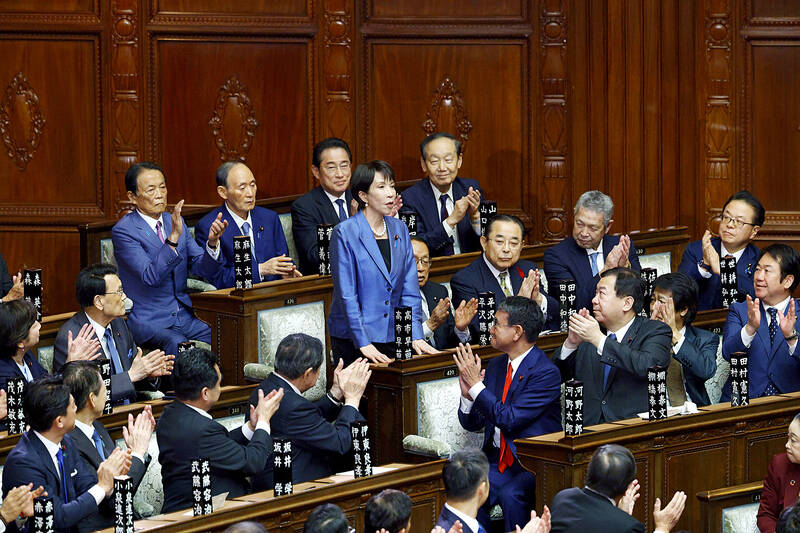
Photo: EPA
Takaichi won 237 votes — four more than a majority — compared with 149 won by Yoshikoko Noda, head of the largest opposition party, the Constitutional Democratic Party of Japan, in the lower house, which elects the prime minister.
Even though her coalition was two seats short of a majority, Takaichi received enough votes to win in the first round. She likely received votes from lawmakers in fringe minority parties from whom she has sought cooperation.
As the results were announced, Takaichi stood up and bowed deeply.
Takaichi, 64, appointed former Japanese minister of defense Minoru Kihara as chief Cabinet secretary.
Takaichi appointed her leadership rivals within the party to her government along with other veteran lawmakers. Toshimitsu Motegi, who previously served as both trade and foreign ministers, was named minister for foreign affairs. Former minister of agriculture, forestry and fisheries Shinjiro Koizumi was named minister of defense, and former chief Cabinet secretary Yoshimasa Hayashi was named minister for internal affairs and communications.
She also appointed Ishiba’s chief trade negotiator, Ryosei Akazawa, as minister of economy, trade and industry.
Despite her earlier pledge to drastically increase the number of women in the Cabinet, she appointed only three, all of them supporters in the party leadership vote — former minister of state for regional revitalization Satsuki Katayama as minister of finance, Kimi Onoda as minister in charge of economic security and Midori Matsushima as the prime minister’s aide.
The LDP’s alliance with the Osaka-based right-wing Japan Innovation Party (JIP), ensured her win because the opposition is not united.
Takaichi’s untested alliance is still short of a majority in both houses of parliament and will need to court other opposition groups to pass any legislation — a risk that could make her government unstable and short-lived.
Tackling rising prices and other economic measures is the top priority for the Takaichi government, LDP Secretary-General Shunichi Suzuki told NHK public television as he apologized over the delay because of the party’s internal power struggle since the July election.
He said the new coalition would cooperate with other opposition parties to quickly tackle rising prices to “live up to the expectations of the people.”
JIP does not hold ministerial posts in Takaichi’s Cabinet until his party is confident about its partnership with the LDP, Yoshimura has said.
Takaichi is running on deadline, as she prepares for a major policy speech later this week, talks with US President Donald Trump and regional summits.
While she is the first woman serving as Japan’s prime minister, she is in no rush to promote gender equality or diversity.
Takaichi is among Japanese politicians who have stonewalled measures for women’s advancement. She supports the imperial family’s male-only succession, and opposes same-sex marriage and allowing separate surnames for married couples.
Takaichi has backed financial support for women’s health and fertility treatment as part of the LDP policy of having women serve in their traditional roles of being good mothers and wives. However, she also acknowledged her struggles with menopause symptoms, and stressed the need to educate men about female health to help women at school and work.
Takaichi has resisted acknowledging Japanese wartime aggression and atrocities and denied that coercion was used against Korean laborers and women held as sexual slaves for Japanese troops. She was part of a campaign to remove references to wartime sexual slavery from school textbooks.
However, she has toned down her hawkish rhetoric. On Friday last week, she sent a religious ornament instead of going to Yasukuni Shrine.

SILENCING CRITICS: In addition to blocking Taiwan, China aimed to prevent rights activists from speaking out against authoritarian states, a Cabinet department said The Ministry of Foreign Affairs (MOFA) yesterday condemned transnational repression by Beijing after RightsCon, a major digital human rights conference scheduled to be held in Zambia this week, was abruptly canceled due to Chinese pressure over Taiwanese participation. This year’s RightsCon, the world’s largest conference discussing issues “at the intersection of human rights and technology,” was scheduled to take place from tomorrow to Friday in Lusaka, and expected to draw 2,600 in-person attendees from 150 countries, along with 1,100 online participants. However, organizers were forced to cancel the event due to behind-the-scenes pressure from China, the ministry said, expressing its “strongest condemnation”
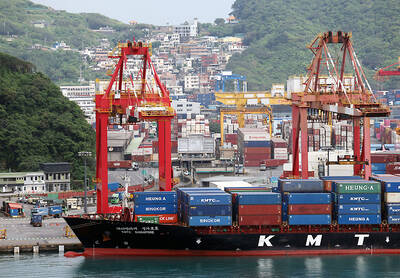
Taiwan’s economy grew far faster than expected in the first quarter, as booming demand for artificial intelligence (AI) applications drove a surge in exports, spilling over into investment and consumption, the Directorate-General of Budget, Accounting and Statistics (DGBAS) said yesterday. GDP growth was 13.69 percent year-on-year during the January-to-March period, beating the DGBAS’ February forecast by 2.23 percentage points and marking the most robust growth in nearly four decades, DGBAS senior official Chiang Hsin-yi (江心怡) told a news conference in Taipei. The result was powered by exports, which remain the backbone of Taiwan’s economy, Chiang said. Outbound shipments jumped 51.12 percent year-on-year to
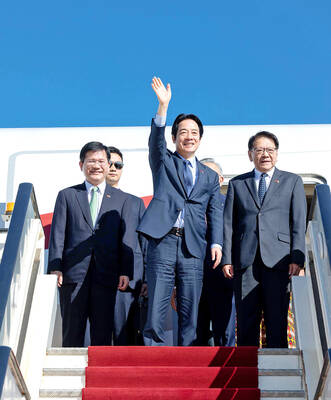
DELAYED BUT DETERMINED: The president’s visit highlights Taiwan’s right to international engagement amid regional pressure from China President Willaim Lai (賴清德) yesterday arrived in Eswatini, more than a week after his planned visit to Taiwan’s sole African ally was suspended because of revoked overflight permits. “The visit, originally scheduled for April 22, was postponed due to unforeseen external factors,” Lai wrote on social media. “After several days of careful arrangements by our diplomatic and national security teams, we successfully arrived today.” Lai said he looked forward to further deepening Taiwan-Eswatini relations through closer cooperation in the economy, agriculture, culture and education, as well as advancing the nation’s international partnerships. The president was initially scheduled to arrive in time to celebrate
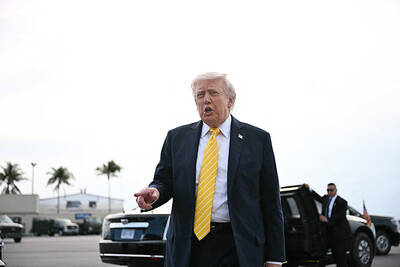
Iran’s Islamic Revolutionary Guard Corp (IRGC) yesterday said the US faced a choice between an “impossible” military operation or a “bad deal” with Tehran, after US President Donald Trump disparaged Iran’s latest peace proposal. Negotiations between the two countries have been deadlocked since a ceasefire came into effect on April 8, with only one round of direct peace talks held so far. Iran’s Tasnim and Fars news agencies reported that Tehran had submitted a 14-point proposal to mediator Pakistan, but Trump was quick to cast doubt on it. “I will soon be reviewing the plan that Iran has just sent to us, but


 RSS
RSS