


Peace is Taiwan’s goal, but it cannot be achieved through a single agreement, President William Lai (賴清德) said yesterday, adding that defending the Republic of China (ROC) must begin with safeguarding Taiwan, as the ROC can only exist if Taiwan exists.
Lai made the remark in an address at a ceremony in Kaohsiung, during which he presented certificates to restore the reputation of victims of the state during the nation’s authoritarian period.
Under the Chinese Nationalist Party’s (KMT) authoritarian rule, martial law was declared on May 20, 1949, and lasted for 38 years, Lai said.
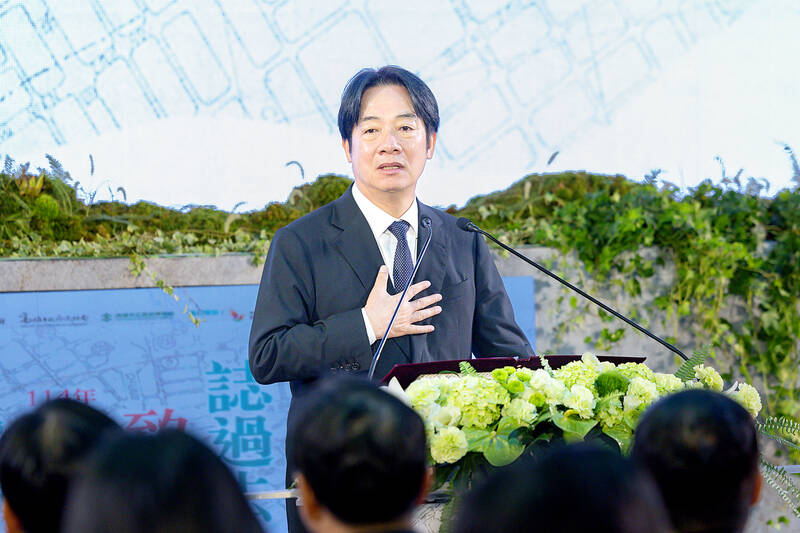
Photo: Screen grab from the Presidential Office’s Flickr page
During that dark period, the state apparatus did not protect the public, but instead persecuted them and violated their human rights, resulting in many being imprisoned or killed, he added.
“How fortunate Taiwan is to have transitioned into a democratic era,” Lai said.
“Over the past few decades, democratic Taiwan has become clearly defined on the international stage by its 23 million people,” he said. “Taiwan has become a beacon of democracy in Asia, enjoying a life of freedom and democracy.”
“We must not forget the past. In the future, certificates of restored honor must continue to be issued to those affected, and such tragedies must never be allowed to happen in Taiwan again,” he added.
As president and the commander-in-chief of the nation’s armed forces, Lai said he is responsible for protecting the nation and the safety of its people.
Although there are differences in national identity in Taiwan, one fundamental principle must be upheld, which is that “the ROC can only exist if Taiwan exists,” Lai said.
He reiterated his commitment to upholding the democratic and free constitutional system, as well as the fact that the ROC and the People’s Republic of China are not subordinate to each other, and to firmly safeguard Taiwan’s sovereignty.
“Taiwan must use democracy as its compass, and peace as its beacon,” Lai said.
“While it is important to have ideals about peace, we must not harbor illusions,” he said.
“Peace cannot be achieved through a single agreement. Believing that signing a peace agreement will bring peace is wishful thinking,” Lai said. “That is false peace, and accepting China’s so-called ‘1992 consensus’ or ‘one China’ principle will not bring peace either.”
“Peace must be built on a foundation of strength,” he said, adding that only by bolstering national defense and enhancing defensive capabilities could Taiwan achieve true peace “through deterrence to prevent war, and preparedness to avoid war.”
The “1992 consensus,” a term former Mainland Affairs Council chairman Su Chi (蘇起) in 2006 admitted making up in 2000, refers to a tacit understanding between the KMT and the Chinese government that both sides of the Strait acknowledge there is “one China,” with each side having its own interpretation of what “China” means.
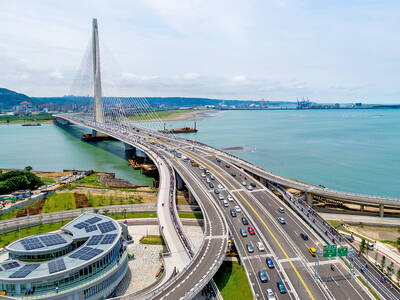
The Ministry of Transportation and Communications yesterday inaugurated the Danjiang Bridge across the Tamsui River in New Taipei City, saying that the structure would be an architectural icon and traffic artery for Taiwan. Feted as a major engineering achievement, the Danjiang Bridge is 920m long, 211m tall at the top of its pylon, and is the longest single-pylon asymmetric cable-stayed bridge in the world, the government’s Web site for the structure said. It was designed by late Iraqi-British architect Zaha Hadid. The structure, with a maximum deck of 70m, accommodates road and light rail traffic, and affords a 200m navigation channel for boats,
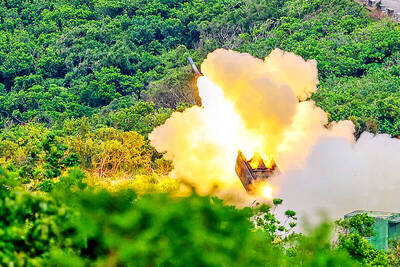
PRECISION STRIKES: The most significant reason to deploy HIMARS to outlying islands is to establish a ‘dead zone’ that the PLA would not dare enter, a source said A High Mobility Artillery Rocket System (HIMARS) would be deployed to Penghu County and Dongyin Island (東引) in Lienchiang County (Matsu) to force the Chinese military to retreat at least 100km from the coastline, a military source said yesterday. Taiwan has been procuring HIMARS and Army Tactical Missile Systems (ATACMS) from the US in batches. Once all batches have been delivered, Taiwan would possess 111 HIMARS units and 504 ATACMS, which have a range of 300km. Considering that “offense is the best defense,” the military plans to forward-deploy the systems to outlying islands such as Penghu and Dongyin so that
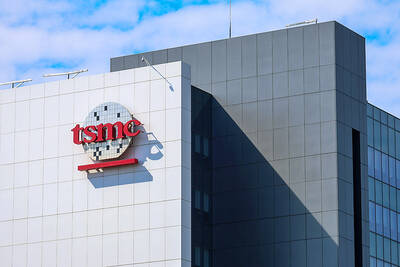
Taiwan Semiconductor Manufacturing Co (TSMC, 台積電), the world’s largest foundry service provider, yesterday said that global semiconductor revenue is projected to hit US$1.5 trillion in 2030, after the figure exceeds US$1 trillion this year, as artificial intelligence (AI) demand boosts consumption of token and compute power. “We are still at the beginning of the AI revolution, but we already see a significant impact across the whole semiconductor ecosystem,” TSMC deputy cochief operating officer Kevin Zhang (張曉強) said at the company’s annual technology symposium in Hsinchu City. “It is fair to say that in the past decade, smartphones and other mobile devices were
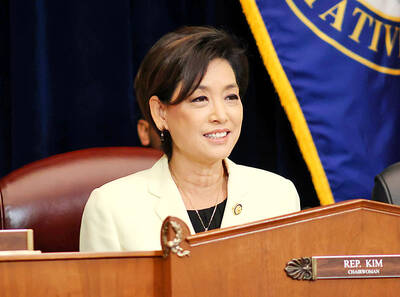
‘CLEAR MESSAGE’: The bill would set up an interagency ‘tiger team’ to review sanctions tools and other economic options to help deter any Chinese aggression toward Taiwan US Representative Young Kim has introduced a bill to deter Chinese aggression against Taiwan, calling for an interagency “tiger team” to preplan coordinated sanctions and economic measures in response to possible Chinese military or political action against Taiwan. “[Chinese President] Xi Jinping [習近平] has directed the People’s Liberation Army to be ready to invade Taiwan by 2027. China has a plan. America should have one too,” Kim said in a news release on Thursday last week. She introduced the “Deter PRC [People’s Republic of China] aggression against Taiwan act” to “ensure the US has a coordinated sanctions strategy ready should


 RSS
RSS