

The Ministry of Transportation and Communications yesterday defended its efforts to improve traffic safety after a report by a German news firm advised international travelers to think twice before visiting Taiwan, saying that road deaths were higher than the number of people killed (the US official death toll stands at 2,977 victims and the 19 hijackers) in the Sept. 11, 2001, terrorist attacks in the US.
The Berlin-based bne IntelliNews on Sunday published a report on the high casualties resulting from traffic incidents in Taiwan with the headline “Taiwan’s deadly mix of drivers and pedestrians.”
Citing a TVBS report, the article said that in 2022 more than 375,000 incidents were recorded across Taiwan, leading to more than 3,000 deaths and 389,269 injuries.
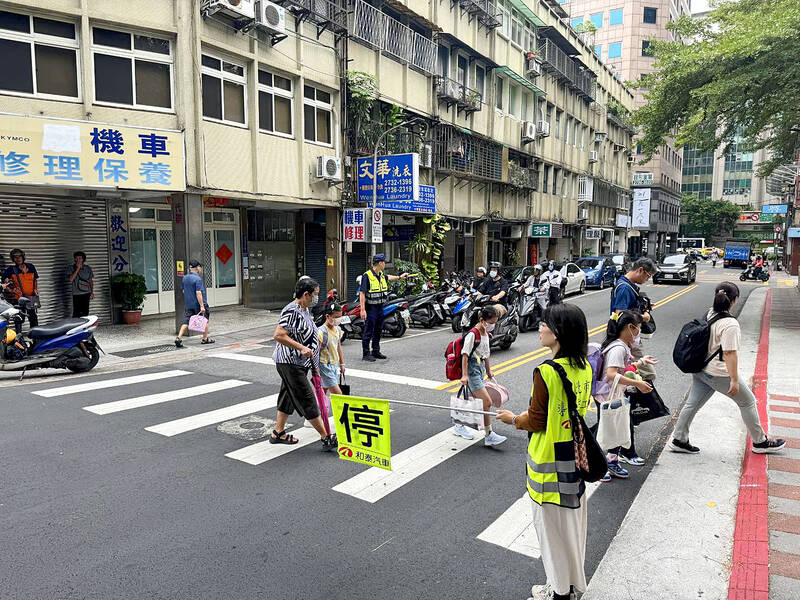
Photo copied by Yao Yueh-hung, Taipei Times
Last year, the nation recorded nearly 400,000 traffic incidents, 290,000 of which were in the first nine months of the year, resulting in more than 2,000 deaths and more than 386,000 injuries, it said, citing TVBS and the Central News Agency.
The article — which said that international and local media have called Taiwan a “living hell for pedestrians” — attributed the high rate of traffic incidents to problematic road design, drivers disregarding traffic rules, loose enforcement of traffic regulations, the omnipresence of scooters and outdated road infrastructure.
It added that the government did not announce reforms on rules regulating elderly drivers until a 78-year-old man in May sped through an elementary school zone in New Taipei City’s Sansia District (三峽), killing three people and injuring 12. The driver also died.
While deaths fell to 469 in the first two months of this year, a six-year low for the period, the improvement was modest against a much larger systematic crisis, it said.
“For now, Taiwan’s road deaths are higher than the total number of those lost in the 9-11 attacks each year, or on the home front, around the same number as are killed in drowning, fires and workplace accidents, combined, and then multiplied by six — each and every year,” it said.
“Until this changes, stepping onto the street in Taiwan will remain an act of risk that no modern democracy should tolerate and those overseas pondering a trip to see all the positives that time in Taiwan offers, should think twice before booking a flight,” it added.
However, Department of Railways, Highways and Road Safety Division Director-General Wu Tung-ling (吳東凌) said that Taiwan is making progress on road safety.
While change is never easy, reforms are moving in the right direction and the public can feel the results, with a comprehensive decline in the deaths of pedestrians, incidents involving elderly drivers and drunk driving, Wu said.
He said that foreign media claims of lax policing were overstated, as the ministry closely works with the National Police Agency.
He also rejected suggestions that people should reconsider visiting Taiwan, emphasizing the nation’s natural beauty and the friendliness of Taiwanese.
The ministry is to unveil a driver’s license reform plan this month, as well as regulatory changes and the use of artificial intelligence to speed up improvements in road safety, he said.
Tourism Administration Deputy Director-General Huang Shih-fang (黃勢芳) said that such foreign media reports have hurt Taiwan’s image, adding that they were based on a “partial misunderstanding” and that many international travelers value Taiwan’s travel environment.
Taiwan initially set a goal of attracting 10 million visitors this year, although that figure appears difficult to achieve, Huang said.
A total of about 9 million arrivals is more realistic, he said, adding that visitor numbers would need to grow by about 20 percent from last year to meet the target, while the current growth rate is only about 10 percent.
Recent flooding, earthquakes and the indirect effect of US tariffs on consumer sentiment have all dampened travel demand, making it harder for Taiwan to boost arrivals as planned, he added.

‘GLOBAL WARNING’: The infiltration is not just a local problem, as Beijing has been deploying the same tactics worldwide against Western democracies, a report said Between 50,000 and 100,000 Chinese spies are operating in Taiwan, far more than the National Security Bureau’s previous estimate of 5,000, German journalist and author Jurgen Kremb said on Monday. Kremb presented his research, titled “The War of Spies: How China’s Intelligence Services Are Infiltrating Taiwan — and What Europe Must Learn from It,” at a joint event held by the Taiwan offices of the Friedrich Naumann Foundation and the European Values Center for Security Policy. The report was published in June in the Ministry of Justice Investigation Bureau’s Prospect & Exploration Monthly (展望與探索月刊). By spies, he said he was referring to informants,
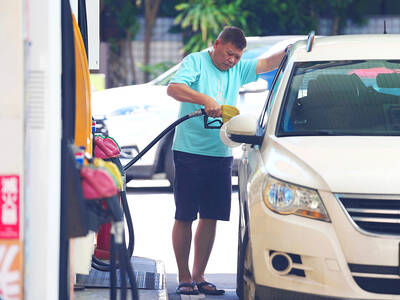
PRICE STABILIZATION: The Ministry of Economic Affairs has urged the legislature to support the Cabinet’s supplementary budget for state-owned energy companies State-owned oil supplier CPC Corp, Taiwan (CPC, 台灣中油) on Saturday announced that it would raise domestic gasoline prices by NT$0.7 (US$0.02) per liter and diesel prices by NT$0.6 per liter this week after international crude oil prices rose above US$100 per barrel last week. Formosa Petrochemical Corp (台塑石化) yesterday said that it matched CPC’s price adjustments for this week. The decisions end a six-week period during which CPC and Formosa kept fuel prices in Taiwan unchanged. Retail gasoline prices this week would rise to NT$31.2, NT$32.7 and NT$34.7 per liter for 92, 95 and 98-octane unleaded gasoline respectively at CPC
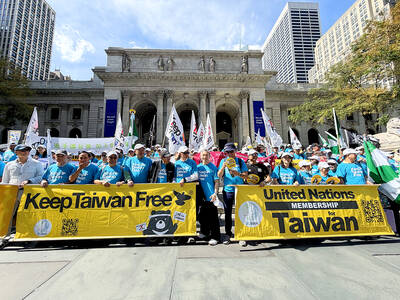
More than 100 Taiwanese-Americans, Taiwanese lawmakers and members of civic groups on Saturday marched through New York City to call for Taiwan’s participation in the UN, with Marshall Island Permanent Representative to the UN John Silk joining the event to show support. Participants chanted: “UN for Taiwan” and “Keep Taiwan Free” as they marched through central Manhattan, passing Times Square and Bryant Park before ending near the New York Public Library. The annual march brought together Taiwanese community groups from across the US East Coast. Silk expressed hope that Taiwan would one day be able to participate in UN meetings

Two aides at independent Legislator May Chin’s (高金素梅) office were ordered detained incommunicado yesterday in a broadening probe into alleged Chinese espionage by Chin’s former chief of staff, Chang Chun-chieh (張俊傑). The move to hold Lin I-chun (林怡君) and current chief of staff Chen Chih-huang (陳智葟) in custody came four days after Chang, indicted on corruption charges, cut off his electronic monitoring wristband and jumped bail. The High Prosecutors’ Office said that it believes Chang had developed a Chinese spy ring, which might have operated for more than a decade, with funding from China, and that Lin and Chen were suspected of


 RSS
RSS