


Russian President Vladimir Putin yesterday told Chinese President Xi Jinping (習近平) that their countries’ ties were at an “unprecedented level,” during talks in Beijing ahead of a massive military parade.
Today’s showcase of China’s might has been seized by world leaders as an opportunity to hold rare face-to-face talks, with North Korean leader Kim Jong-un expected to hold summits with both Putin and Xi, according to South Korean sources.
Xi himself has embarked on a flurry of diplomatic meetings this week, including attendance at the Shanghai Cooperation Organization summit in the northern city of Tianjin — a forum that China sees as an alternative to Western-dominated international cooperation.
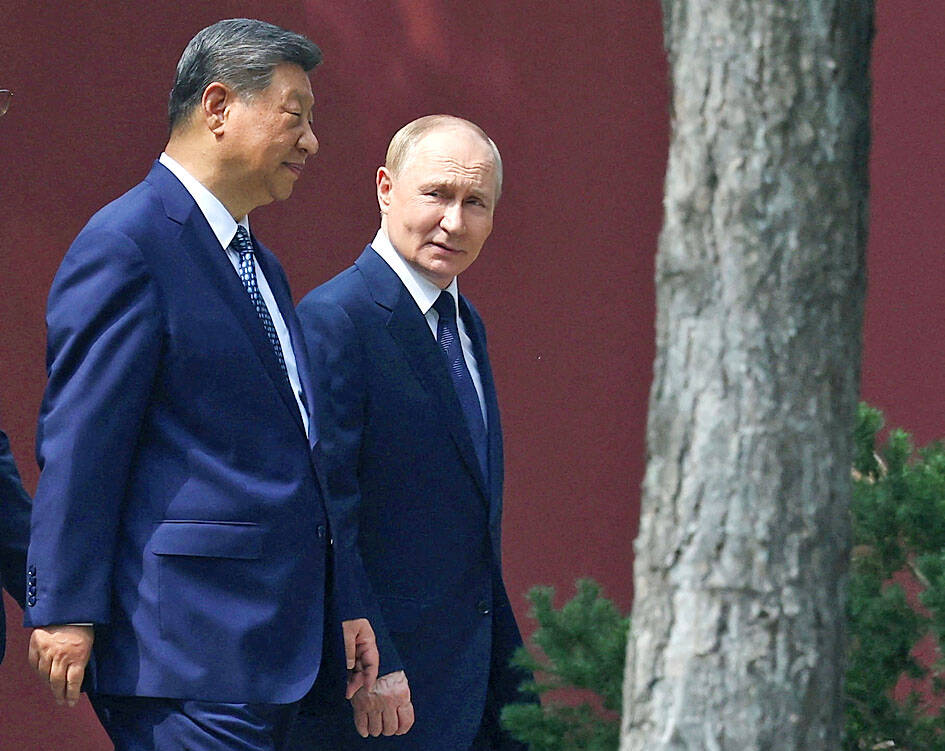
Photo: Sputnik / Alexander Kazakov / Reuters
Meeting Xi yesterday, Putin told him “our close communication reflects the strategic nature of Russian-Chinese ties, which are currently at an unprecedented level,” according to a pooled live feed.
In a nod to cooperation between the two countries during World War II, Putin said “we were always together then, and we remain together now.”
Xi and Putin have also both met with Iranian President Masoud Pezeshkian, as Tehran faces the reimposition of European sanctions over its nuclear program.
Xi told Pezeshkian China opposed the “use of force to resolve differences,” but said it “supports Iran in safeguarding its national sovereignty.”
The military parade marks 80 years since the end of World War II and is to be attended by about two dozen world leaders, including Kim in his first visit to China since 2019.
Kim is expected to mingle with other world leaders at a gala performance, as well as meet Xi and Putin for talks, Lee Seong-kweun, a South Korean lawmaker briefed by Seoul’s spy agency, told reporters.
Putin yesterday also met with Slovakian Prime Minister Robert Fico, praising his country’s “independent foreign policy.”
Fico has irked European leaders by criticizing the EU’s support for Ukraine and pushing back against efforts to cut energy imports from Russia. Slovakia is highly reliant on Russian gas.
The Chinese and Russian leaders criticized Western governments during the summit on Monday, where Xi slammed “bullying behavior” from certain countries — a veiled reference to the US — while Putin defended Russia’s Ukraine offensive and blamed the West for triggering the conflict.
“China-Russia relations have withstood the test of international changes,” Xi told Putin yesterday.
Xi added that Beijing was willing to work with Moscow to “promote the construction of a more just and reasonable global governance system.”
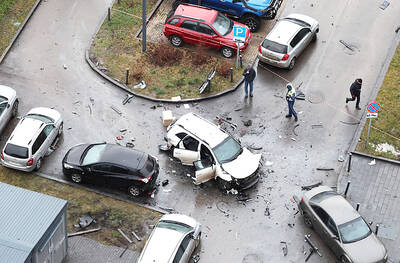
A car bomb killed a senior Russian general in southern Moscow yesterday morning, the latest high-profile army figure to be blown up in a blast that came just hours after Russian and Ukrainian delegates held separate talks in Miami on a plan to end the war. Kyiv has not commented on the incident, but Russian investigators said they were probing whether the blast was “linked” to “Ukrainian special forces.” The attack was similar to other assassinations of generals and pro-war figures that have either been claimed, or are widely believed to have been orchestrated, by Ukraine. Russian Lieutenant General Fanil Sarvarov, 56, head
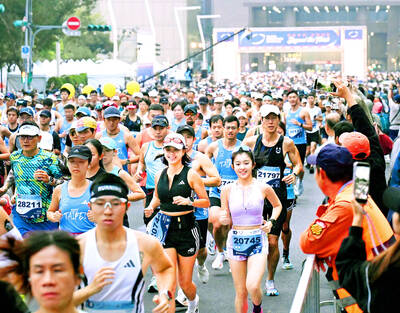
SAFETY FIRST: Double the number of police were deployed at the Taipei Marathon, while other cities released plans to bolster public event safety Authorities across Taiwan have stepped up security measures ahead of Christmas and New Year events, following a knife and smoke bomb attack in Taipei on Friday that left four people dead and 11 injured. In a bid to prevent potential copycat incidents, police deployments have been expanded for large gatherings, transport hubs, and other crowded public spaces, according to official statements from police and city authorities. Taipei Mayor Chiang Wan-an (蔣萬安) said the city has “comprehensively raised security readiness” in crowded areas, increased police deployments with armed officers, and intensified patrols during weekends and nighttime hours. For large-scale events, security checkpoints and explosives
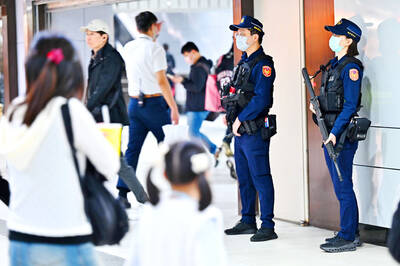
PUBLIC SAFETY: The premier said that security would be tightened in transport hubs, while President Lai commended the public for their bravery The government is to deploy more police, including rapid response units, in crowded public areas to ensure a swift response to any threats, President William Lai (賴清德) said yesterday after a knife attack killed three people and injured 11 in Taipei the previous day. Lai made the remarks following a briefing by the National Police Agency on the progress of the investigation, saying that the attack underscored the importance of cooperation in public security between the central and local governments. The attack unfolded in the early evening on Friday around Taipei Main Station’s M7 exit and later near the Taipei MRT’s Zhongshan
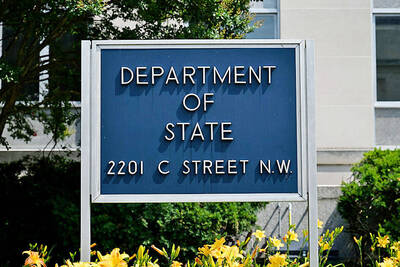
REBUFFED: In response to Chinese criticism over recent arms sales, Washington urged Beijing to engage in meaningful dialogue instead of threats and intimidation Washington’s long-term commitment to Taiwan would not change, the US Department of State said yesterday, urging Beijing to stop pressuring Taiwan and engage in meaningful bilateral dialogues. The remarks came in response to a backlash from Beijing about Washington’s latest approval of arms sales to Taiwan. The US Defense Security Cooperation Agency said in a statement on Wednesday that the Taipei Economic and Cultural Representative Office in the US has asked to purchase an arms package, including Tactical Mission Network Software; AH-1W helicopter spare and repair parts; M109A7 self-propelled howitzers; HIMARS long range precision strike systems; tube-launched, optically tracked, wire-guided missiles; Javelin


 RSS
RSS