


The Legislative Yuan yesterday passed amendments aimed at boosting Taiwan’s appeal to foreign professionals by easing pathways to permanent residency, extending stays for digital nomads, and strengthening labor and social rights guarantees.
The amendments to the Act Governing Recruitment and Employment of Foreign Professionals (外國專業人才延攬及雇用法) broaden the scope of eligibility, while expanding government support for foreign workers.
One key change allows graduates from the world’s top 1,500 universities — up from the current top 500 — to work in Taiwan and would exempt them from the requirement of two years of previous work experience.
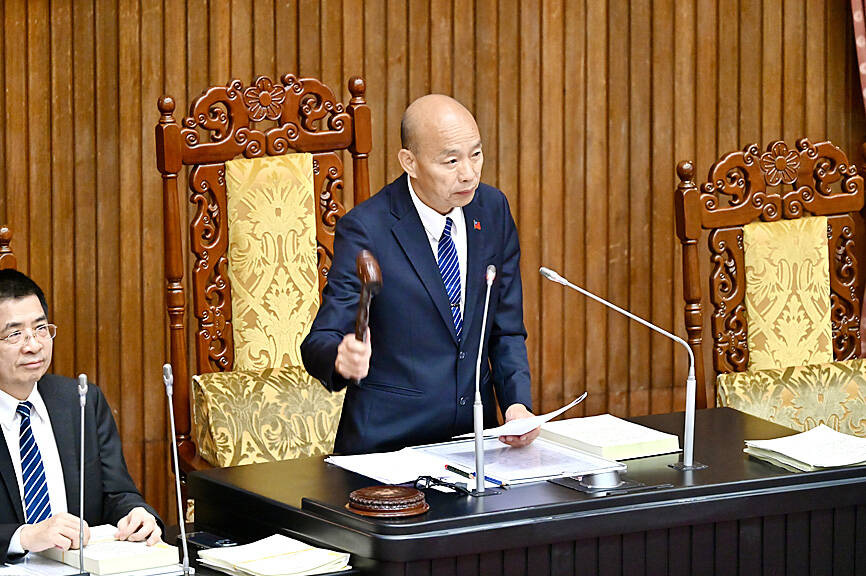
Photo: George Tsorng, Taipei Times
Lawmakers went further than the Executive Yuan’s initial proposal, which had suggested raising the threshold to the top 1,000 schools.
Foreign professionals who obtained a degree in Taiwan can now count part of their studies toward the residency requirement: One year for a bachelor’s or associate’s degree, two years for a master’s degree and three years for a doctorate.
The degrees cannot overlap.
In addition, foreigners who earned a bachelor’s degree within the past five years from one of the world’s top 200 universities, as designated by the Ministry of Education, can apply to the Ministry of Labor for professional work in Taiwan.
Visas obtained under these provisions are limited to two years, cannot be renewed and can only be applied for once.
Graduates of associate’s degree programs or higher from Taiwanese institutions can remain in the country to work after applying to extend their stay as new graduates, without the need to obtain a separate work permit.
Spouses of foreigners entering Taiwan under the Gold Card program would be eligible to apply for work permits through the Ministry of Labor, although the duration of such permits cannot exceed the validity of their dependent status, according to the amendment.
Professionals working remotely who do not work for domestic employers, but meet requirements set by the authorities, can apply for a six-month, multiple-entry visa through the Ministry of Foreign Affairs or its overseas missions. The provision also covers spouses, minor children and dependent adult children.
Digital nomads would be able to extend their visa with the National Immigration Agency for up to two years in total, the amendment said.
The amendment also eases income requirements for Gold Card holders seeking permanent residency, allowing foreigners who earn at least NT$6 million (US$196,046) annually to apply after just one year of residence.
Foreigners would no longer need permanent residency to qualify for benefits under the revamped labor pension system, while those who do obtain permanent residency would also become eligible for employment insurance, it said.
The National Development Council said that its Talent Taiwan program is targeting recruitment for the Six Core Strategic Industries as well as the nation’s 10 key artificial intelligence infrastructure projects.

‘NO SECURITY RISK’: The Railway Bureau reassured the public that the technicians’ activities were limited to technical guidance and did not involve sensitive systems The Railway Bureau yesterday said it had invited eight Chinese technicians to assist with an airport MRT construction project. The bureau issued the confirmation after an Internet user said Chinese nationals had entered the construction zone of Taiwan Taoyuan International Airport’s Terminal 3 project. They asked why “individuals from an enemy state” were allowed access to such a major national infrastructure project, which raised serious concerns over Taiwan’s industrial safety, sensitive systems and information security. The bureau’s Northern Region Engineering Branch Office said subcontractor Taiwan Handle Industrial Co (台灣手把工業) of the Taoyuan airport MRT’s “Contract No. CU05 Project A14 Station Civil, MEP &

A US uncrewed surface vessel (USV) encountered multiple Chinese warships during an autonomous transit of the Taiwan Strait, US defense company Seasats said in a statement on Wednesday. Seasats announced that a Lightfish USV had completed the first autonomous transit of the Taiwan Strait. Over five days, the USV traversed the entire length of the Strait while constantly monitoring surface vessel traffic, the company said. The Lightfish encountered multiple Chinese warships, one of which was a Chinese People’s Liberation Army Navy (PLAN) Type 056 corvette, it said. The Chinese vessels were operating “well within Taiwan’s exclusive economic zone without transmitting their identity via the
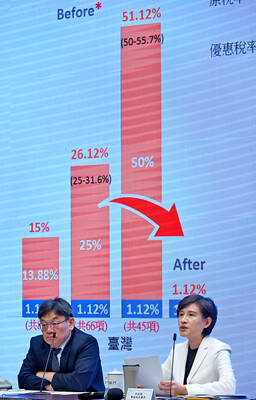
GREATER REACH? Auto parts and wood products would face tariffs of up to 15%, matching those targeting the EU, Japan and South Korea, Vice Premier said The US has announced that preferential tariff treatment for Taiwan’s non-semiconductor Section 232 goods would take effect retroactively from May 1, the Executive Yuan said yesterday. The US government yesterday posted a notice on the Federal Register’s public inspection Web site previewing tariff concessions for Taiwan under a memorandum of understanding (MOU) on Taiwan-US investment after two months of negotiations. The MOU signed on Jan. 15 stipulated three major preferential tariff arrangements: a 15 percent “reciprocal” tariff rate for Taiwan without stacking most-favored nation (MFN) rates; preferential Section 232 treatment for semiconductors and related products; and preferential Section 232 treatment for non-semiconductor

TIT-FOR-TAT: The US allegedly revoked the visa of a Chinese national working at Xinhua News Agency in the US in response to Beijing’s expulsion of Vivian Wang The Presidential Office yesterday condemned China for expelling a New York Times correspondent from Beijing following the newspaper’s interview with President William Lai (賴清德), saying the move highlighted Beijing’s suppression of press freedom and its threat to international news media. Taiwan has noted a series of recent incidents in which Beijing used similar tactics to “threaten and pressure international media outlets and journalists,” Presidential Office spokeswoman Karen Kuo (郭雅慧) said in a statement. “This concerns not only press freedom and freedom of expression, but also the safety of journalists, and Taiwan and relevant partners are paying close attention to the situation,” she


 RSS
RSS