


The armed forces are mulling placing additional orders for indigenously developed missiles in response to the growing threat from China, a defense official said yesterday.
Speaking on condition of anonymity, the source said the army, navy and air force have each submitted requests to the Ministry of National Defense (MND) for more missiles than originally planned under the Sea-Air Combat Power Improvement Plan.
Although the plan is scheduled to wind down next year, the military believes Taiwan must acquire more indigenous and foreign-made missile systems to meet its defensive operational needs, the official said.
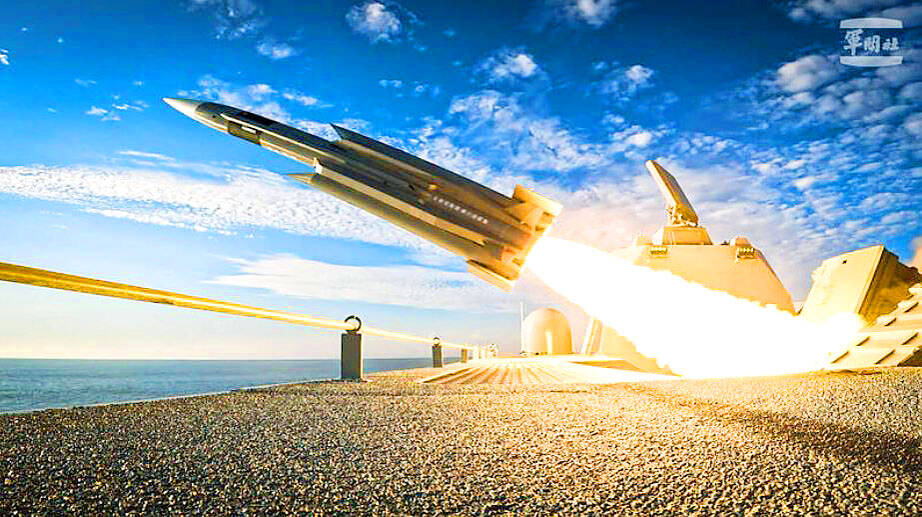
Photo courtesy of the Military News Agency
The source said that the requests include orders for 231 Tien Kung III (天弓, “Sky Bow”) surface-to-air missiles; 108 ground-launched variants of the Lu Chien II (陸劍, “Land Sword II”) missile; 232 Hsiung Feng II/III (雄風, “Brave Wind”) anti-ship missiles; and 107 extended-range Tien Chien II (天劍, “Sky Sword II”) air-to-air missiles.
The military is also seeking to procure two Tien Kung IV air defense systems for the air force, along with 128 associated missiles, they added.
Mass production of the system — which has a maximum intercept altitude of 70km — would significantly improve the nation’s ability to defend against the Chinese People’s Liberation Army’s (PLA) ballistic and cruise missiles, they said.
The military’s internal assessments align with US recommendations for Taiwan to acquire additional Patriot Advanced Capability-3 systems and National Advanced Surface-to-Air Missile Systems, they added.
The size of Taiwan’s missile stockpile is critical to the armed forces’ ability to withstand a prolonged missile campaign by the PLA after repelling an initial strike, the source said.
Separately, a source familiar with the matter said that the army’s 584 Armor Brigade — Taiwan’s primary operator of US-supplied M1A2T Abrams tanks — has met all performance benchmarks ahead of its scheduled reactivation in October.
The brigade’s transformation into a fully equipped M1A2T unit is a milestone in the army’s efforts to modernize its armored capabilities, they said.
The US has delivered 80 M1A2T main battle tanks and is expected to deliver the remaining 28 tanks during the first quarter of next year.
On Thursday, General Lu Kun-hsiu (呂坤修), commander of the army headquarters, inspected the 584 Armor Brigade’s maintenance teams, including contractors, and reviewed progress on constructing prepared fighting positions.
“The new weapon systems’ and equipment’s combat potential cannot be realized without proper logistics and maintenance,” he said during the tour of the brigade.
Units slated to receive new weapon systems must rigorously train under realistic combat conditions, retain technical expertise and practice risk mitigation to ensure the army’s force structure plans are implemented on schedule, he added.

A signaling system malfunction disrupted high-speed rail (HSR) services beginning at 8am today, with trains temporarily reduced to three northbound and three southbound trains per hour as authorities conduct inspections. The malfunction occurred on a section of track in Miaoli County during pre-operation checks early this morning, forcing northbound and southbound trains to use a single track, the HSR operator said. The regular schedule has been replaced with three hourly trains offering only nonreserved seating in each direction, stopping at every station, it said, adding that business class cars would still have reserved seating. Departures from terminal stations are scheduled at the top

Taiwan is still in the process of assessing the possibility of recruiting workers from Eswatini, the Ministry of Foreign Affairs said yesterday, adding that its goal is to help Eswatini upgrade its vocational training centers. If there are plans to recruit workers from Eswatini, safeguarding national security, protecting public health and ensuring the employment rights of Taiwanese would be prerequisites, Department of West Asian and African Affairs Director-General Yen Chia-liang (顏嘉良) told a news conference. Key considerations would also include filling labor shortages in specific industries, and fostering bilateral professional and technical exchanges, he said. Yen was asked about the progress of labor

A US uncrewed surface vessel (USV) encountered multiple Chinese warships during an autonomous transit of the Taiwan Strait, US defense company Seasats said in a statement on Wednesday. Seasats announced that a Lightfish USV had completed the first autonomous transit of the Taiwan Strait. Over five days, the USV traversed the entire length of the Strait while constantly monitoring surface vessel traffic, the company said. The Lightfish encountered multiple Chinese warships, one of which was a Chinese People’s Liberation Army Navy (PLAN) Type 056 corvette, it said. The Chinese vessels were operating “well within Taiwan’s exclusive economic zone without transmitting their identity via the

VERBOSE VESSELS: A CGA cutter and a China Coast Guard exchanged verbal barbs for more than a day in Taiwanese-controlled waters before the Chinese vessel left The Taiwanese and Chinese coast guards had a standoff near the strategically located Pratas Islands (Dongsha Islands, 東沙群島) in the north of the South China Sea, the Coast Guard Administration (CGA) said yesterday. The two sides engaged in intense radio exchanges over sovereignty claims during the 33-hour standoff. China Coast Guard vessel 3501 eventually left the restricted waters, 26.6 nautical miles (49.2km) west of the Pratas Islands, at 5pm yesterday, the CGA said. Lying approximately between southern Taiwan and Hong Kong, the Taiwan-controlled Pratas are seen by some security experts as vulnerable to Chinese attack due to their distance — more than


 RSS
RSS