


The alleged attendance of Legislative Yuan General Affairs Department Director Liao Chiung-chih (廖炯志) at a dinner hosted by executives of Taikoo Motors Ltd (太古汽車), which is seeking to import Chinese firm BYD Co’s (比亞迪) new Denza electric vehicles made in Thailand, on July 28 might have violated the Ethics Guidelines for Civil Servants (公務員廉政倫理規範), Democratic Progressive Party (DPP) caucus chief executive Rosalia Wu (吳思瑤) said yesterday.
Wu cited Chinese-language reports by Mirror Media magazine (鏡週刊), which also claimed that staffers from the office of Legislative Speaker Han Kuo-yu (韓國瑜) and Deputy Legislative Speaker Johnny Chiang (江啟臣) were also present.
The report claimed that the event was an attempt by BYD to lobby Taiwanese politicians into relaxing regulations so that its cars would be allowed to enter the local market.
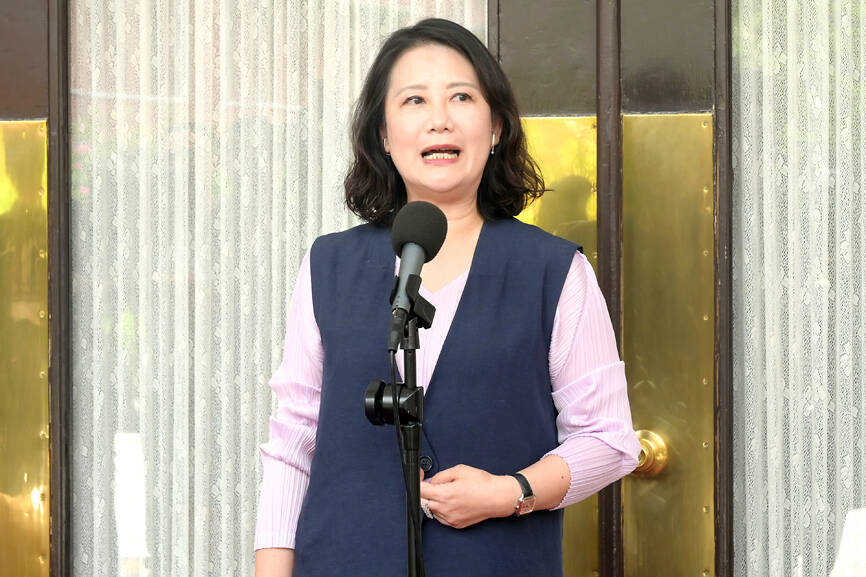
Photo: Wang Yi-sung, Taipei Times
The optics of staffers from the speaker’s and deputy speaker’s office attending a dinner with Chinese executives at a Michelin-star restaurant at a time when floods beset Taiwan is condemnable, Wu said, calling on Han and Chiang to issue statements on the issue.
Liao said that he had no business dealings with the people at the dinner and he did not breach ethics regulations.
The guidelines state that Liao, as a civil servant, should not attend functions that create a conflict of interest, and his alleged attendance would be illegal if he had not notified the Legislative Yuan.
Asked about the incident on his way to preside over yesterday’s legislative session, Han only proffered a “good morning.”
Chiang’s office said that the staffer attended the dinner of their own accord and was unaware of who else would be there.
Political commentator Wen Lang-tung (溫朗東) on Facebook said that regardless of whether it was BYD or Taikoo Motors attempting to lobby for imports of BYD cars, there was no registration of such lobbying at the Legislative Yuan.
Wen said that BYD vehicles are compromised in terms of security and safety, citing 10 incidents of the cars catching fire and how an Australian BYD owner found that the vehicle’s SIM card made anonymous calls and transmitted data to third-party sources without the owner’s permission.
The legislature’s Lobbying Act (遊說法) registration site had no mentions of BYD, Taikoo or Shenzhen Denza New Energy Co (騰勢), which Taikoo cofounded with Mercedes-Benz.
The act states that all lobbying must be recorded.
Separately, a government official, commenting on condition of anonymity, said that authorities are looking into the claims that BYD executives are lobbying legislators.
Chinese entering Taiwan on business visas found to be conducting affairs outside the scope of their visa should be banned from entering Taiwan for five years, experts said.
The Ministry of Economic Affairs yesterday it is reviewing new regulatory measures to block indirect imports of Chinese cars, following reports that electric vehicle giant BYD is planning to enter the Taiwan market by assembling vehicles in Thailand and selling them under the "Denza" brand through a local agent.
The ministry said the proposed regulations, which are expected by the end of the year, will address concerns over national security, vehicle safety, information security, and the protection of Taiwan’s auto industry.
Currently, Taiwan bans direct imports of fully assembled vehicles from China. Locally assembled vehicles using Chinese components must meet strict localization thresholds in order to be approved for sale and registration.
To prevent the dumping of Chinese-made vehicles in Taiwan, the Ministry of Economic Affairs last year introduced a new policy regarding the local content ratio of domestically produced cars. The regulation applies to all manufacturers falling under the following categories: joint ventures between Chinese capital and international brands, such as Denza, international brands acquired by Chinese capital such as Volvo, international brands producing in China, such as Beijing Hyundai, and Chinese brands such as BYD.
The policy requires that any partner factories producing vehicles in Taiwan must commit to a localized supply chain with a defined local content ratio.
Taikoo Motors Group in Taiwan told Mirror News that Denza is an international brand and not manufactured in China, adding that it hopes to use this distinction to bypass regulations set by the Ministry of Economic Affairs and avoid violating the government’s policy prohibiting the import of complete vehicles from Chinese automotive brands.
Currently, BYD’s two hybrid models of “Sealion" (海獅) have been imported from Thailand via Taikoo and already delivered to the Vehicle Safety Certification Center for safety testing. However, testing has recently been suspended, and the vehicles have not yet received approval for registration or road use.
Additional reporting by Chen Cheng-yu and CNA

A signaling system malfunction disrupted high-speed rail (HSR) services beginning at 8am today, with trains temporarily reduced to three northbound and three southbound trains per hour as authorities conduct inspections. The malfunction occurred on a section of track in Miaoli County during pre-operation checks early this morning, forcing northbound and southbound trains to use a single track, the HSR operator said. The regular schedule has been replaced with three hourly trains offering only nonreserved seating in each direction, stopping at every station, it said, adding that business class cars would still have reserved seating. Departures from terminal stations are scheduled at the top

Taiwan is still in the process of assessing the possibility of recruiting workers from Eswatini, the Ministry of Foreign Affairs said yesterday, adding that its goal is to help Eswatini upgrade its vocational training centers. If there are plans to recruit workers from Eswatini, safeguarding national security, protecting public health and ensuring the employment rights of Taiwanese would be prerequisites, Department of West Asian and African Affairs Director-General Yen Chia-liang (顏嘉良) told a news conference. Key considerations would also include filling labor shortages in specific industries, and fostering bilateral professional and technical exchanges, he said. Yen was asked about the progress of labor

A US uncrewed surface vessel (USV) encountered multiple Chinese warships during an autonomous transit of the Taiwan Strait, US defense company Seasats said in a statement on Wednesday. Seasats announced that a Lightfish USV had completed the first autonomous transit of the Taiwan Strait. Over five days, the USV traversed the entire length of the Strait while constantly monitoring surface vessel traffic, the company said. The Lightfish encountered multiple Chinese warships, one of which was a Chinese People’s Liberation Army Navy (PLAN) Type 056 corvette, it said. The Chinese vessels were operating “well within Taiwan’s exclusive economic zone without transmitting their identity via the

VERBOSE VESSELS: A CGA cutter and a China Coast Guard exchanged verbal barbs for more than a day in Taiwanese-controlled waters before the Chinese vessel left The Taiwanese and Chinese coast guards had a standoff near the strategically located Pratas Islands (Dongsha Islands, 東沙群島) in the north of the South China Sea, the Coast Guard Administration (CGA) said yesterday. The two sides engaged in intense radio exchanges over sovereignty claims during the 33-hour standoff. China Coast Guard vessel 3501 eventually left the restricted waters, 26.6 nautical miles (49.2km) west of the Pratas Islands, at 5pm yesterday, the CGA said. Lying approximately between southern Taiwan and Hong Kong, the Taiwan-controlled Pratas are seen by some security experts as vulnerable to Chinese attack due to their distance — more than


 RSS
RSS