


A former Macanese pro-democracy lawmaker became the first person to be arrested under the territory’s national security law, with authorities yesterday alleging that he had ties to foreign groups endangering China.
The Chinese casino hub, which has its own legal system largely based on Portuguese law, enacted national security legislation in 2009 and widened its powers in 2023, to bring it in line with similar laws in Hong Kong and China.
Macanese Judiciary Police said a 68-year-old local man surnamed Au (歐) was arrested and handed over to public prosecutors on suspicion of “establishing connections ... outside Macau to commit acts endangering national security.”
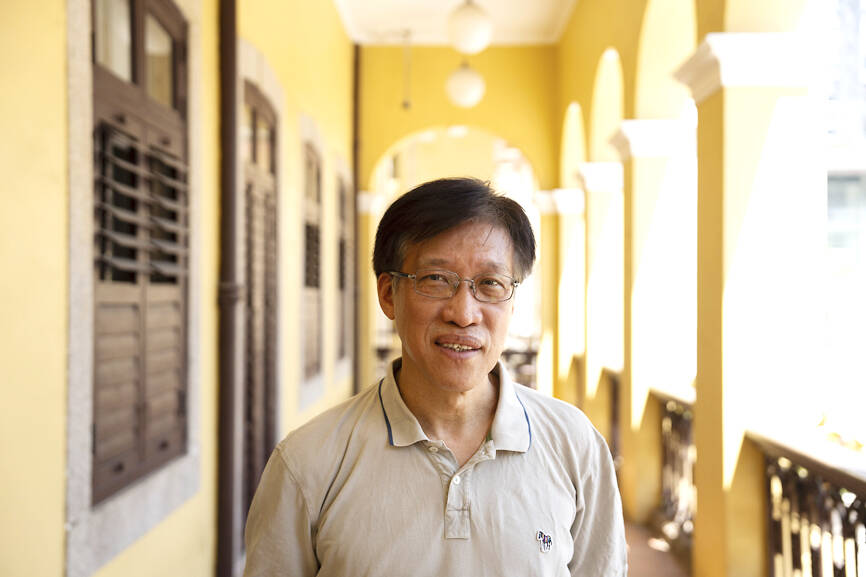
Photo: AP
Local media identified the man as Au Kam-san (歐錦新), a primary-school teacher who became one of Macau’s longest-serving pro-democracy legislators before deciding not to seek re-election in 2021.
The man allegedly provided “a large amount of false and seditious information to an anti-China group” for public exhibitions online and abroad since 2022, and “stirred up hatred” against the Macanese and Chinese governments.
He is also accused of spreading false information to groups, which allegedly disrupted the territory’s leadership election last year and caused foreign countries to take hostile action against Macau, police said in a statement, without naming the groups.
A stalwart of Macau’s tiny opposition camp, Au spent years campaigning on issues such as social welfare, corruption and electoral reform. He was one of the founders of several pro-democracy groups, including the New Macau Association.
Online news platform All About Macau reported that judicial police on Wednesday took away the former lawmaker and his wife, Virginia Cheang (鄭妙珊).
Cheang yesterday told the outlet outside the public prosecution office that she was listed as a witness and that she did not know why her husband was detained.
The former Portuguese colony reverted to Chinese rule in 1999 through a “one country, two systems” framework that promised a high degree of autonomy and rights protections.
For years it was regarded by Beijing as a poster child in contrast with neighboring Hong Kong, which often saw boisterous protests.
The high-water mark of Macau activism came in 2014 when 200,000 people rallied to oppose granting perks to retired government officials, an event that Au helped organize.
After Beijing cracked down on Hong Kong after months of huge and sometimes violent democracy protests in 2019, curbs established in that territory were extended to Macau.
Macanese officials last month disqualified 12 candidates from the legislative elections set for next month, saying that they did not uphold Macau’s mini-constitution or pledge allegiance to the territory.
Additional reporting Reuters

A signaling system malfunction disrupted high-speed rail (HSR) services beginning at 8am today, with trains temporarily reduced to three northbound and three southbound trains per hour as authorities conduct inspections. The malfunction occurred on a section of track in Miaoli County during pre-operation checks early this morning, forcing northbound and southbound trains to use a single track, the HSR operator said. The regular schedule has been replaced with three hourly trains offering only nonreserved seating in each direction, stopping at every station, it said, adding that business class cars would still have reserved seating. Departures from terminal stations are scheduled at the top

Taiwan is still in the process of assessing the possibility of recruiting workers from Eswatini, the Ministry of Foreign Affairs said yesterday, adding that its goal is to help Eswatini upgrade its vocational training centers. If there are plans to recruit workers from Eswatini, safeguarding national security, protecting public health and ensuring the employment rights of Taiwanese would be prerequisites, Department of West Asian and African Affairs Director-General Yen Chia-liang (顏嘉良) told a news conference. Key considerations would also include filling labor shortages in specific industries, and fostering bilateral professional and technical exchanges, he said. Yen was asked about the progress of labor

A US uncrewed surface vessel (USV) encountered multiple Chinese warships during an autonomous transit of the Taiwan Strait, US defense company Seasats said in a statement on Wednesday. Seasats announced that a Lightfish USV had completed the first autonomous transit of the Taiwan Strait. Over five days, the USV traversed the entire length of the Strait while constantly monitoring surface vessel traffic, the company said. The Lightfish encountered multiple Chinese warships, one of which was a Chinese People’s Liberation Army Navy (PLAN) Type 056 corvette, it said. The Chinese vessels were operating “well within Taiwan’s exclusive economic zone without transmitting their identity via the

VERBOSE VESSELS: A CGA cutter and a China Coast Guard exchanged verbal barbs for more than a day in Taiwanese-controlled waters before the Chinese vessel left The Taiwanese and Chinese coast guards had a standoff near the strategically located Pratas Islands (Dongsha Islands, 東沙群島) in the north of the South China Sea, the Coast Guard Administration (CGA) said yesterday. The two sides engaged in intense radio exchanges over sovereignty claims during the 33-hour standoff. China Coast Guard vessel 3501 eventually left the restricted waters, 26.6 nautical miles (49.2km) west of the Pratas Islands, at 5pm yesterday, the CGA said. Lying approximately between southern Taiwan and Hong Kong, the Taiwan-controlled Pratas are seen by some security experts as vulnerable to Chinese attack due to their distance — more than


 RSS
RSS