


President William Lai (賴清德) currently has no plans to travel overseas, Ministry of Foreign Affairs spokesman Hsiao Kuang-wei (蕭光偉) said yesterday, denying media reports that a planned trip to Paraguay via New York was blocked by the US.
At a routine news conference, Hsiao denied a Financial Times report that said Lai’s planned visits to diplomatic allies Paraguay, Guatemala and Belize had been delayed or canceled due to US President Donald Trump blocking a stopover in New York following protests from China.
The Financial Times, which cited three anonymous sources for its story, said that Trump was concerned that Lai’s trip would affect ongoing trade talks between the US and China.
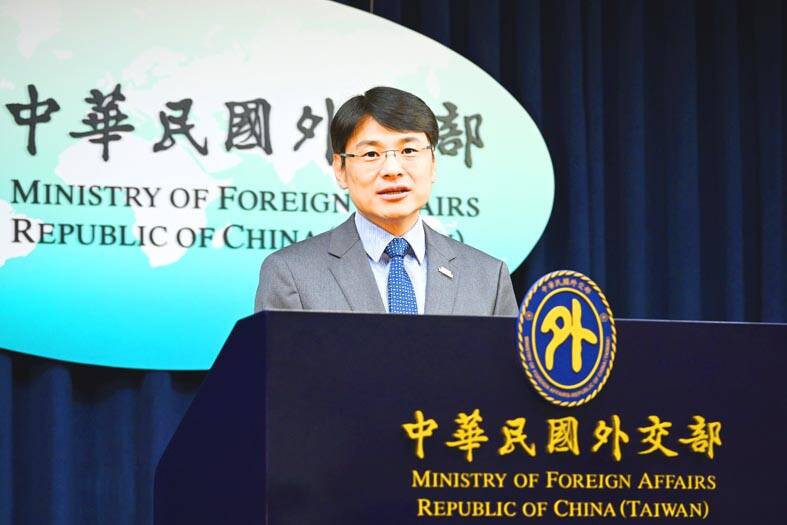
Photo: Chen Yi-kuan, Taipei Times
Hsiao said that Lai did not have any overseas travel arrangements because of ongoing recovery efforts in southern Taiwan following Typhoon Danas and international developments such as tariff negotiations with the US.
Any finalized overseas itinerary would be announced by the Presidential Office in line with usual procedures, he said.
Hsiao’s statement was nearly identical to that made on Monday night by Presidential Office spokeswoman Karen Kuo (郭雅慧), as the government responded to questions about a trip that had reportedly been planned, but not yet formally announced.
An Agence France-Presse report on July 14 cited Paraguayan President Santiago Pena as saying at an investment forum that Lai would visit his country “in 30 days.”
At the time Pena made the comment, he was hosting a delegation comprising about 30 business leaders and Minister of Foreign Affairs Lin Chia-lung (林佳龍) in Asuncion.
Bloomberg News reported two days later that Lai was planning to stop in New York on Monday next week and then Dallas 10 days later as part of a trip to diplomatic allies Paraguay, Guatemala and Belize.
However, a Bloomberg report on Monday said that plans for the trip were thrown into flux late last week when Taiwan could not get the US to give the green light.
Like the Financial Times, the Bloomberg report also cited the Trump administration’s concern that Lai’s stopovers in the US could derail trade talks with China.
The American Institute in Taiwan, responding to an inquiry about the matter, said that it could not comment on hypothetical questions, as Taiwan had not announced the president’s visit.
Meanwhile, the US Department of State yesterday said that its policies for stopovers by Taiwanese leaders have not changed.
“The United States remains committed to our longstanding ‘one China’ policy, which is guided by the Taiwan Relations Act, the Three Joint Communiques and the ‘six assurances,’” a state department spokesperson told the Central News Agency on condition of anonymity.

‘NO SECURITY RISK’: The Railway Bureau reassured the public that the technicians’ activities were limited to technical guidance and did not involve sensitive systems The Railway Bureau yesterday said it had invited eight Chinese technicians to assist with an airport MRT construction project. The bureau issued the confirmation after an Internet user said Chinese nationals had entered the construction zone of Taiwan Taoyuan International Airport’s Terminal 3 project. They asked why “individuals from an enemy state” were allowed access to such a major national infrastructure project, which raised serious concerns over Taiwan’s industrial safety, sensitive systems and information security. The bureau’s Northern Region Engineering Branch Office said subcontractor Taiwan Handle Industrial Co (台灣手把工業) of the Taoyuan airport MRT’s “Contract No. CU05 Project A14 Station Civil, MEP &

A US uncrewed surface vessel (USV) encountered multiple Chinese warships during an autonomous transit of the Taiwan Strait, US defense company Seasats said in a statement on Wednesday. Seasats announced that a Lightfish USV had completed the first autonomous transit of the Taiwan Strait. Over five days, the USV traversed the entire length of the Strait while constantly monitoring surface vessel traffic, the company said. The Lightfish encountered multiple Chinese warships, one of which was a Chinese People’s Liberation Army Navy (PLAN) Type 056 corvette, it said. The Chinese vessels were operating “well within Taiwan’s exclusive economic zone without transmitting their identity via the
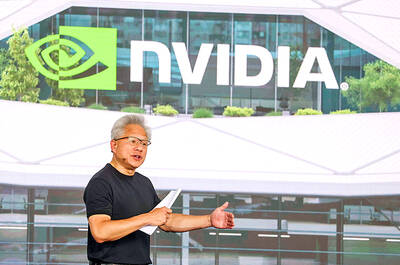
‘BOOMING’: ’ The number of partners we have here is incredible. You can see from their stock prices. They’re doing so well, they’re so happy,’ Jensen Huang said Nvidia Corp’s spending in Taiwan has ballooned to about US$150 billion a year, 10 times the US$10 billion to US$15 billion the company spent five years ago, Nvidia chief executive officer Jensen Huang (黃仁勳) said yesterday, suggesting Taiwan’s strategic importance in the global artificial intelligence (AI) supply chain. “Taiwan is the epicenter of the AI revolution. This is where the chips come, packaging comes. This is where the systems are made. This is where AI supercomputers were created,” Huang said at a meeting for the company’s employees in Beitou-Shilin Technology Park (北投士林科技園區) in Taipei, the planned site of Nvidia’s Taipei headquarters. “Taiwan
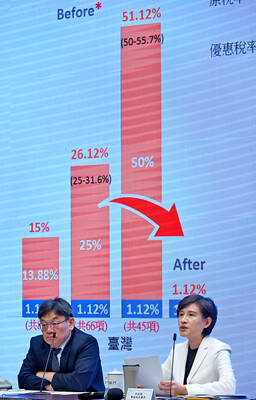
GREATER REACH? Auto parts and wood products would face tariffs of up to 15%, matching those targeting the EU, Japan and South Korea, Vice Premier said The US has announced that preferential tariff treatment for Taiwan’s non-semiconductor Section 232 goods would take effect retroactively from May 1, the Executive Yuan said yesterday. The US government yesterday posted a notice on the Federal Register’s public inspection Web site previewing tariff concessions for Taiwan under a memorandum of understanding (MOU) on Taiwan-US investment after two months of negotiations. The MOU signed on Jan. 15 stipulated three major preferential tariff arrangements: a 15 percent “reciprocal” tariff rate for Taiwan without stacking most-favored nation (MFN) rates; preferential Section 232 treatment for semiconductors and related products; and preferential Section 232 treatment for non-semiconductor


 RSS
RSS