


Israel appeared to be expanding its air campaign against Tehran five days after its surprise attack on Iran’s military and nuclear program, as US President Donald Trump posted an ominous message warning residents of the capital to evacuate.
“IRAN CAN NOT HAVE A NUCLEAR WEAPON,” Trump wrote on Monday night before returning to Washington early from a G7 summit in Canada.
“Everyone should immediately evacuate Tehran,” he added.
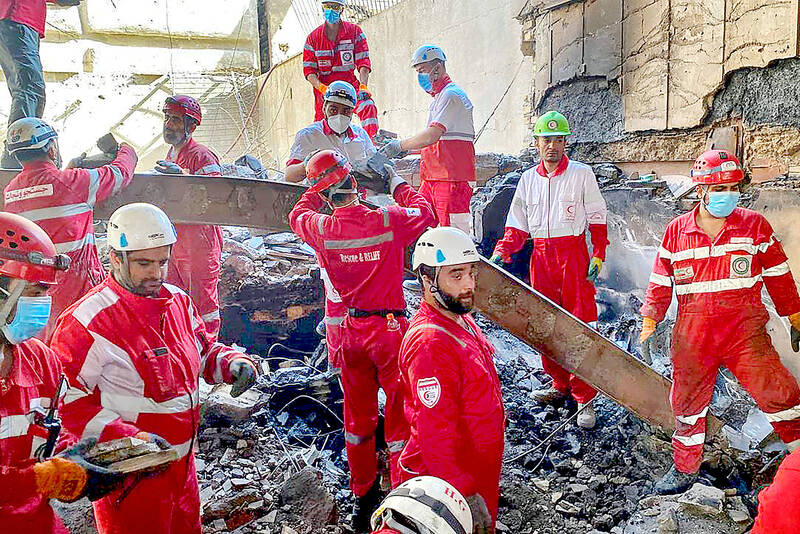
Photo: AFP / Iranian Red Crescent
Trump later denied he had rushed back to work on a ceasefire, telling reporters on Air Force One during the flight back to Washington: “I’m not looking at a ceasefire. We’re looking at better than a ceasefire.”
Asked why he had urged for the evacuation of Tehran, he said: “I just want people to be safe.”
Earlier, the Israeli military had called for the estimated 330,000 residents of a neighborhood in downtown Tehran to evacuate. Tehran is one of the largest cities in the Middle East, with about 10 million people, roughly equivalent to the entire population of Israel. People have been fleeing since the hostilities began.
Israel says its sweeping assault on Iran’s top military leaders, nuclear scientists, uranium enrichment sites and ballistic missile program is necessary to prevent its longtime adversary from getting any closer to building an atomic weapon. The strikes have killed at least 224 people in Iran and wounded 1,277 since Friday.
Iran has retaliated by launching more than 370 missiles and hundreds of drones at Israel. So far, 24 people have been killed in Israel and more than 500 wounded. The Israeli military said a new barrage of missiles was launched yesterday, and explosions could be heard in northern Israel.
Downtown Tehran appeared to be emptying out early yesterday, with many shops closed. On the roads out of Tehran to the west, traffic stood bumper to bumper. Many appeared to be heading to the Caspian Sea area. Long lines also could be seen at gas stations in Tehran, with printed placards and boards calling for a “severe” response to Israel visible across the city.
Authorities canceled leave for doctors and nurses as the attacks continued, but insisted that everything was under control and did not offer any guidance for the public on what to do.
Meanwhile, the Israeli military claimed to have killed someone it described as Iran’s top general in a strike on Tehran. Iran did not immediately comment on the reported killing of General Ali Shadmani, who had just been named as the head of the Khatam al-Anbiya Central Headquarters, part of the paramilitary Revolutionary Guard.
Iran has named other generals to replace the top leaders of the Revolutionary Guard and the regular armed forces after they were killed in earlier strikes.
Before leaving the summit in Canada, Trump joined the other leaders in a joint statement saying Iran “can never have a nuclear weapon” and calling for a “de-escalation of hostilities in the Middle East, including a ceasefire in Gaza.”
French President Emmanuel Macron told reporters that discussions were under way on a ceasefire between Israel and Iran, but Trump appeared to shoot that down in his comments on social media.
Macron “mistakenly said that I left the G7 Summit, in Canada, to go back to D.C. to work on a ‘cease fire’ between Israel and Iran,” Trump wrote. “Wrong! He has no idea why I am now on my way to Washington, but it certainly has nothing to do with a Cease Fire. Much bigger than that.”
Meanwhile, US Secretary of Defense Pete Hegseth headed to the White House Situation Room to meet with the president and his national security team.
Hegseth did not provide details on what prompted the meeting, but said on Fox News late on Monday that the movements were to “ensure that our people are safe.”
Trump said he was not ready to give up on diplomatic talks, and could send US Vice President J.D. Vance and US Special Envoy to the Middle East Steve Witkoff to meet with the Iranians.
“I may,” he said. “It depends on what happens when I get back.”
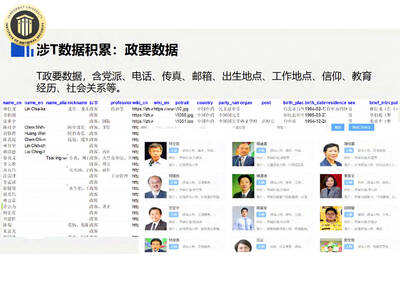
NETWORK-MAPPING PROJECT: The database contains 170 detailed files of Taiwanese politicians and about 23 million records of household registration data in Taiwan China has developed a network-mapping project targeting political figures and parties in Taiwan to monitor public opinion during elections and to craft tailored influence campaigns aimed at dividing Taiwanese society, according to documents leaked by Chinese technology firm GoLaxy (中科天璣). The documents, collected by Taipei-based Doublethink Lab, showed a database was specifically created to gather detailed information on Taiwanese political figures, including their political affiliations, job histories, birthplaces, residences, education, religion and a brief biography about them. Several notable Taiwanese politicians are in the database, including President William Lai (賴清德), former president Tsai Ing-wen (蔡英文), Minister of Foreign Affairs Lin Chia-lung (林佳龍),

RECOGNITION: Former Fijian prime minister Mahendra Chaudhry said that Taiwan’s New Southbound Policy serves as a stabilizing force in the Indo-Pacific region Taiwan can lead the unification of the Chinese people, Nobel Peace Prize laureate and former Polish president Lech Walesa said in Taipei yesterday, adding that as the world order is changing, peaceful discussion would find good solutions, and that the use of force and coercion would always fail. Walesa made the remarks during his keynote address at a luncheon of the Yushan Forum in Taipei, titled “Indo-Pacific Partnership Prospects: Taiwan’s Values, Technology and Resilience,” organized by the Taiwan-Asia Exchange Foundation with the Ministry of Foreign Affairs. Walesa said that he had been at the forefront of a big peaceful revolution and “if

KEY INDUSTRY: The vice premier discussed a plan to create a non-red drone supply chain by next year, which has been allocated a budget of more than NT$7.2 billion The government has budgeted NT$44.2 billion (US$1.38 billion) to cultivate Taiwan’s uncrewed aerial vehicle (UAV) industry over the next five years, which would make the nation a major player in the industry’s democratic supply chain in the Asia-Pacific region, Premier Cho Jung-tai (卓榮泰) said yesterday. Cho made the remarks during a visit to the facilities of Cub Elecparts Inc (為升電裝). Democratic Progressive Party (DPP) Legislator Chen Su-yueh (陳素月) and Chinese Nationalist Party (KMT) Legislator Hsieh Yi-fong (謝依鳳) also participated in the trip. Cub Elecparts has transitioned from the automotive industry to the defense industry, which is the top priority among the nation’s
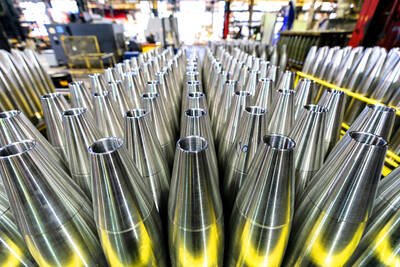
UPGRADED MISSILE: The Chungshan Institute of Science and Technology is reportedly to conduct a live-fire test of the Hsiung Feng III anti-ship missile on Thursday next week The US Army is planning to build new facilities to boost explosives production and strengthen its supply chain, a move aimed at addressing munitions shortages and supporting obligations to partners including Taiwan, Ukraine and Israel, Defense News reported. The army has issued a sources sought notice for a proposed Center of Excellence at the Blue Grass Army Depot in Kentucky, the report said. The facility would serve as a hub within the US industrial base for the production of key military explosives, including research department explosives (RDX) and high melting explosives (HMX), while also supporting research and development of next-generation materials. The proposed


 RSS
RSS