


Nationalist historian Karol Nawrocki won Poland’s presidential election, official results showed yesterday, in a major blow for the pro-EU government.
The 42-year-old fan of US President Donald Trump scored 50.9 percent of the vote in Sunday’s runoff in the highly polarized NATO and EU nation.
His 53-year-old rival, Rafal Trzaskowski, Warsaw’s pro-EU mayor and an ally of the centrist government led by Polish Prime Minister Donald Tusk, won 49.1 percent.
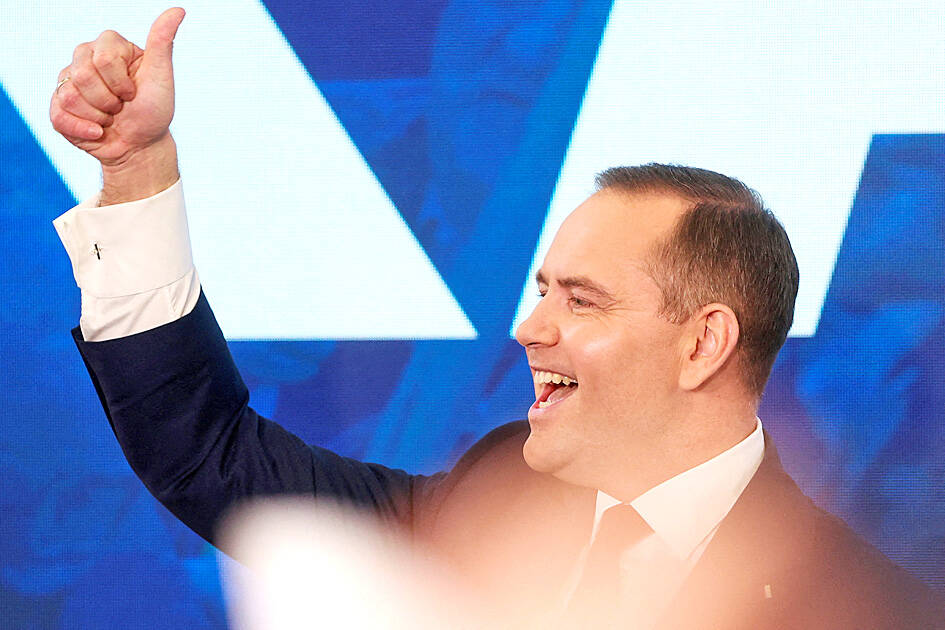
Photo: Reuters
Trzaskowski took hours to concede defeat.
“Congratulations to Karol Nawrocki... This win is an obligation, especially in such difficult times. Especially with a close result. Don’t forget that,” he said on X.
Nawrocki’s win would block the government’s progressive agenda for abortion and LGBTQ rights, and could revive tensions with Brussels over rule-of-law issues.
“Nawrocki’s presidency will be a rough ride for the Tusk government,” analyst Piotr Buras said in a statement.
He said the election result was a “yellow card” for the government and could lead to “early parliamentary elections, maybe not this year, but next.”
Nawrocki’s victory could undermine strong ties with Ukraine, as he is critical of Kyiv’s EU and NATO accession plans and wants to cut benefits for Ukrainian refugees.
Ukrainian President Volodymyr Zelenskiy yesterday said that he looked forward to “continued fruitful cooperation with Poland and with President Nawrocki personally.”
Polish presidents have some influence over foreign and defense policy, and wield veto power over legislation.
Reforms planned by Tusk, a former European Council president who came to power in 2023, have been held up by a deadlock with the current president, who endorsed Nawrocki.
Many Nawrocki supporters say they want stricter curbs on immigration, and advocate conservative social values and more sovereignty for the country within the EU.
European Commission President Ursula von der Leyen said she was “confident” that “very good cooperation” would continue with Warsaw.
Hungarian Prime Minister Viktor Orban hailed his fellow nationalist’s “fantastic victory,” writing on X: “We are looking forward to working with you.”
French far-right leader Marine Le Pen also welcomed the “good news,” while Italian Prime Minister Giorgia Meloni offered “best wishes” to Nawrocki and said their countries “share common values.”
Nawrocki had visited the White House during his campaign and said Trump told him: “You will win.”
Outgoing Polish President Andrzej Duda, a conservative who has served the two-term limit, congratulated Nawrocki and thanked Poles for the voter turnout of 72 percent.
Far-right leader Slawomir Mentzen, who came third in the first round of the election and played kingmaker in the runoff, also sent his congratulations.
He said his Confederation party’s voters expected Nawrocki to “not put Ukraine’s interests on par with ours.”

PROVOCATIVE: Chinese Deputy Ambassador to the UN Sun Lei accused Japan of sending military vessels to deliberately provoke tensions in the Taiwan Strait China denounced remarks by Japan and the EU about the South China Sea at a UN Security Council meeting on Monday, and accused Tokyo of provocative behavior in the Taiwan Strait and planning military expansion. Ayano Kunimitsu, a Japanese vice foreign minister, told the Council meeting on maritime security that Tokyo was seriously concerned about the situation in the East China and South China seas, and reiterated Japan’s opposition to any attempt to change the “status quo” by force, and obstruction of freedom of navigation and overflight. Stavros Lambrinidis, head of the EU delegation to the UN, also highlighted South China Sea

The final batch of 28 M1A2T Abrams tanks purchased from the US arrived at Taipei Port last night and were transported to the Armor Training Command in Hsinchu County’s Hukou Township (湖口), completing the military’s multi-year procurement of 108 of the tanks. Starting at 12:10am today, reporters observed more than a dozen civilian flatbed trailers departing from Taipei Port, each carrying an M1A2T tank covered with black waterproof tarps. Escorted by military vehicles, the convoy traveled via the West Coast Expressway to the Armor Training Command, with police implementing traffic control. The army operates about 1,000 tanks, including CM-11 Brave Tiger
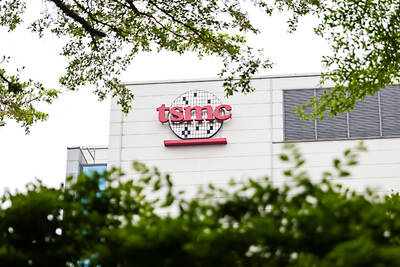
Taiwan Semiconductor Manufacturing Co (TSMC, 台積電), the world’s largest contract chipmaker, said it expects its 2-nanometer (2nm) chip capacity to grow at a compound annual rate of 70 percent from this year to 2028. The projection comes as five fabs begin volume production of 2-nanometer chips this year — two in Hsinchu and three in Kaohsiung — TSMC senior vice president and deputy cochief operating officer Cliff Hou (侯永清) said at the company’s annual technology symposium in Silicon Valley, California, last week. Output in the first year of 2-nanometer production, which began in the fourth quarter of last year, is expected to

Taiwan’s drone exports surged past US$100 million in the first quarter, exceeding last year’s full-year total, with the Czech Republic emerging as the largest buyer, the Ministry of Economic Affairs said. Exports of complete drones reached US$115.85 million in the period, about 1.2 times the total recorded for all of last year, the ministry said in a report. Exports to the Czech Republic accounted for about US$100 million, far outpacing other markets. Poland, last year’s top destination, recorded about US$11.75 million in the first quarter. Taiwan’s drone exports have expanded rapidly in the past few years, with last year’s total


 RSS
RSS