


The South Korean Constitutional Court yesterday unanimously removed Yoon Suk-yeol from office, ending his presidency and setting up a new election, four months after he issued an ill-fated declaration of martial law.
The verdict capped a dramatic fall for Yoon, a former star prosecutor who became president in 2022, just a year after he entered politics.
In a televised hearing, the court’s acting chief Moon Hyung-bae said that the eight-member bench found Yoon’s actions were unconstitutional and had a grave impact.
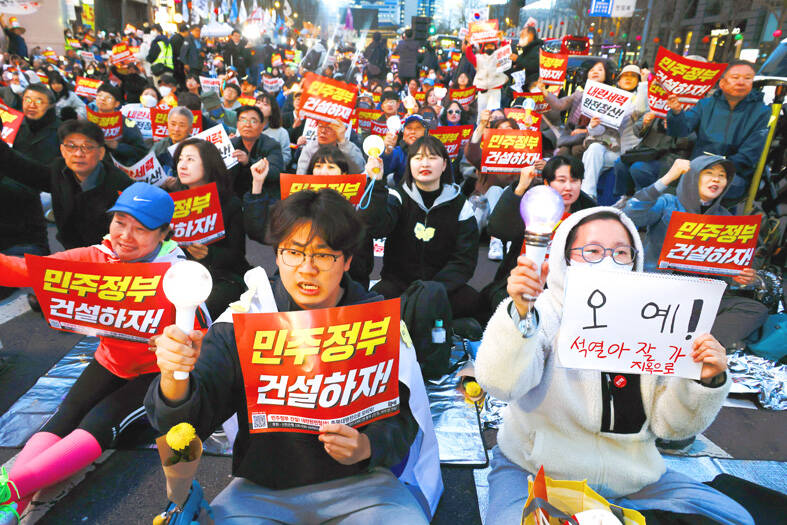
Photo: EPA-EFE
“By declaring martial law in breach of the constitution and other laws, the defendant brought back the history of abusing state emergency decrees, shocked the people and caused confusion in the society, economy, politics, diplomacy and all other areas,” Moon said. “Given the negative impact on constitutional order caused by the defendant’s violation of laws and its ripple effects are grave, we find that the benefits of upholding the constitution by dismissing the defendant far outweigh the national losses from the dismissal of the president.”
Protesters near the court erupted into tears and danced when the verdict was announced in the late morning.
Two women wept as they hugged and an old man near them leaped to his feet and screamed with joy.
The crowd later began marching through Seoul.
Outside Yoon’s official residence, many supporters cried, screamed and yelled at journalists when they saw the news of the verdict on a giant TV screen.
However, they quickly cooled down after an organizer pleaded for calm.
“We will absolutely not be shaken,” a protest leader said on stage. “Anyone who accepts this ruling and prepares for an early presidential election is our enemy.”
An election is likely within two months for a new president.
Yoon said in a statement issued via his defense team that he deeply regrets failing to live up to the public’s expectations.
There have been fears he would incite efforts to resist his removal, as he earlier vowed to fight to the end.
He added that he would pray for the country and its people.
“It has been the greatest honor of my life to serve our nation,” Yoon said.
Yoon’s ruling People Power Party said it would accept the decision, but one of Yoon’s lawyers, Yoon Kap-keun, called the ruling “completely incomprehensible” and a “pure political decision.”
South Korean Prime Minister Han Duck-soo, the country’s acting leader, vowed to maintain public safety and order and ensure a smooth transition to the next administration.
Surveys show that Lee Jae-myung, leader of the main liberal opposition Democratic Party, is the early favorite to win the upcoming presidential by-election, although he faces several trials for corruption and other charges.
Lee welcomed the ruling and credited the South Korean people for “protecting our democratic republic.”
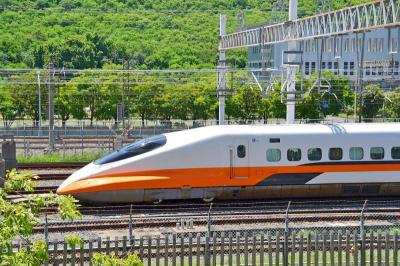
A signaling system malfunction disrupted high-speed rail (HSR) services beginning at 8am today, with trains temporarily reduced to three northbound and three southbound trains per hour as authorities conduct inspections. The malfunction occurred on a section of track in Miaoli County during pre-operation checks early this morning, forcing northbound and southbound trains to use a single track, the HSR operator said. The regular schedule has been replaced with three hourly trains offering only nonreserved seating in each direction, stopping at every station, it said, adding that business class cars would still have reserved seating. Departures from terminal stations are scheduled at the top

Taiwan is still in the process of assessing the possibility of recruiting workers from Eswatini, the Ministry of Foreign Affairs said yesterday, adding that its goal is to help Eswatini upgrade its vocational training centers. If there are plans to recruit workers from Eswatini, safeguarding national security, protecting public health and ensuring the employment rights of Taiwanese would be prerequisites, Department of West Asian and African Affairs Director-General Yen Chia-liang (顏嘉良) told a news conference. Key considerations would also include filling labor shortages in specific industries, and fostering bilateral professional and technical exchanges, he said. Yen was asked about the progress of labor

VERBOSE VESSELS: A CGA cutter and a China Coast Guard exchanged verbal barbs for more than a day in Taiwanese-controlled waters before the Chinese vessel left The Taiwanese and Chinese coast guards had a standoff near the strategically located Pratas Islands (Dongsha Islands, 東沙群島) in the north of the South China Sea, the Coast Guard Administration (CGA) said yesterday. The two sides engaged in intense radio exchanges over sovereignty claims during the 33-hour standoff. China Coast Guard vessel 3501 eventually left the restricted waters, 26.6 nautical miles (49.2km) west of the Pratas Islands, at 5pm yesterday, the CGA said. Lying approximately between southern Taiwan and Hong Kong, the Taiwan-controlled Pratas are seen by some security experts as vulnerable to Chinese attack due to their distance — more than

A US uncrewed surface vessel (USV) encountered multiple Chinese warships during an autonomous transit of the Taiwan Strait, US defense company Seasats said in a statement on Wednesday. Seasats announced that a Lightfish USV had completed the first autonomous transit of the Taiwan Strait. Over five days, the USV traversed the entire length of the Strait while constantly monitoring surface vessel traffic, the company said. The Lightfish encountered multiple Chinese warships, one of which was a Chinese People’s Liberation Army Navy (PLAN) Type 056 corvette, it said. The Chinese vessels were operating “well within Taiwan’s exclusive economic zone without transmitting their identity via the


 RSS
RSS