


President William Lai (賴清德) yesterday reaffirmed the nation’s commitment to funding indigenous shipbuilding and aircraft programs to lay the foundations for developing local defense industries, adding that they are key to strengthening the nation’s self-defense capabilities.
Lai made the remarks while presiding over a keel-laying ceremony in Kaohsiung for the first of six domestically built cruisers.
The cruisers were ordered by the Coast Guard Administration (CGA) under former president Tsai Ing-wen’s (蔡英文) 2021 initiative to combat illegal fishing, and cost a total of NT$12.9 billion (US$390 million).
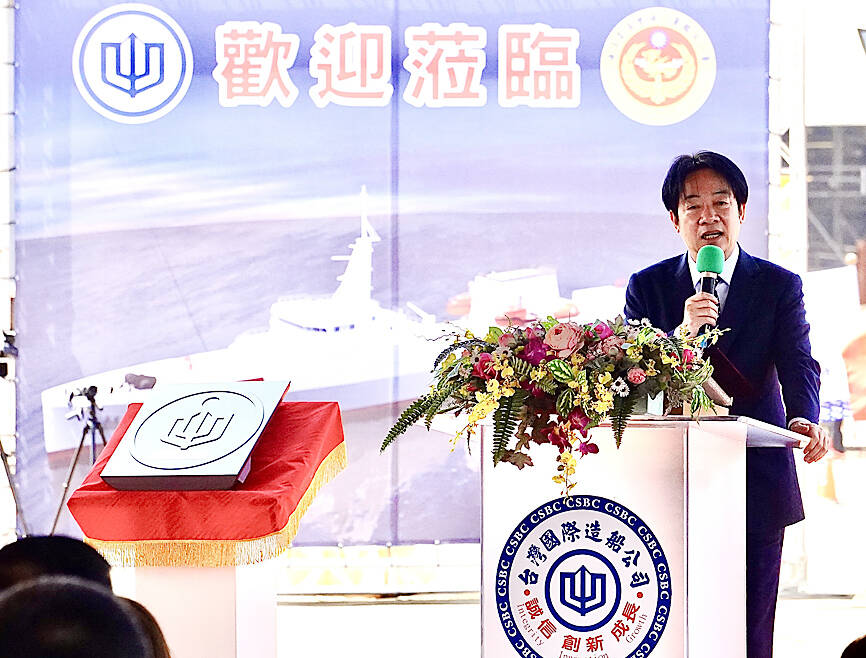
Photo: CNA
The plan aims to build six long-range vessels capable of patrolling international waters, extending Taiwan’s maritime reach and reinforcing the government’s commitment to safeguarding the nation’s territorial waters, Lai said.
The ship under construction would be equipped with a diesel-electric propulsion system powerful enough to circle Taiwan up to 30 times per deployment, he said, adding that the extended range would enable the vessels to operate further afield.
The ship’s rear deck can store supplies, a coastal multipurpose boat, an attack boat, or a drone, depending on the ship’s mission, he said.
The vessel would bolster the coast guard’s maritime patrol capabilities, while also serving as a supply ship for outlying islands, or as a marine rescue ship, Lai said.
The nation’s coast guard personnel are hard at work defending our maritime borders against the Chinese Communist Party’s incessant harassment via “gray zone” tactics, Lai said, urging coast guard personnel to keep themselves safe when on duty.
Lai called on the Ocean Affairs Council, the CGA and CSBC Taiwan (台灣國際造船) — the company building the vessels — to work hard to stay on schedule, while urging legislators across party lines to support relevant budgets to help safeguard Taiwan’s democratic way of life.
CSBC Taiwan chairman Huang Cheng-hung (黃正弘) said construction of the first vessel began last year and it is expected to be launched by October, after which it would undergo sea trials and testing, with delivery to the CGA scheduled for Aug. 11 next year.
The ship, measuring 100m in length, 16.5m at its widest point and 8m in depth, is expected to displace more than 3,000 tonnes without equipment and up to 8,000 tonnes when fully outfitted, Huang said
It would be armed with water cannons and high-pressure water guns, and feature the XTR-102 20mm remote weapon system developed by the Chungshan Institute of Science and Technology, he added.
Designed for versatility, the ship would be capable of towing the CGA’s 4,000-tonne Chiayi-class patrol vessels and carrying modular cargo crates, broadening its potential operational roles, Huang said.

A signaling system malfunction disrupted high-speed rail (HSR) services beginning at 8am today, with trains temporarily reduced to three northbound and three southbound trains per hour as authorities conduct inspections. The malfunction occurred on a section of track in Miaoli County during pre-operation checks early this morning, forcing northbound and southbound trains to use a single track, the HSR operator said. The regular schedule has been replaced with three hourly trains offering only nonreserved seating in each direction, stopping at every station, it said, adding that business class cars would still have reserved seating. Departures from terminal stations are scheduled at the top

Taiwan is still in the process of assessing the possibility of recruiting workers from Eswatini, the Ministry of Foreign Affairs said yesterday, adding that its goal is to help Eswatini upgrade its vocational training centers. If there are plans to recruit workers from Eswatini, safeguarding national security, protecting public health and ensuring the employment rights of Taiwanese would be prerequisites, Department of West Asian and African Affairs Director-General Yen Chia-liang (顏嘉良) told a news conference. Key considerations would also include filling labor shortages in specific industries, and fostering bilateral professional and technical exchanges, he said. Yen was asked about the progress of labor

A US uncrewed surface vessel (USV) encountered multiple Chinese warships during an autonomous transit of the Taiwan Strait, US defense company Seasats said in a statement on Wednesday. Seasats announced that a Lightfish USV had completed the first autonomous transit of the Taiwan Strait. Over five days, the USV traversed the entire length of the Strait while constantly monitoring surface vessel traffic, the company said. The Lightfish encountered multiple Chinese warships, one of which was a Chinese People’s Liberation Army Navy (PLAN) Type 056 corvette, it said. The Chinese vessels were operating “well within Taiwan’s exclusive economic zone without transmitting their identity via the

VERBOSE VESSELS: A CGA cutter and a China Coast Guard exchanged verbal barbs for more than a day in Taiwanese-controlled waters before the Chinese vessel left The Taiwanese and Chinese coast guards had a standoff near the strategically located Pratas Islands (Dongsha Islands, 東沙群島) in the north of the South China Sea, the Coast Guard Administration (CGA) said yesterday. The two sides engaged in intense radio exchanges over sovereignty claims during the 33-hour standoff. China Coast Guard vessel 3501 eventually left the restricted waters, 26.6 nautical miles (49.2km) west of the Pratas Islands, at 5pm yesterday, the CGA said. Lying approximately between southern Taiwan and Hong Kong, the Taiwan-controlled Pratas are seen by some security experts as vulnerable to Chinese attack due to their distance — more than


 RSS
RSS