


President William Lai (賴清德) yesterday pledged to double down on efforts to disclose political archives on past wrongdoing by the state as he apologized for the 228 Incident and the Lin family murders on behalf of the country.
Yesterday marked the 78th anniversary of the 228 Incident, also known as the 228 Massacre, a crackdown launched by the then-Chinese Nationalist Party (KMT) regime against civilian demonstrations following an incident in Taipei on Feb. 27, 1947.
The ensuing massacre and imposition of martial law marked the beginning of the decades-long White Terror era, during which thousands of Taiwanese were arrested, imprisoned and executed. Historians estimate as many as 30,000 people were killed.
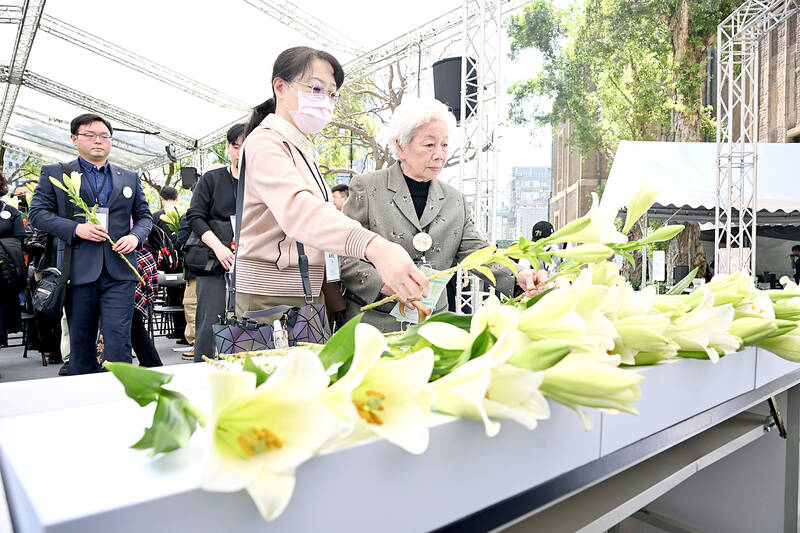
Photo: Lo Pei-te, Taipei Times
The Lin family murder case refers to the killing of democracy campaigner Lin I-hsiung’s (林義雄) 60-year-old mother and seven-year-old twin daughters on Feb. 28, 1980. The murderer has never been apprehended. However, Lin and many Taiwanese believe the killings were politically motivated.
Lai in his address at the National 228 Memorial Museum in Taipei yesterday commemorating the 228 Incident said it was his first time attending the event in his capacity as president and that he would again apologize for the 228 Massacre on behalf of the government, as well as pay tribute to every martyr who was courageous enough to rise up against the authoritarian regime.
He also expressed condolences to people who died in the Incident and sent regards to the survivors.
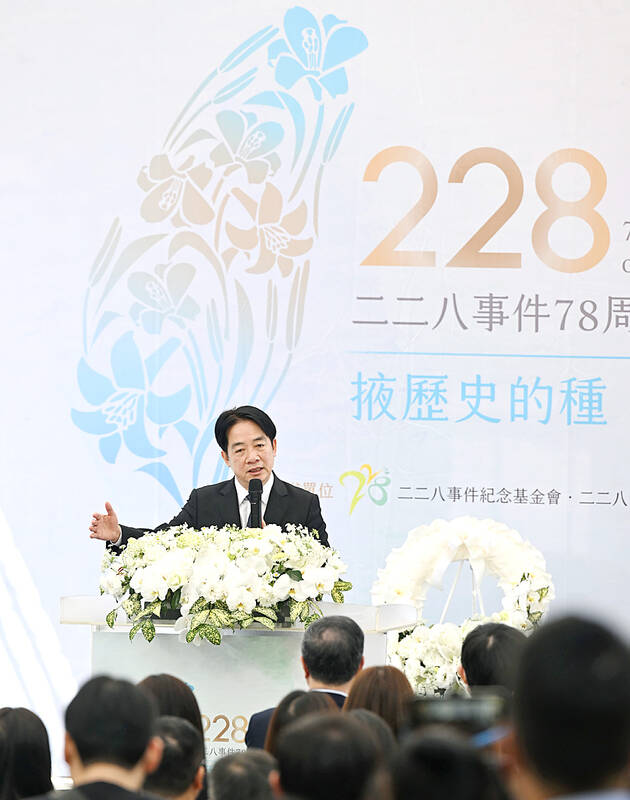
Photo: Lo Pei-te, Taipei Times
“Greetings to all family members of the affected individuals. My heart stays with you,” Lai said.
Speaking of the 228 Incident, Lai said the tragedy was not triggered by ethnic conflicts, nor do those who commemorate the event 78 years later seek to provoke them.
Any attempt to reduce the Incident and its memorials to such a narrative is “irresponsible” and “unacceptable,” he said.
Family members of the martyrs would not be fully consoled and reconciliation would not be truly achieved in society should the historical truths remain buried and unsolved, Lai said.
“Uncovering historical truths is not easy,” he said, citing the case of the Lin family murder.
“Recent studies and examinations showed that the then-government must have been involved in the murders and that intelligence agencies did interfere with the investigation into the case by damaging critical evidence,” he said, adding that the government cannot escape the blame for the murders.
“Today, I apologize to the Lin family on behalf of the government,” he said.
The government would step up declassifying political documents to unveil 228 historical truths, Lai said.
Lai said he has instructed the National Security Bureau to examine the nearly 1 million pieces of data it possesses to manually uncover the political documents.
The examination process would be completed by May with the documents handed to the National Archives Administration in June for review, publication and further investigation, he added.
He said the government would also implement transitional justice by preserving more historical sites of transitional justice significance, such as the Gikong Presbyterian Church in Taipei — the site of the Lin family murders.
The commemoration of the 228 Incident would continue to be held annually, he added.
“The anniversary ceremony of the 228 Incident is held not only to commemorate the martyrs, console their family and relieve the pain, but also to remember history to avoid repeating it,” Lai said.
Additional reporting by CNA
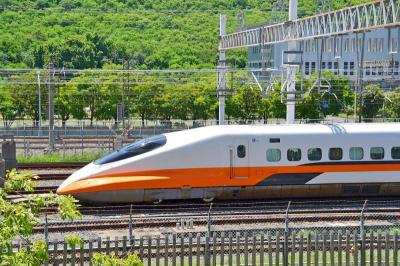
A signaling system malfunction disrupted high-speed rail (HSR) services beginning at 8am today, with trains temporarily reduced to three northbound and three southbound trains per hour as authorities conduct inspections. The malfunction occurred on a section of track in Miaoli County during pre-operation checks early this morning, forcing northbound and southbound trains to use a single track, the HSR operator said. The regular schedule has been replaced with three hourly trains offering only nonreserved seating in each direction, stopping at every station, it said, adding that business class cars would still have reserved seating. Departures from terminal stations are scheduled at the top
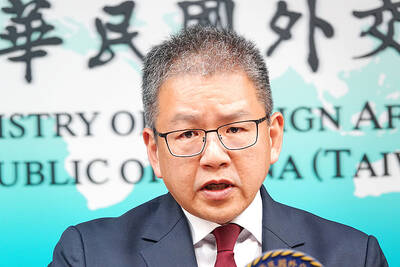
Taiwan is still in the process of assessing the possibility of recruiting workers from Eswatini, the Ministry of Foreign Affairs said yesterday, adding that its goal is to help Eswatini upgrade its vocational training centers. If there are plans to recruit workers from Eswatini, safeguarding national security, protecting public health and ensuring the employment rights of Taiwanese would be prerequisites, Department of West Asian and African Affairs Director-General Yen Chia-liang (顏嘉良) told a news conference. Key considerations would also include filling labor shortages in specific industries, and fostering bilateral professional and technical exchanges, he said. Yen was asked about the progress of labor
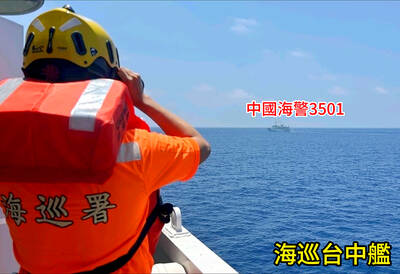
VERBOSE VESSELS: A CGA cutter and a China Coast Guard exchanged verbal barbs for more than a day in Taiwanese-controlled waters before the Chinese vessel left The Taiwanese and Chinese coast guards had a standoff near the strategically located Pratas Islands (Dongsha Islands, 東沙群島) in the north of the South China Sea, the Coast Guard Administration (CGA) said yesterday. The two sides engaged in intense radio exchanges over sovereignty claims during the 33-hour standoff. China Coast Guard vessel 3501 eventually left the restricted waters, 26.6 nautical miles (49.2km) west of the Pratas Islands, at 5pm yesterday, the CGA said. Lying approximately between southern Taiwan and Hong Kong, the Taiwan-controlled Pratas are seen by some security experts as vulnerable to Chinese attack due to their distance — more than

A US uncrewed surface vessel (USV) encountered multiple Chinese warships during an autonomous transit of the Taiwan Strait, US defense company Seasats said in a statement on Wednesday. Seasats announced that a Lightfish USV had completed the first autonomous transit of the Taiwan Strait. Over five days, the USV traversed the entire length of the Strait while constantly monitoring surface vessel traffic, the company said. The Lightfish encountered multiple Chinese warships, one of which was a Chinese People’s Liberation Army Navy (PLAN) Type 056 corvette, it said. The Chinese vessels were operating “well within Taiwan’s exclusive economic zone without transmitting their identity via the


 RSS
RSS