


Taiwanese should not forget history, must protect Taiwan’s freedom and sovereignty, be the masters of their own country and never allow something like the 228 Incident to happen again, President William Lai (賴清德) said yesterday.
Lai made the remarks at a meeting with members of the Overseas 2-28 Survivors Homecoming Group at the Presidential Office in Taipei.
Lai said he would like to express on behalf of the public a sincere welcome to members returning to Taiwan to attend the government’s 228 Incident memorial ceremony this year.
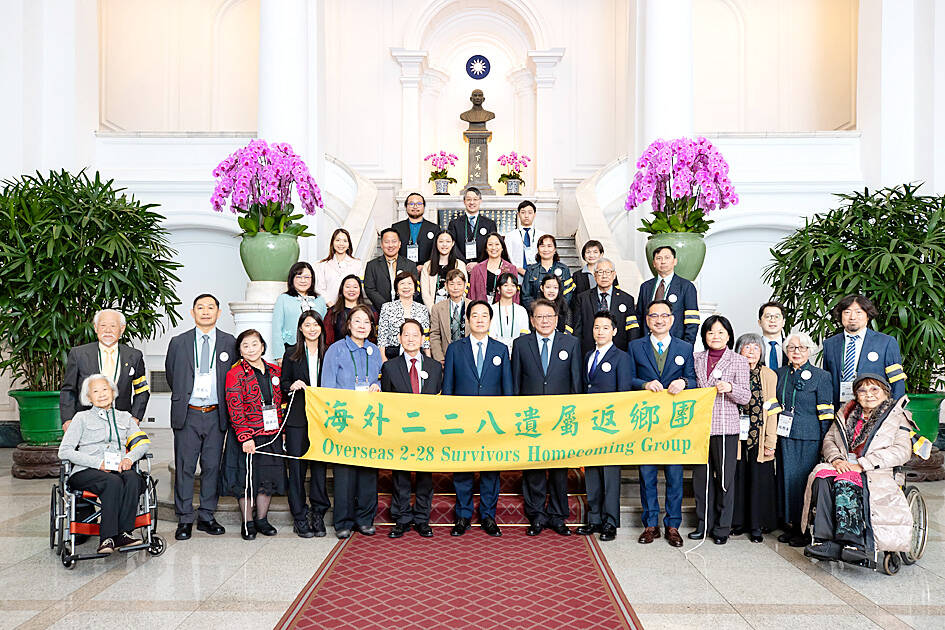
Photo: CNA
It has been 78 years since the incident, and many survivors have been working for the rehabilitation of the victims of the 228 Incident and speaking up for Taiwan, he said, adding that he is very grateful for their efforts and, with a solemn heart, he joins them in commemorating the victims.
Taiwan suffered immensely from the 228 Incident and the generational trauma has been passed down to today, he said.
Many social elites of that time had “disappeared,” including Wang Yu-lin (王育霖), who was the first Taiwanese prosecutor during the Japanese colonial period; Shi Jiang-nan (施江南), who was the youngest person to receive a doctorate in medicine at the time; and dentist Yang A-shou (楊阿壽), Lai said.
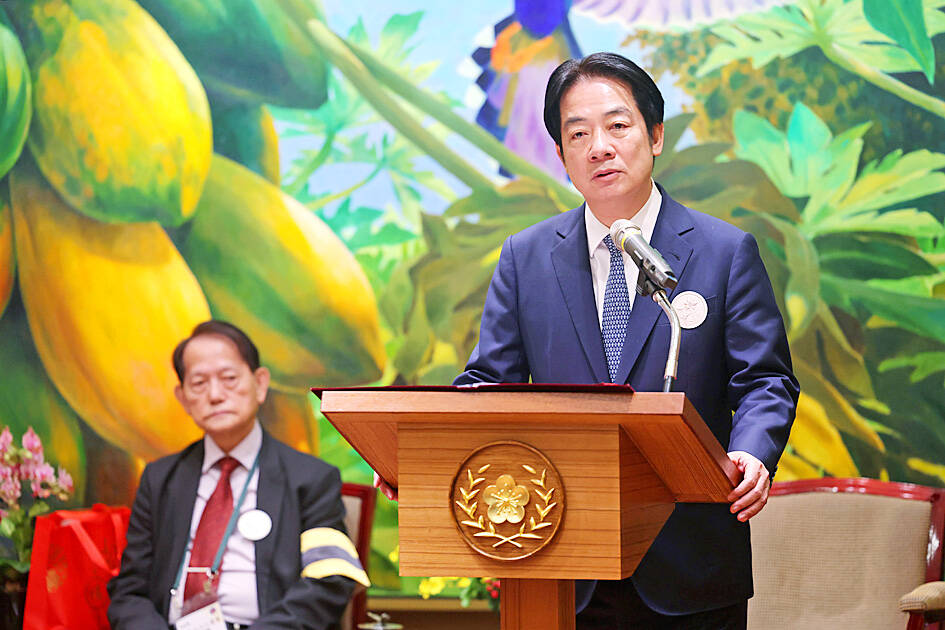
Photo: CNA
They also included Taiwanese artist Chen Cheng-po (陳澄波), who was a pioneer in the development of modern art in Taiwan; Wang Ping-shui (王平水), a successful entrepreneur and district representative; lawyer Lin Lien-tsung (林連宗); and teacher Lin Kuang-chien (林光前), among other outstanding and important people, he said.
The death of these social elites had caused an incalculable loss to Taiwanese society, so he again apologizes to everyone on behalf of the government, the president said.
He ensured that the government would continue to carry out remedial measures, including admitting culpability, apologizing, compensating, seeking the truth, restitution of reputation, and establishing memorial halls and monuments.
It is the efforts of survivors, particularly Kenneth Wang (王克雄), who has in the past several decades persistently urged society to face this scar in history, that have led to the transitional justice accomplishments we have today, Lai said.
The pursuit of transitional justice is for “seeking the truth,” “compensation,” “serving justice” and “guaranteeing that it would never happen again,” he said.
It is also for our children and grandchildren to understand that the democracy they now enjoy did not come on a silver platter, but was earned by their ancestors, who fought for it with their blood, tears and lives, Lai said.
“Up to now, it is still an unfinished task,” he said. “We must continue to seek justice and truth, and declassify political archives. We must not forget history, must understand the difference between democracy and authoritarianism, and protect our freedoms.”
Lai said the government would continue to seek solidarity among the public, protect people’s safety and never allow something like the 228 Incident to happen again.
Taiwan’s sovereignty must be protected, he said, adding that the public must insist that the Republic of China (ROC) and the People’s Republic of China are not subordinate to each other, Taiwan’s sovereignty is inviolable and cannot be annexed, and that the future of the ROCs is to be determined by the 23 million people of Taiwan.
“We must also let Taiwanese be the masters of their own country — every master of the country is entitled to live on this land safely and freely,” Lai said.
“I hope the 23 million people [of Taiwan] can come together to protect Taiwan, and the democratic and free constitutional system with human rights, allowing Taiwan to continue developing prosperously so that their descendants can live with lasting stability and peace on this land,” he said.

A signaling system malfunction disrupted high-speed rail (HSR) services beginning at 8am today, with trains temporarily reduced to three northbound and three southbound trains per hour as authorities conduct inspections. The malfunction occurred on a section of track in Miaoli County during pre-operation checks early this morning, forcing northbound and southbound trains to use a single track, the HSR operator said. The regular schedule has been replaced with three hourly trains offering only nonreserved seating in each direction, stopping at every station, it said, adding that business class cars would still have reserved seating. Departures from terminal stations are scheduled at the top

Taiwan is still in the process of assessing the possibility of recruiting workers from Eswatini, the Ministry of Foreign Affairs said yesterday, adding that its goal is to help Eswatini upgrade its vocational training centers. If there are plans to recruit workers from Eswatini, safeguarding national security, protecting public health and ensuring the employment rights of Taiwanese would be prerequisites, Department of West Asian and African Affairs Director-General Yen Chia-liang (顏嘉良) told a news conference. Key considerations would also include filling labor shortages in specific industries, and fostering bilateral professional and technical exchanges, he said. Yen was asked about the progress of labor

VERBOSE VESSELS: A CGA cutter and a China Coast Guard exchanged verbal barbs for more than a day in Taiwanese-controlled waters before the Chinese vessel left The Taiwanese and Chinese coast guards had a standoff near the strategically located Pratas Islands (Dongsha Islands, 東沙群島) in the north of the South China Sea, the Coast Guard Administration (CGA) said yesterday. The two sides engaged in intense radio exchanges over sovereignty claims during the 33-hour standoff. China Coast Guard vessel 3501 eventually left the restricted waters, 26.6 nautical miles (49.2km) west of the Pratas Islands, at 5pm yesterday, the CGA said. Lying approximately between southern Taiwan and Hong Kong, the Taiwan-controlled Pratas are seen by some security experts as vulnerable to Chinese attack due to their distance — more than

A US uncrewed surface vessel (USV) encountered multiple Chinese warships during an autonomous transit of the Taiwan Strait, US defense company Seasats said in a statement on Wednesday. Seasats announced that a Lightfish USV had completed the first autonomous transit of the Taiwan Strait. Over five days, the USV traversed the entire length of the Strait while constantly monitoring surface vessel traffic, the company said. The Lightfish encountered multiple Chinese warships, one of which was a Chinese People’s Liberation Army Navy (PLAN) Type 056 corvette, it said. The Chinese vessels were operating “well within Taiwan’s exclusive economic zone without transmitting their identity via the


 RSS
RSS