


President William Lai (賴清德) yesterday officially launched a government program to fund young Taiwanese’s travel abroad for volunteer work, training or cross-cultural exchanges.
The Taiwan Global Pathfinders Initiative offers more than 800 opportunities this year for Taiwanese nationals aged 15 to 30 to travel overseas for two weeks to one year, Deputy Minister of Education Yeh Ping-cheng (葉丙成) said at the launch in Taoyuan.
The program encourages young Taiwanese to “step out of their comfort zone” and take on challenges abroad, with the goal of “broadening their horizons” while promoting Taiwan and its values of freedom and democracy, Yeh said.

Photo: Chou Min-hung, Taipei Times
From the government’s perspective, young people play a crucial role in Taiwan’s sustainable development, and those with a global perspective and mindset would enhance the nation’s competitiveness on the international stage, he added.
The program, with the government pledging to provide NT$10 billion (US$306 million), is accepting applications and proposals until March 14, and again from May 1 to June 20.
It is a collaborative effort among government agencies to help young people with aspirations and courage to gain more overseas experience, Lai said.
By doing so, they would hopefully drive Taiwan’s progress and contribute to the international community, he said.
The initiative could be expanded to include young people from the nation’s 12 diplomatic allies, offering them additional opportunities to come to Taiwan for exchanges and training, he added.
The program currently covers 85 projects, providing 610 opportunities for overseas voluntary work, training, internship or other types of exchanges in various fields this year, the Ministry of Education said.
One of the projects is to select three students to go on a tour in Paris to gain insight into French politics by visiting the French parliament, the headquarters of the French newspaper Le Monde and other related sites, Yeh said.
Another initiative is to send 20 young people passionate about the entertainment industry to Seoul to receive training at the Bornstar Training Center, Yen said.
The ministry also aims to select 200 young people who are to receive up to NT$2 million in grants for their own proposals.
The program is to cover round-trip airfare, living expenses, insurance, visa fees and other costs incurred at home and abroad for those selected.
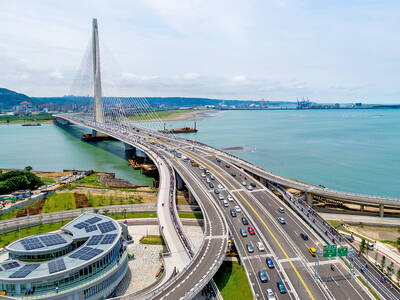
The Ministry of Transportation and Communications yesterday inaugurated the Danjiang Bridge across the Tamsui River in New Taipei City, saying that the structure would be an architectural icon and traffic artery for Taiwan. Feted as a major engineering achievement, the Danjiang Bridge is 920m long, 211m tall at the top of its pylon, and is the longest single-pylon asymmetric cable-stayed bridge in the world, the government’s Web site for the structure said. It was designed by late Iraqi-British architect Zaha Hadid. The structure, with a maximum deck of 70m, accommodates road and light rail traffic, and affords a 200m navigation channel for boats,
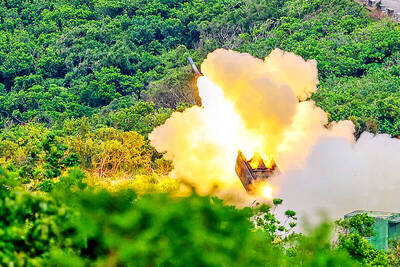
PRECISION STRIKES: The most significant reason to deploy HIMARS to outlying islands is to establish a ‘dead zone’ that the PLA would not dare enter, a source said A High Mobility Artillery Rocket System (HIMARS) would be deployed to Penghu County and Dongyin Island (東引) in Lienchiang County (Matsu) to force the Chinese military to retreat at least 100km from the coastline, a military source said yesterday. Taiwan has been procuring HIMARS and Army Tactical Missile Systems (ATACMS) from the US in batches. Once all batches have been delivered, Taiwan would possess 111 HIMARS units and 504 ATACMS, which have a range of 300km. Considering that “offense is the best defense,” the military plans to forward-deploy the systems to outlying islands such as Penghu and Dongyin so that

Taiwan Semiconductor Manufacturing Co (TSMC, 台積電), the world’s largest foundry service provider, yesterday said that global semiconductor revenue is projected to hit US$1.5 trillion in 2030, after the figure exceeds US$1 trillion this year, as artificial intelligence (AI) demand boosts consumption of token and compute power. “We are still at the beginning of the AI revolution, but we already see a significant impact across the whole semiconductor ecosystem,” TSMC deputy cochief operating officer Kevin Zhang (張曉強) said at the company’s annual technology symposium in Hsinchu City. “It is fair to say that in the past decade, smartphones and other mobile devices were
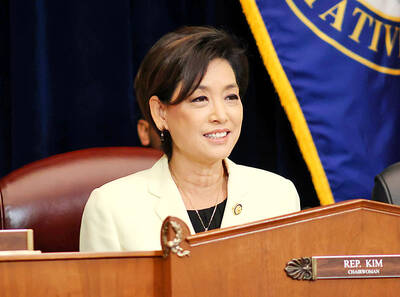
‘CLEAR MESSAGE’: The bill would set up an interagency ‘tiger team’ to review sanctions tools and other economic options to help deter any Chinese aggression toward Taiwan US Representative Young Kim has introduced a bill to deter Chinese aggression against Taiwan, calling for an interagency “tiger team” to preplan coordinated sanctions and economic measures in response to possible Chinese military or political action against Taiwan. “[Chinese President] Xi Jinping [習近平] has directed the People’s Liberation Army to be ready to invade Taiwan by 2027. China has a plan. America should have one too,” Kim said in a news release on Thursday last week. She introduced the “Deter PRC [People’s Republic of China] aggression against Taiwan act” to “ensure the US has a coordinated sanctions strategy ready should


 RSS
RSS