


Scores of same-sex and transgender couples married in Thailand yesterday as the kingdom’s equal marriage law went into effect, with two high-profile gay actors among the first to do so.
In matching beige suits, Apiwat “Porsch” Apiwatsayree, 49 — who was in tears — and Sappanyoo “Arm” Panatkool, 38, were handed their pink-bordered marriage certificates at a registry office in Bangkok.
“We fought for it for decades and today is a remarkable day that love is love,” Arm said.
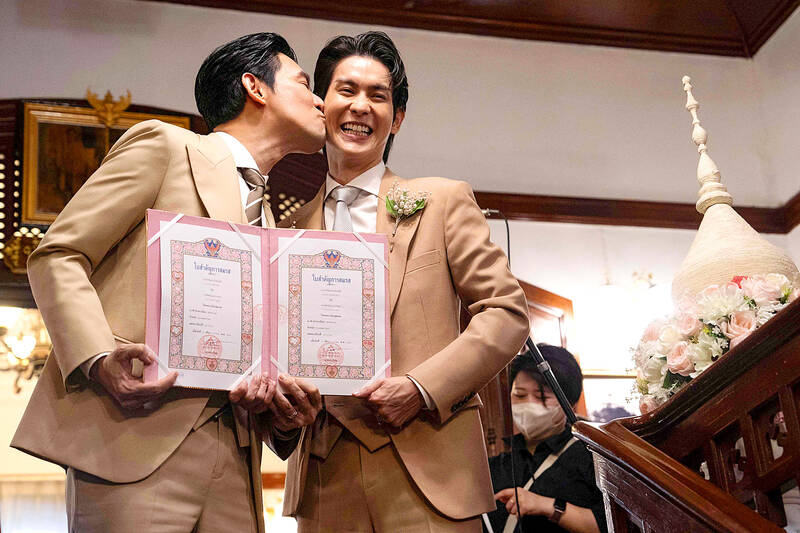
Photo: AFP
The milestone sees Thailand become by far the biggest nation in Asia to recognize equal marriage, after Taiwan and Nepal.
“Today, the rainbow flag is proudly flying over Thailand,” Thai Prime Minister Paetongtarn Shinawatra wrote on social media.
The new marriage law uses gender-neutral terms in place of “men,” “women,” “husbands” and “wives,” also clearing the way for transgender people to wed, and grants adoption and inheritance rights to all married couples.
Lesbian couple Sumalee Sudsaynet, 64, and Thanaphon Chokhongsung, 59, were the first to wed at Bangrak district office, and the couple showed the media their engagement rings.
“We are so happy. We’ve been waiting for this day for 10 years,” said Thanaphon, wearing a white gown.
The couple met a decade ago through a mutual friend and bonded over their passion for Buddhism and merit-making.
“The legalization of same-sex marriage uplifts our dignity,” Sumalee said. “It allows us to enjoy the same rights as heterosexual couples. My emotions today are so overwhelming, I can’t even put them into words.”
Dozens of couples dressed in traditional and contemporary wedding outfits trickled into a large hall in a shopping center for a mass LGBTQ wedding organized by campaign group Bangkok Pride with city authorities.
Officials helped the couples fill out marriage forms at rows of tables, an administrative step before they could collect their certificates.
Kevin Pehthai Thanomkhet, a 31-year-old transgender man, married his wife, Maple Nathnicha Klintgaworn, 39.
“So happy, like, oh my god ... my heart is beating,” Kevin said.
His 65-year-old father Phornchai added: “I have always accepted [him]. Whatsoever, it is OK with me.”
Thailand ranks highly on indices of LGBTQ legal and living conditions, and yesterday’s milestone makes it the first nation in Southeast Asia to allow equal marriage.
The kingdom’s same-sex marriage bill was passed in a historic parliamentary vote in June last year, the third place in Asia to do so, and the law came into effect 120 days after it was ratified by Thai King Maha Vajiralongkorn.
Thai activists have been pushing for same-sex marriage rights for more than a decade, with their advocacy stalled by political turbulence in a nation regularly upended by military coups and mass street protests.
Former Thai prime minister Srettha Thavisin, who attended Wednesday’s mass wedding event, took an apparent swipe at newly inaugurated US President Donald Trump, who on Monday decreed there were only two genders.
“Recently a country’s leader said that there were only two genders, but I think we are more open-minded than that,” he said.

‘NO SECURITY RISK’: The Railway Bureau reassured the public that the technicians’ activities were limited to technical guidance and did not involve sensitive systems The Railway Bureau yesterday said it had invited eight Chinese technicians to assist with an airport MRT construction project. The bureau issued the confirmation after an Internet user said Chinese nationals had entered the construction zone of Taiwan Taoyuan International Airport’s Terminal 3 project. They asked why “individuals from an enemy state” were allowed access to such a major national infrastructure project, which raised serious concerns over Taiwan’s industrial safety, sensitive systems and information security. The bureau’s Northern Region Engineering Branch Office said subcontractor Taiwan Handle Industrial Co (台灣手把工業) of the Taoyuan airport MRT’s “Contract No. CU05 Project A14 Station Civil, MEP &

A US uncrewed surface vessel (USV) encountered multiple Chinese warships during an autonomous transit of the Taiwan Strait, US defense company Seasats said in a statement on Wednesday. Seasats announced that a Lightfish USV had completed the first autonomous transit of the Taiwan Strait. Over five days, the USV traversed the entire length of the Strait while constantly monitoring surface vessel traffic, the company said. The Lightfish encountered multiple Chinese warships, one of which was a Chinese People’s Liberation Army Navy (PLAN) Type 056 corvette, it said. The Chinese vessels were operating “well within Taiwan’s exclusive economic zone without transmitting their identity via the
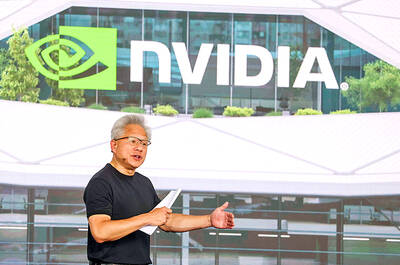
‘BOOMING’: ’ The number of partners we have here is incredible. You can see from their stock prices. They’re doing so well, they’re so happy,’ Jensen Huang said Nvidia Corp’s spending in Taiwan has ballooned to about US$150 billion a year, 10 times the US$10 billion to US$15 billion the company spent five years ago, Nvidia chief executive officer Jensen Huang (黃仁勳) said yesterday, suggesting Taiwan’s strategic importance in the global artificial intelligence (AI) supply chain. “Taiwan is the epicenter of the AI revolution. This is where the chips come, packaging comes. This is where the systems are made. This is where AI supercomputers were created,” Huang said at a meeting for the company’s employees in Beitou-Shilin Technology Park (北投士林科技園區) in Taipei, the planned site of Nvidia’s Taipei headquarters. “Taiwan
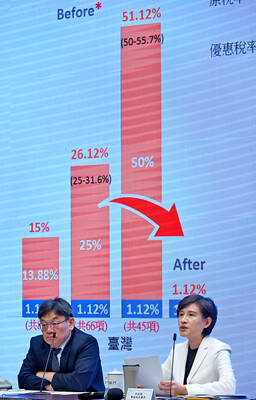
GREATER REACH? Auto parts and wood products would face tariffs of up to 15%, matching those targeting the EU, Japan and South Korea, Vice Premier said The US has announced that preferential tariff treatment for Taiwan’s non-semiconductor Section 232 goods would take effect retroactively from May 1, the Executive Yuan said yesterday. The US government yesterday posted a notice on the Federal Register’s public inspection Web site previewing tariff concessions for Taiwan under a memorandum of understanding (MOU) on Taiwan-US investment after two months of negotiations. The MOU signed on Jan. 15 stipulated three major preferential tariff arrangements: a 15 percent “reciprocal” tariff rate for Taiwan without stacking most-favored nation (MFN) rates; preferential Section 232 treatment for semiconductors and related products; and preferential Section 232 treatment for non-semiconductor


 RSS
RSS