


The foreign ministers of South Korea and Japan met in Seoul yesterday to discuss strengthening their relations in the face of increasing security challenges in the region and political tumult in the host nation.
It marked the highest-level diplomatic meeting between the nations since South Korean President Yoon Suk-yeol’s short-lived imposition of martial law last month, a move that has triggered political turmoil in one of Asia’s most vibrant democracies.
It also came amid heightened concerns about North Korea’s missile testing and deepening security pact with Russia, and China’s increasingly muscular attempts to assert its maritime claims in the South and East China seas.

Photo: EPA-EFE
“The security situation in this region is becoming very severe, and in that strategic environment the importance of Japan-ROK [Republic of Korea] relations has not changed, and in fact has become increasingly important,” Japanese Minister of Foreign Affairs Takeshi Iwaya said at a joint news conference with South Korean Minister of Foreign Affairs Cho Tae-yul.
Iwaya yesterday was also due to meet Acting South Korean President Choi Sang-mok, who is standing in for the impeached Yoon.
Yoon has been holed up in his hillside villa in Seoul since parliament voted to suspend him last month over his martial law decree on Dec. 3, with investigators vowing to arrest him in a separate probe into possible insurrection.
At their news conference, Iwaya and Choi also reiterated the importance of developing three-way security cooperation with their shared ally, the US.
With the administration of US president-elect Donald Trump set to begin on Monday next week, none of the original leaders who established the security pact between the nations in 2023 — US President Joe Biden, Yoon and former Japanese prime minister Fumio Kishida — would remain in power.
Yoon had made it a diplomatic priority to mend ties with Tokyo — often strained by historic issues — and pursue a joint security drive with Washington to tackle North Korea’s military threats.
In a nod to those efforts to put aside historic issues, Iwaya earlier yesterday visited the Seoul National Cemetery which honors Korean veterans, including those who died seeking independence from Japanese colonial rule, which ended in 1945.
US Secretary of State Antony Blinken last week on a visit to South Korea expressed confidence in Seoul’s democratic process, although he said that Washington had expressed “serious concerns” over some of the actions Yoon took over the course of his martial law declaration.
Despite polls showing a majority of South Koreans disapprove of Yoon’s martial law declaration and support his impeachment, his ruling People Power Party has enjoyed somewhat of a revival.
Support for the party stood at 40.8 percent in the latest Realmeter poll released yesterday, while the main opposition Democratic Party’s support stood at 42.2 percent, within a margin of error and down from a gap of 10.8 percent last week, the poll said.
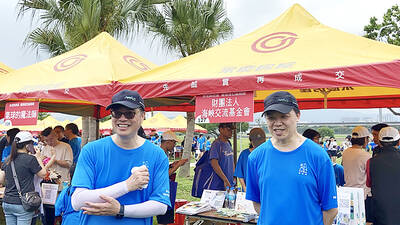
SECURITY: As China is ‘reshaping’ Hong Kong’s population, Taiwan must raise the eligibility threshold for applications from Hong Kongers, Chiu Chui-cheng said When Hong Kong and Macau citizens apply for residency in Taiwan, it would be under a new category that includes a “national security observation period,” Mainland Affairs Council (MAC) Minister Chiu Chui-cheng (邱垂正) said yesterday. President William Lai (賴清德) on March 13 announced 17 strategies to counter China’s aggression toward Taiwan, including incorporating national security considerations into the review process for residency applications from Hong Kong and Macau citizens. The situation in Hong Kong is constantly changing, Chiu said to media yesterday on the sidelines of the Taipei Technology Run hosted by the Taipei Neihu Technology Park Development Association. With
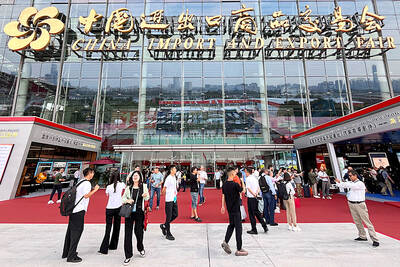
CARROT AND STICK: While unrelenting in its military threats, China attracted nearly 40,000 Taiwanese to over 400 business events last year Nearly 40,000 Taiwanese last year joined industry events in China, such as conferences and trade fairs, supported by the Chinese government, a study showed yesterday, as Beijing ramps up a charm offensive toward Taipei alongside military pressure. China has long taken a carrot-and-stick approach to Taiwan, threatening it with the prospect of military action while reaching out to those it believes are amenable to Beijing’s point of view. Taiwanese security officials are wary of what they see as Beijing’s influence campaigns to sway public opinion after Taipei and Beijing gradually resumed travel links halted by the COVID-19 pandemic, but the scale of
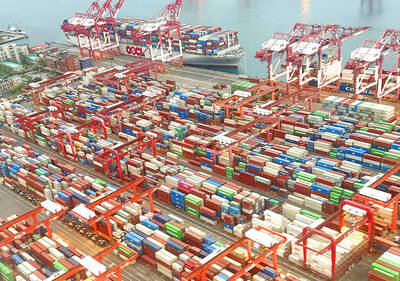
TRADE: A mandatory declaration of origin for manufactured goods bound for the US is to take effect on May 7 to block China from exploiting Taiwan’s trade channels All products manufactured in Taiwan and exported to the US must include a signed declaration of origin starting on May 7, the Bureau of Foreign Trade announced yesterday. US President Donald Trump on April 2 imposed a 32 percent tariff on imports from Taiwan, but one week later announced a 90-day pause on its implementation. However, a universal 10 percent tariff was immediately applied to most imports from around the world. On April 12, the Trump administration further exempted computers, smartphones and semiconductors from the new tariffs. In response, President William Lai’s (賴清德) administration has introduced a series of countermeasures to support affected
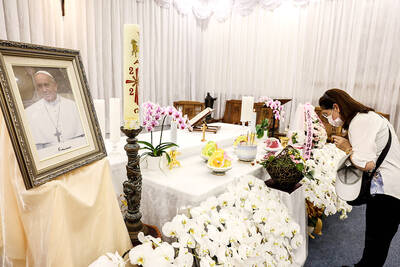
Pope Francis is be laid to rest on Saturday after lying in state for three days in St Peter’s Basilica, where the faithful are expected to flock to pay their respects to history’s first Latin American pontiff. The cardinals met yesterday in the Vatican’s synod hall to chart the next steps before a conclave begins to choose Francis’ successor, as condolences poured in from around the world. According to current norms, the conclave must begin between May 5 and 10. The cardinals set the funeral for Saturday at 10am in St Peter’s Square, to be celebrated by the dean of the College


 RSS
RSS