


Taiwan last week reported 127,000 new cases of influenza and the epidemic’s flare-up is expected to peak during or around the Lunar New Year holiday, the Centers for Disease Control (CDC) said yesterday.
This year’s Lunar New Year holiday begins on Jan. 25.
The cases included six deaths and 43 people with severe flu complications, with emergency room patients comprising 12.6 percent of the total, CDC Epidemic Intelligence Center Deputy Director Lee Chia-lin (李佳琳) told a news conference.
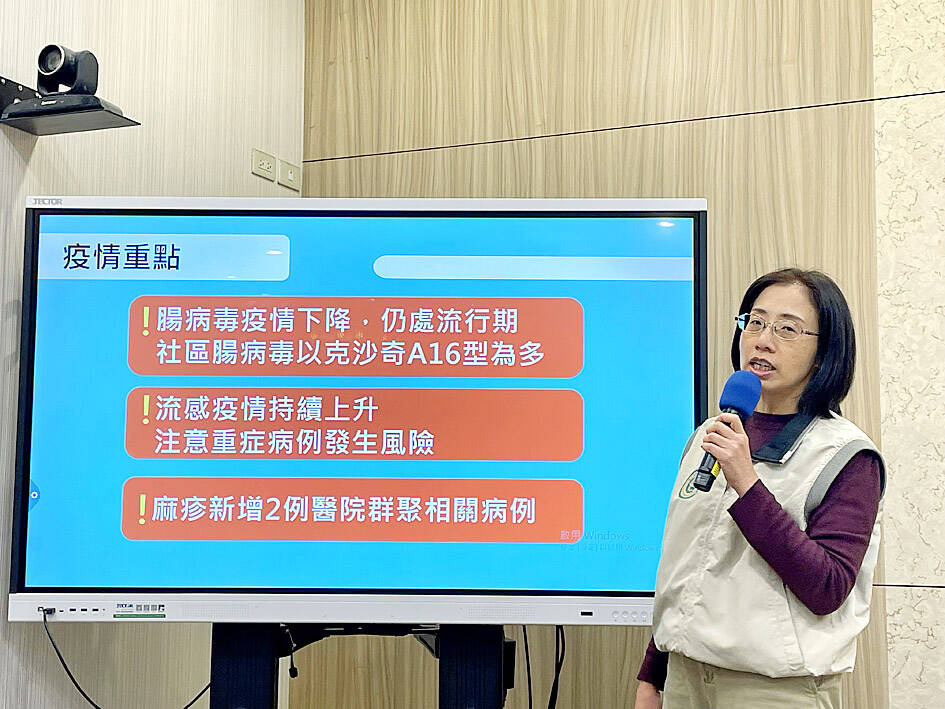
Photo: Lin Chih-yi, Taipei Times
All the people who died were unvaccinated and older than 50, she said.
Taiwan has inoculated 5.98 million people for flu, including 64.7 percent of children younger than six and 44.8 percent of people older than 65, since vaccinations started in October last year, CDC Deputy Director-General Tseng Shu-hui (曾淑慧) said.
The vaccination numbers are well short of the ideal, she said, and urged people at risk to get vaccinated.
The CDC expects the flu situation to worsen in the coming weeks and infect 150,000 people during its peak week, she added.
One of the people who passed away, a 50-year-old man receiving in-patient treatment for cancer, was infected late last month before being diagnosed with H1N1-caused viral pneumonia, CDC physician Lin Yung-ching (林詠青) said.
He died two weeks after the diagnosis despite receiving antiviral drugs, she said.
A 10-year-old girl, who was immunocompromised, developed symptoms last month shortly after being inoculated, Lin said.
The girl is in critical condition, Lin said.
Separately, Tseng said four new measles cases — two domestic and two imported — were reported last week.
One of the domestic cases is a 30-year-old person accompanying a hospitalized person and the other is a 40-year-old care worker, both linked to a hospital cluster in central Taiwan, she said.
Sixteen people were infected by measles at the hospital, including four medical staff members, a care worker, a janitor, a maintenance worker, two patients and three visitors, Tseng said.
Two other people were infected in connection with the cluster, but not involved with the hospital, she said.
Officials are monitoring 1,541 of the 3,123 contacts who had been traced, she said, adding that observation for them would continue until Jan. 23.
The remaining contacts have been cleared, she said.
People employed in medical care-related jobs should implement infectious disease protocols, and those who had not been inoculated for measles or tested positive in antibody checks can wear N95 masks, she said.
Members of the public should observe cough etiquette and wear masks as directed when visiting hospitals, Tseng said.
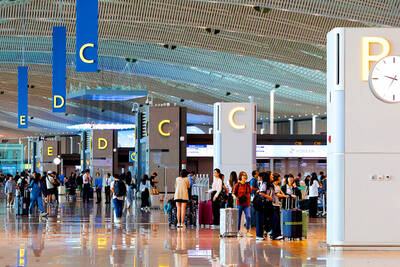
South Korea has adjusted its electronic arrival card system to no longer list Taiwan as a part of China, a move that the Ministry of Foreign Affairs said would help facilitate exchanges between the two sides. South Korea previously listed “Taiwan” as “Taiwan (China)” in the drop-down menus of its online arrival card system, where people had to fill out where they came from and their next destination. The ministry had requested South Korea make a revision and said it would change South Korea’s name on Taiwan’s online immigration system from “Republic of Korea” to “Korea (South),” should the issue not be

The Legislative Yuan’s Finance Committee yesterday approved proposed amendments to the Amusement Tax Act (娛樂稅法) that would abolish taxes on films, cultural activities and competitive sporting events, retaining the fee only for dance halls and golf courses. The proposed changes would set the maximum tax rate for dance halls and golf courses at 50 and 20 percent respectively, with local governments authorized to suspend the levies. Article 2 of the act says that “amusement tax shall be levied on tickets sold or fees charged by amusement places, facilities or activities” in six categories: “Cinema; professional singing, story-telling, dancing, circus, magic show, acrobatics

Tainan, Taipei and New Taipei City recorded the highest fines nationwide for illegal accommodations in the first quarter of this year, with fines issued in the three cities each exceeding NT$7 million (US$220,639), Tourism Administration data showed. Among them, Taipei had the highest number of illegal short-term rental units, with 410. There were 3,280 legally registered hotels nationwide in the first quarter, down by 14 properties, or 0.43 percent, from a year earlier, likely indicating operators exiting the market, the agency said. However, the number of unregistered properties rose to 1,174, including 314 illegal hotels and 860 illegal short-term rental
INFLATION UP? The IMF said CPI would increase to 1.5 percent this year, while the DGBAS projected it would rise to 1.68 percent, with GDP per capita of US$44,181 The IMF projected Taiwan’s real GDP would grow 5.2 percent this year, up from its 2.1 percent outlook in January, despite fears of global economic disruptions sparked by the US-Iran conflict. Taiwan’s consumer price index (CPI) is projected to increase to 1.5 percent, while unemployment would be 3.4 percent, roughly in line with estimates for Asia as a whole, the international body wrote in its Global Economic Outlook Report published in the US on Monday. The figures are comparatively better than the IMF outlook for the rest of the world, which pegged real GDP growth at 3.1 percent, down from 3.3 percent


 RSS
RSS