


The TAIEX yesterday finished the year with a 28.47 percent gain, the highest annual gain since 2009, thanks to the artificial intelligence (AI) boom, Taiwan Stock Exchange data showed.
The local bourse yesterday shed 0.67 percent to 23,035.1 amid profit-taking, but still ranked the second-best market globally next only to the technology-heavy NASDAQ index’s 31.97 percent gain.
As of the end of the year, the Taiwan Stock Exchange’s market turnover hit a new high of NT$99.81 trillion (US$3.04 trillion), smashing the previous high of NT$95.52 trillion at the end of 2021.
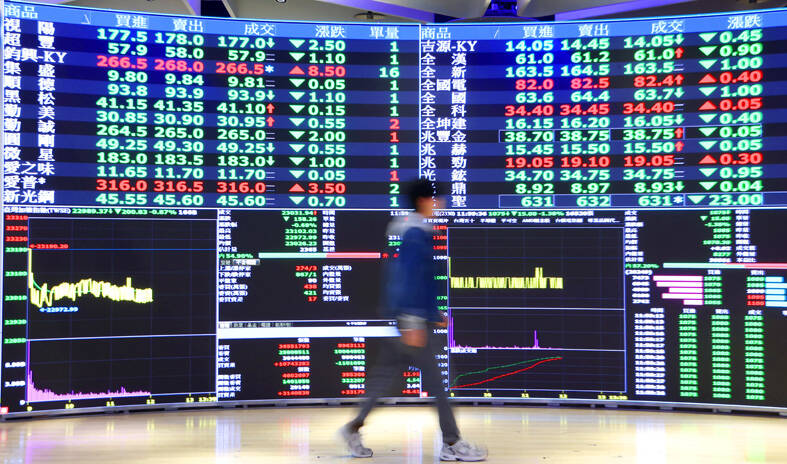
Photo: CNA
Based on the increase of NT$17.1 trillion in market capitalization to NT$73.9 trillion, investors on the main board each earned almost NT$1.3 million in the year. About 13.18 million investors were registered on the local stock market at the end of November.
The record came even though foreign portfolio managers sold local shares by a net NT$695.14 billion and proprietary dealers cut their stakes by NT$823.8 billion in the year, Taiwan Stock Exchange (TWSE) data showed.
However, investment trust funds lent support by investing NT$832.2 billion, in line with the growing popularity of exchange-traded funds (ETFs) among local retail investors, according to TWSE data.
ETFs gathered another NT$200 billion to NT$2.9 trillion despite a choppy market in the second half of the year.
Shares of Taiwan Semiconductor Manufacturing Co (TSMC, 台積電) spiked 81.28 percent in the year to close at NT$1,075 yesterday amid growing optimism over AI applications and the company’s strong bottom line.
Due to its significant share price gains, TSMC’s market capitalization rose by NT$12.5 trillion from a year earlier, and it contributed more than 3,800 points to the TAIEX’s gains in the year.
Average capital gains would moderate to NT$434,700 per investor if TSMC’s contribution was stripped out.
The chipmaker is to benefit further from aggressive spending by US technology giants on cloud computing and AI applications, First Securities Inc (第一金證券) said yesterday.
“TSMC has proved a reliable and favored partner because of its leadership in chipmaking processes,” First Securities said.
TSMC is to host an investors’ conference on Jan. 16 to outline its business outlook for the new year, after delivering better-than-expected results three months earlier.
Securities houses largely share the view that the TAIEX would rally above 24,000 points this year, as TSMC is forecast to improve its sales by double-digit percentage points in the next five years.
Overall corporate profits this year would expand 15.2 percent, but electronics firms would achieve 30 percent growth because they have demonstrated better pricing ability and management efficiency, PGIM Securities Investment Trust Enterprise Co (保德信投信) said.
By contrast, the New Taiwan dollar fared less well last year, weakening 6.24 percent to NT$32.781 yesterday versus the US dollar, central bank data showed.
That was the poorest end-of-year rate in the past nine years, but that retreat paled in comparision with the won’s 12.58 percent decline and yen's 9.48 percent fall, the central bank said.
Elsewhere in Asia last year, the Vietnamese dong fell 4.88 percent against the US dollar, the Singapore dollar declined 2.97 percent and China's yuan dropped 2.84 percent, the central bank added.
Global funds have flowed to the US dollar in light of relatively high interest rates in the US and ahead of potential tariff hikes by the White House when US president-elect Donald Trump assumes office on Jan. 20.
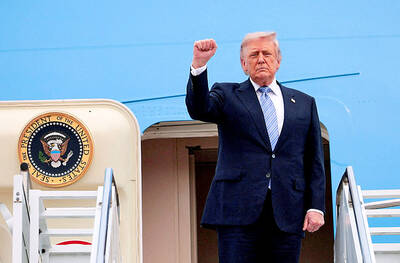
US-CHINA SUMMIT: MOFA welcomed US reassurance of no change in its Taiwan policy; Trump said he did not comment when Xi talked of opposing independence US President Donald Trump yesterday said he has not made a decision on whether to move forward with a major arms package for Taiwan after hearing concerns about it from Chinese President Xi Jinping (習近平). Trump’s comments on Taiwan came as he flew back to Washington after wrapping up critical talks in which both leaders said important progress was made in stabilizing US-China relations even as deep differences persist between the world’s two biggest powers on Iran and Taiwan. “I will make a determination,” Trump said, adding: “I’ll be making decisions. But, you know, I think the last thing we need right
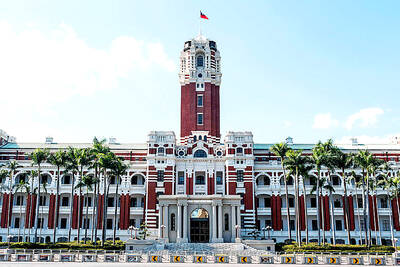
SECURITY: Taipei presses the US for arms supplies, saying the arms sales are not only a reflection of the US security commitment to Taiwan but also serve as a mutual deterrent against regional threats Taiwan is committed to preserving the cross-strait “status quo” and contributing to regional peace and stability, the Presidential Office said yesterday. “It is an undeniable fact that the Republic of China is a sovereign and independent democratic nation,” Presidential Office spokeswoman Karen Kuo (郭雅慧) reiterated, adding that Beijing has no right to claim sovereignty over Taiwan. The statements came after US President Donald Trump warned against Taiwanese independence. Trump wrapped up a state visit to Beijing on Friday, during which Chinese President Xi Jinping (習近平) had pressed him not to support Taiwan. Taiwan depends heavily on US security backing to deter China from carrying
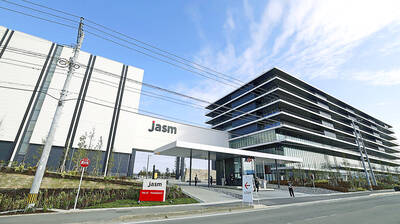
The subsidiary of Taiwan Semiconductor Manufacturing Co (TSMC, 台積電) in Kumamoto, Japan, turned a profit in the first quarter of this year, marking the first time the first fab of the unit has become profitable since mass production started at the end of 2024. According to the contract chipmaker’s financial statement released on Friday, Japan Advanced Semiconductor Manufacturing Inc (JASM), a joint venture running the fab in Kumamoto, posted NT$951 million (US$30.19 million) in profit in the January-to-March period, compared with a loss of NT$1.39 billion in the previous quarter, and a loss of NT$3.25 billion in the first quarter of
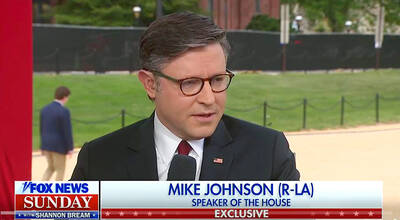
RESOLUTE BACKING: Two Republican senators are planning to introduce legislation that would impose immediate sanctions on China if it attempts to invade Taiwan US House of Representatives Speaker Mike Johnson on Sunday reaffirmed US congressional support for Taiwan, saying the US and “all freedom-loving people” have a stake in preventing China from seizing Taiwan by force. Johnson made the remarks in an interview with Fox News Sunday on US President Donald Trump’s summit with Chinese President Xi Jinping (習近平) last week. In an interview that aired on Friday on Fox News, just as Trump wrapped up a high-stakes visit to China, he said he has yet to green-light a new US$14 billion arms package to Taiwan and that it “depends on China.” “It’s a very good


 RSS
RSS