


A Manhattan resident has pleaded guilty to helping establish a secret police station in New York City on behalf of the Chinese government.
Chen Jinping (陳金平), 60, in Brooklyn Federal Court on Wednesday pleaded guilty on a single count of conspiracy to act as an agent of a foreign government.
US Department of Justice Assistant Attorney General Matthew Olsen said Chen admitted in court to his role in “audaciously establishing an undeclared police station” in Manhattan and attempting to conceal the effort when approached by the FBI.
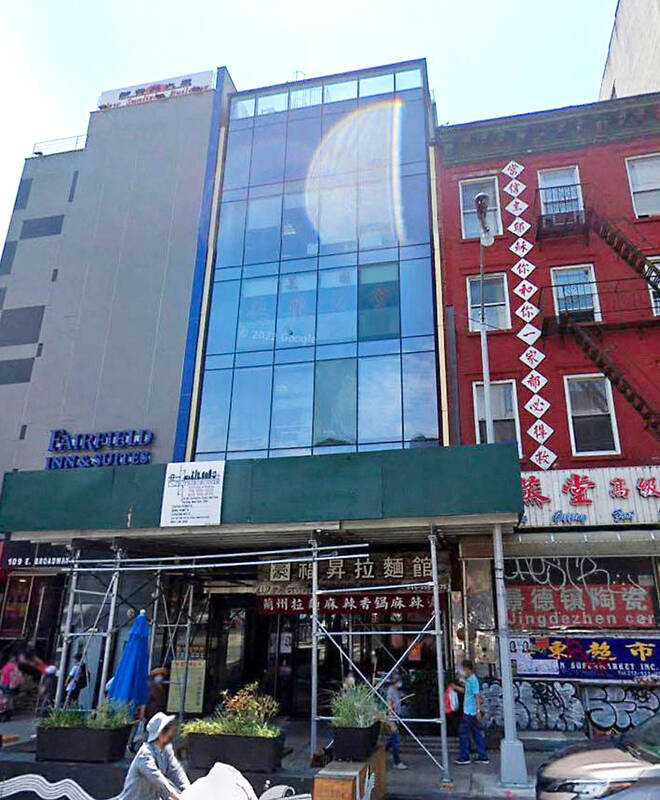
Photo: AFP / US District Court Eastern District New York / HANDOUT
“This illegal police station was not opened in the interest of public safety, but to further the nefarious and repressive aims of the [People’s Republic of China] PRC in direct violation of American sovereignty,” he said in statement.
Prosecutors said Chen and his codefendant, Lu Jianwang (盧建旺), opened and operated a local branch of the Chinese Ministry of Public Security in Manhattan’s Chinatown neighborhood starting in early 2022.
The office, which occupied an entire floor of the building, performed basic services, such as helping Chinese citizens renew their Chinese driver’s licenses, but also identified pro-democracy activists living in the US, federal authorities said.
The clandestine Chinese police operation was shuttered in the fall of 2022 amid an FBI investigation. However, in an apparent effort to obstruct the federal probe, Chen and Lu deleted from their phones communications with a Chinese government official they reported to, prosecutors said.
China is believed to be operating such secretive police outposts in North America, Europe and other places where there are Chinese communities. However, Beijing has denied that they are police stations, saying that they exist mainly to provide citizen services such as renewing driver’s licenses.
The arrest of Chen and Lu in April last year was part of a series of US Department of Justice prosecutions aimed at cracking down on “transnational repression,” in which foreign governments such as China work to identify, intimidate and silence dissidents in the US.
Lawyers for Chen and Lu declined to comment on Wednesday. Chen faces up to five years in prison at his sentencing on May 30.
Lu, who is due back in court in February, had a longstanding relationship with Chinese law enforcement officials, prosecutors said.
Over the years, Lu helped harass and threaten a Chinese fugitive living in the US and worked to locate a pro-democracy activist in California on behalf of the Chinese government, they said.

‘NO SECURITY RISK’: The Railway Bureau reassured the public that the technicians’ activities were limited to technical guidance and did not involve sensitive systems The Railway Bureau yesterday said it had invited eight Chinese technicians to assist with an airport MRT construction project. The bureau issued the confirmation after an Internet user said Chinese nationals had entered the construction zone of Taiwan Taoyuan International Airport’s Terminal 3 project. They asked why “individuals from an enemy state” were allowed access to such a major national infrastructure project, which raised serious concerns over Taiwan’s industrial safety, sensitive systems and information security. The bureau’s Northern Region Engineering Branch Office said subcontractor Taiwan Handle Industrial Co (台灣手把工業) of the Taoyuan airport MRT’s “Contract No. CU05 Project A14 Station Civil, MEP &

A US uncrewed surface vessel (USV) encountered multiple Chinese warships during an autonomous transit of the Taiwan Strait, US defense company Seasats said in a statement on Wednesday. Seasats announced that a Lightfish USV had completed the first autonomous transit of the Taiwan Strait. Over five days, the USV traversed the entire length of the Strait while constantly monitoring surface vessel traffic, the company said. The Lightfish encountered multiple Chinese warships, one of which was a Chinese People’s Liberation Army Navy (PLAN) Type 056 corvette, it said. The Chinese vessels were operating “well within Taiwan’s exclusive economic zone without transmitting their identity via the
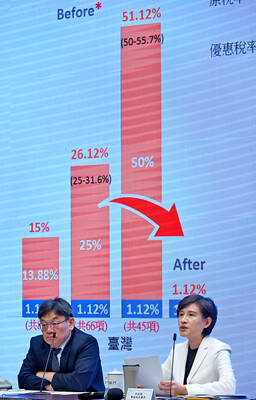
GREATER REACH? Auto parts and wood products would face tariffs of up to 15%, matching those targeting the EU, Japan and South Korea, Vice Premier said The US has announced that preferential tariff treatment for Taiwan’s non-semiconductor Section 232 goods would take effect retroactively from May 1, the Executive Yuan said yesterday. The US government yesterday posted a notice on the Federal Register’s public inspection Web site previewing tariff concessions for Taiwan under a memorandum of understanding (MOU) on Taiwan-US investment after two months of negotiations. The MOU signed on Jan. 15 stipulated three major preferential tariff arrangements: a 15 percent “reciprocal” tariff rate for Taiwan without stacking most-favored nation (MFN) rates; preferential Section 232 treatment for semiconductors and related products; and preferential Section 232 treatment for non-semiconductor

The National Chungshan Institute of Science and Technology yesterday showcased its locally developed variants of the Vision 60 robotic patrol dog, which it plans to deploy on the nation’s outlying territories in the South China Sea. The variants were produced under the Joint Lab project — created by the institute and domestic companies — and assembled with domestically produced motors, lenses and artificial intelligence (AI) systems alongside licensed tech from the US, Missile and Rocket Systems Research Division deputy director Jen Kuo-kang (任國光) told the media event at a military base in Taipei’s Dazhi (大直) area. Taiwan has built up its strengths


 RSS
RSS