


The Ministry of National Defense (MND) yesterday said China had nearly doubled the number of its warships operating around the nation in the previous 24 hours, ahead of what security sources expect would be a new round of war games.
China’s military activities come amid speculation Beijing might organize military drills around the nation in response to President William Lai’s (賴清德) recent visit to Pacific allies, including stops in Hawaii and Guam, a US territory. Lai returned from the week-long trip on Friday night.
Beijing has held two rounds of war games around Taiwan this year, and sends ships and military planes near the nation almost daily.
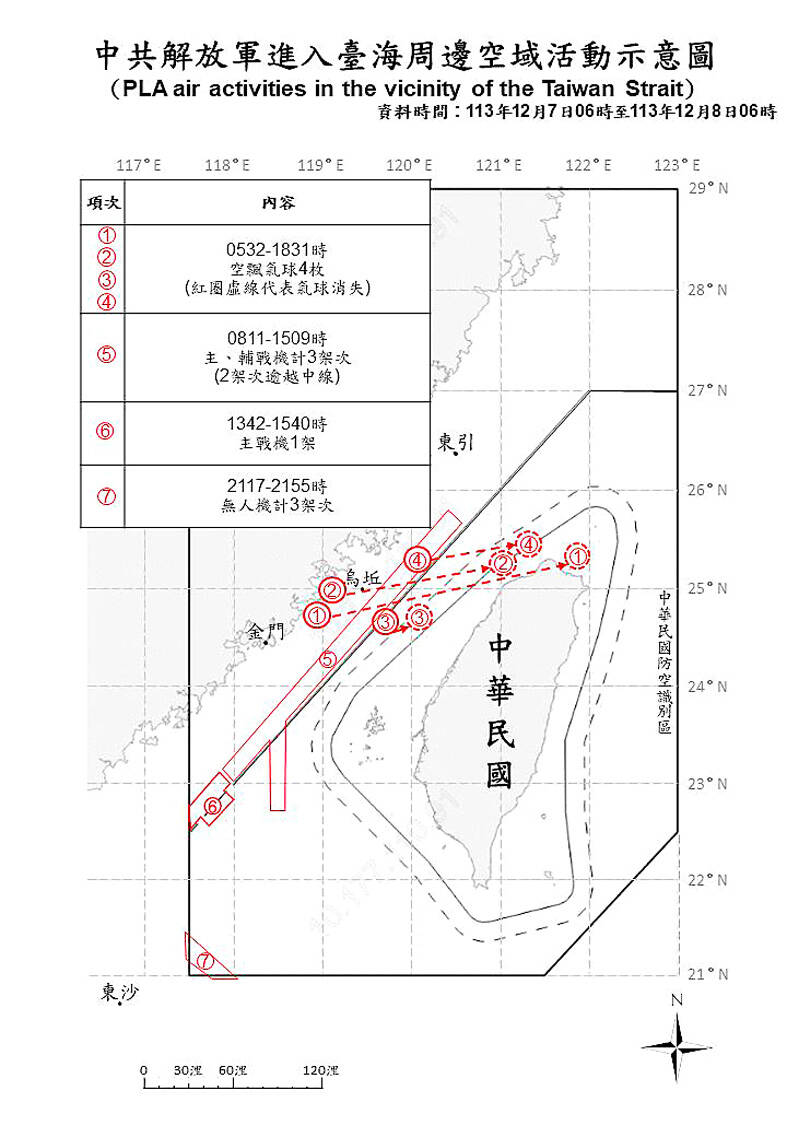
Photo courtesy of the Ministry of National Defense
In its daily morning report on Chinese military activities, the ministry said there were 14 Chinese warships operating nearby, up from the eight it reported the previous day.
Six of the aircraft crossed the median line of the Taiwan Strait, an unofficial demarcation zone between Taiwan and China, the ministry said.
The ministry said it had detected four Chinese balloons flying over the Taiwan Strait, one of which had brushed the top of the Taiwan proper.
Weather conditions would likely be a factor in China’s decision on any war games, security sources said.
Weather in the Strait has been poor this weekend.
The Chinese Ministry of Defense did not answer calls yesterday.
However, in a strongly worded commentary on its WeChat account yesterday, the Chinese Ministry of State Security said Lai’s efforts to “use arms to seek independence” and cosy up to the US were doomed to fail.
Taiwan’s government is putting on a “false display of power” while the US government is “acting in cahoots with gangsters and jackals” in supporting Taiwan, it said.
No one should presume they can “step out of line on the Taiwan issue without having to pay a price,” it added.
Lai on Friday called on China to refrain from threats and said Beijing’s military exercises “will not be able to win the respect” of neighboring countries.
Speaking to reporters in Palau on the final day of his tour, Lai said “It is better to open your hands than to clench your fists.”
“No matter how many military drills China stages and how many ships and aircraft they dispatch to intimidate regional countries, China will not win the respect from any country,” he added.
Additional reporting by AP and staff writer


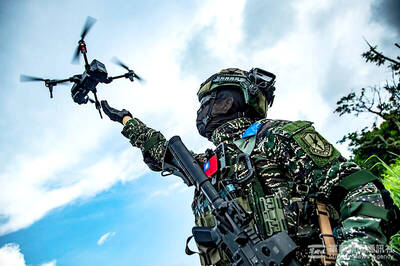
The National Chungshan Institute of Science and Technology yesterday showcased its locally developed variants of the Vision 60 robotic patrol dog, which it plans to deploy on the nation’s outlying territories in the South China Sea. The variants were produced under the Joint Lab project — created by the institute and domestic companies — and assembled with domestically produced motors, lenses and artificial intelligence (AI) systems alongside licensed tech from the US, Missile and Rocket Systems Research Division deputy director Jen Kuo-kang (任國光) told the media event at a military base in Taipei’s Dazhi (大直) area. Taiwan has built up its strengths
RESILIENCE: Taiwan plays a key role in semiconductors, energy, information infrastructure and advanced manufacturing, AIT Director Raymond Greene said Taiwan’s continued investment in deterrence and resilience remains vital, especially in uncrewed systems and other emerging technologies, American Institute in Taiwan (AIT) Director Raymond Greene said yesterday. Greene made the remarks at the annual National Strategic Summit on Supply Chain Resilience held by the Research Institute for Democracy, Society and Emerging Technology (DSET), a government-backed think tank. As Taiwan last year became the US’ fourth-largest trading partner and supply chain security is becoming more important, cooperation in emerging technologies continues to deepen between the two countries, he said. The US is committed to accelerating innovation, building key infrastructure, strengthening cooperation

RIGHT DIRECTION: Taiwan’s efforts to prevent forced labor include a proposal to ‘fully prohibit’ employers from withholding workers’ documents, an official said Taiwan is to establish a mechanism to restrict imports of goods linked to forced labor, the Executive Yuan said yesterday, after the US proposed imposing additional tariffs on Taiwanese goods over labor concerns. “The Ministry of Labor and the Ministry of Economic Affairs are to establish an interministerial review procedure,” Executive Yuan spokesperson Michelle Lee (李慧芝) said at a news briefing in Taipei. “The government is to use the Foreign Trade Act [貿易法] as the legal basis to restrict imports of goods produced with forced labor” and bring its supply chain governance more in line with international standards on human rights, resilience

NOT IMMEDIATE: Taiwan has a chance to appeal the proposed 10 percent tariff before it starts, while other countries face a 12.5 percent tariff from the trade office Taiwan is among 60 economies determined by the US to have failed to impose or enforce a ban on the importation of goods produced with forced labor, according to a notice released on Tuesday by the Office of the US Trade Representative (USTR), which proposed imposing an additional 10 percent or more tariff on them. The USTR in a statement said that following an investigation, it had determined under Section 301 of the Trade Act of 1974 that the failure of the 60 economies to impose and effectively enforce a prohibition on the importation of goods produced with forced labor is


 RSS
RSS