


President William Lai (賴清德) yesterday urged China to “unclench its fists” and not take any unilateral actions, adding that expected Chinese war games around the nation would not win Beijing any respect from international society.
China is expected to launch another round of exercises in response to Lai’s trip to the Pacific, which included stopovers in Hawaii and the US territory of Guam, security sources have said.
Speaking to reporters in Palau on the final day of his tour, Lai said he hoped China would return to the rules-based international order.
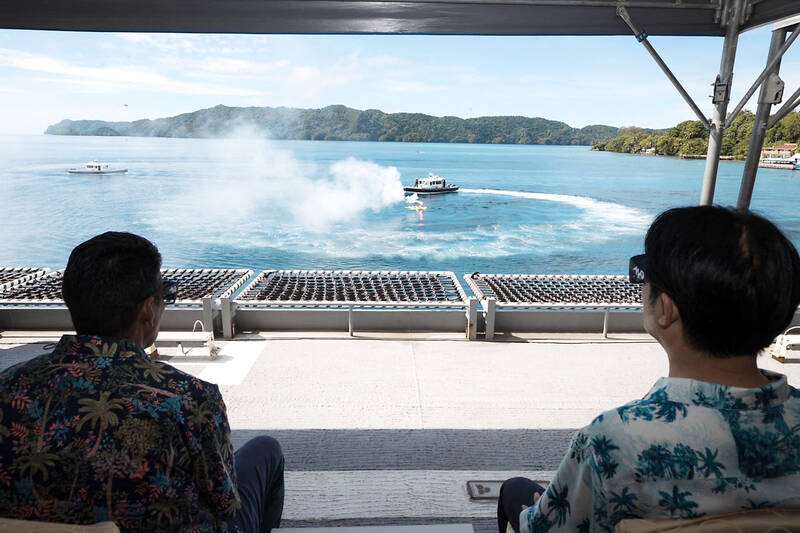
Photo courtesy of the Presidential Office
“It is better to open your hands than to clench your fists. Only by doing so can China win respect from the international community,” Lai said in comments carried live on Taiwanese television.
“No matter how many military drills China stages and how many ships and aircraft they dispatch to intimidate regional countries, China will not win the respect from any country,” he added, urging Beijing to stop “unsettling and regrettable” unilateral actions.
Asked about possible Chinese drills, Lai said Taiwan’s engagement with the world “should not be used by authoritarian countries as an excuse for provocation.”
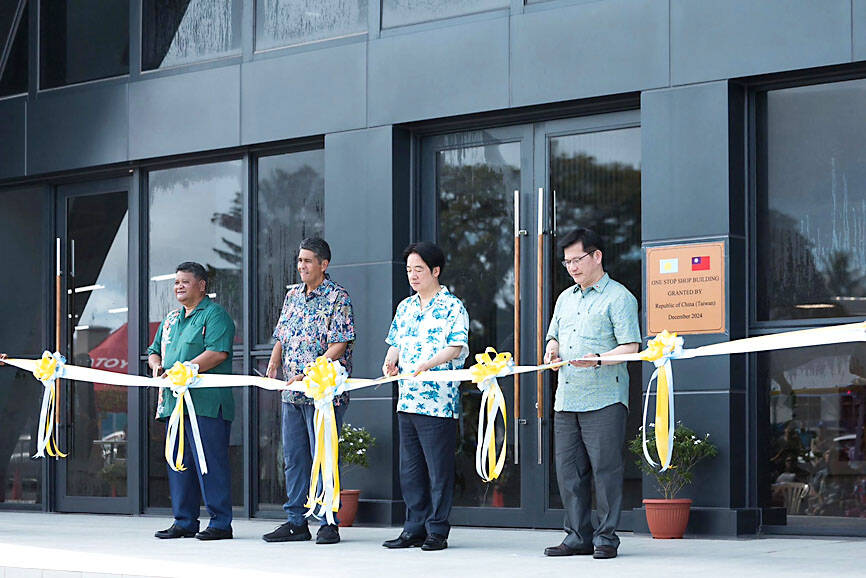
Photo courtesy of the Presidential Office
The government has a full grasp of the security situation in the region and has made the “best preparations” to ensure the security of the Taiwan Strait, he added.
Chinese Ministry of Foreign Affairs spokesman Lin Jian (林劍), asked yesterday about the potential for war games, said the Taiwan issue was the “core of China’s core interests.”
“It is the first red line that cannot be crossed in Sino-US relations, and China’s determination to defend its national sovereignty and territorial integrity is unwavering,” Lin told a routine news conference in Beijing.
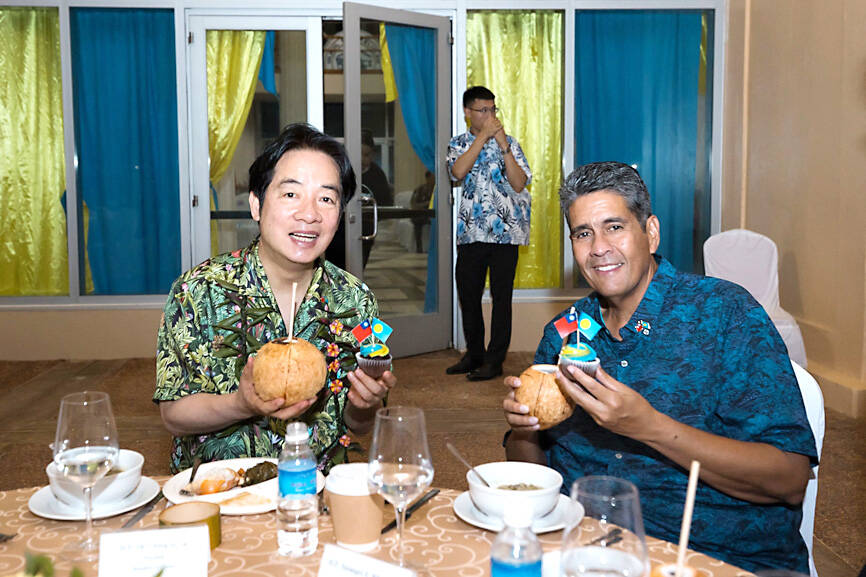
Photo courtesy of the Presidential Office
Lai reiterated that while Taiwan wants engagement with China, he cannot have any illusions about peace and that Taiwan must continue to strengthen its defenses.
Peace is priceless and there are no winners in a war, he added, repeating comments he made in Hawaii after visiting a memorial to the 1941 Japanese attack on Pearl Harbor.
China has staged two rounds of war games around Taiwan so far this year, one in May shortly after Lai’s inauguration and another in October following his Double Ten National Day speech.
In Guam on Thursday, Lai spoke with US congressional leaders, including House of Representatives Speaker Mike Johnson, ahead of US president-elect Donald Trump returning to the White House on Jan. 20.
“Taiwan is confident that we can continue to deepen cooperation with the new US government and resist the expansion of authoritarianism,” Lai said.
Earlier yesterday in Palau, Lai and Palauan President Surangel Whipps Jr inspected a joint exercise in waters near the Pacific island nation where coast guard forces simulated a rescue mission involving a capsized fishing vessel.
The exercise was part of joint efforts to maintain maritime order following the signing of a cooperative agreement between Taiwan and Palau on coast guard exchanges and humanitarian rescue cooperation in 2019, Lai said in his remarks.
He emphasized the importance of countries working together on maritime safety and humanitarian rescue, adding that Taiwan remained committed to collaborating with Palau and other democratic nations to contribute to regional stability and security.
Whipps said the exercise demonstrated that the cooperation between Taiwan and Palau went beyond operational aspects and reflected their shared values and commitments.
To test the ability of the coast guards from Taiwan and Palau to jointly perform rescue missions at sea, the exercise had coast guard teams simulate scrambling to the aid of a capsized vessel and five crew members who had fallen into the sea.
The Yunlin, a 4,000-tonne Coast Guard Administration Chiayi-class patrol vessel, and two patrol boats that Taiwan gifted Palau in 2021 were involved in the exercise in waters near Malakal Island.
Ni Chih-chung (倪志忠), commander of the Yunlin, said maritime rescue “knows no borders” and that his vessel was working with those from other countries to ensure maritime safety and enhance the quality of humanitarian rescue operations in the face of rapidly changing situations at sea.
Additional reporting by CNA

‘NO SECURITY RISK’: The Railway Bureau reassured the public that the technicians’ activities were limited to technical guidance and did not involve sensitive systems The Railway Bureau yesterday said it had invited eight Chinese technicians to assist with an airport MRT construction project. The bureau issued the confirmation after an Internet user said Chinese nationals had entered the construction zone of Taiwan Taoyuan International Airport’s Terminal 3 project. They asked why “individuals from an enemy state” were allowed access to such a major national infrastructure project, which raised serious concerns over Taiwan’s industrial safety, sensitive systems and information security. The bureau’s Northern Region Engineering Branch Office said subcontractor Taiwan Handle Industrial Co (台灣手把工業) of the Taoyuan airport MRT’s “Contract No. CU05 Project A14 Station Civil, MEP &

The National Chungshan Institute of Science and Technology yesterday showcased its locally developed variants of the Vision 60 robotic patrol dog, which it plans to deploy on the nation’s outlying territories in the South China Sea. The variants were produced under the Joint Lab project — created by the institute and domestic companies — and assembled with domestically produced motors, lenses and artificial intelligence (AI) systems alongside licensed tech from the US, Missile and Rocket Systems Research Division deputy director Jen Kuo-kang (任國光) told the media event at a military base in Taipei’s Dazhi (大直) area. Taiwan has built up its strengths

TIT-FOR-TAT: The US allegedly revoked the visa of a Chinese national working at Xinhua News Agency in the US in response to Beijing’s expulsion of Vivian Wang The Presidential Office yesterday condemned China for expelling a New York Times correspondent from Beijing following the newspaper’s interview with President William Lai (賴清德), saying the move highlighted Beijing’s suppression of press freedom and its threat to international news media. Taiwan has noted a series of recent incidents in which Beijing used similar tactics to “threaten and pressure international media outlets and journalists,” Presidential Office spokeswoman Karen Kuo (郭雅慧) said in a statement. “This concerns not only press freedom and freedom of expression, but also the safety of journalists, and Taiwan and relevant partners are paying close attention to the situation,” she

NOT IMMEDIATE: Taiwan has a chance to appeal the proposed 10 percent tariff before it starts, while other countries face a 12.5 percent tariff from the trade office Taiwan is among 60 economies determined by the US to have failed to impose or enforce a ban on the importation of goods produced with forced labor, according to a notice released on Tuesday by the Office of the US Trade Representative (USTR), which proposed imposing an additional 10 percent or more tariff on them. The USTR in a statement said that following an investigation, it had determined under Section 301 of the Trade Act of 1974 that the failure of the 60 economies to impose and effectively enforce a prohibition on the importation of goods produced with forced labor is


 RSS
RSS