


Taiwan and Lithuania are indispensable partners, as both are democracies at the front line against authoritarian threats, Minister of Foreign Affairs Lin Chia-lung (林佳龍) said at a dinner ceremony in Lithuania on Wednesday.
The dinner marked the third anniversary of the establishment of the Taiwanese Representative Office in Lithuania, with Lithuanian Member of Parliament Matas Maldeikis handing his post as head of the Lithuania-Taiwan friendship group to Lithuanian Parliamentarian Ruslanas Baranovas.
Lin said in his address that Taiwan-Lithuania relations have rapidly developed since the office was established in Vilnius in 2021, laying solid foundations for trade and collaborations in semiconductors, ultra-fast lasers, biotechnology, renewable energy and other fields.
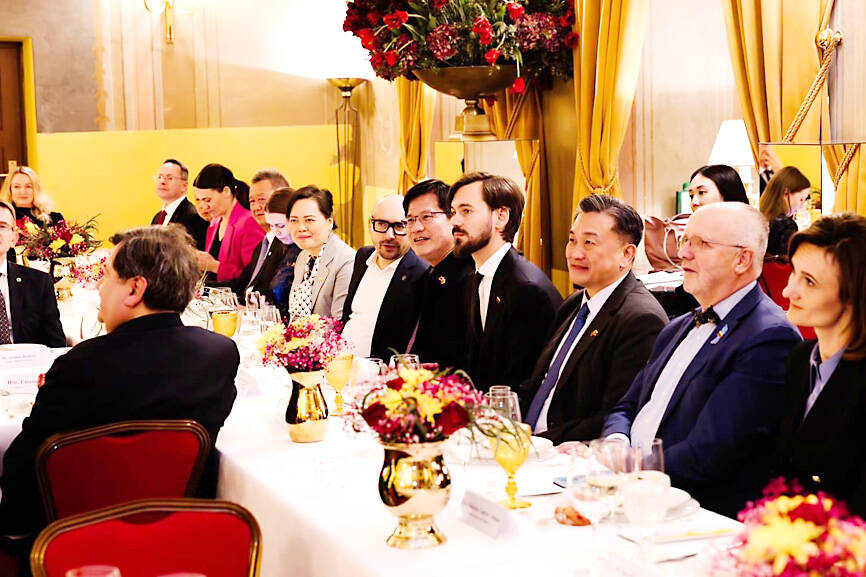
Photo from Lin Chia-lung’s Facebook
With 19 Taiwanese drone manufacturers accompanying him to Lithuania, he expected to expand the partnership to other fields to work toward the common goal of promoting peace and prosperity, he said.
Taiwan and Lithuania are on a geopolitical front line against authoritarian regimes, China and Russia, and should work together against authoritarian expansion to defend democracy, Lin said.
Taiwan is a reliable partner for democratic countries, especially when constructing global democratic supply chains, as it has a free market economy and cutting-edge technology, competitive edges that have made it a crucial contributor to the global economy, he said.
“Taiwan needs the world, and the world needs Taiwan,” Lin said.
He also thanked Lithuanian members of parliament for their support for Taiwan.
On Tuesday, Taiwan and Latvia signed a memorandum of understanding on drone collaboration during the first visit by a Taiwanese drone industry delegation to the Baltic country.
The agreement was signed in Riga, Latvia’s capital, by Aerospace Industrial Development Corp (漢翔航空) chairman Hu Kai-hung (胡開宏), who led the Taiwanese delegation, and a representative from the Latvian Federation of Defense and Security Industries, a statement issued yesterday by the Taipei Mission in the Republic of Latvia said.
The 47-member Taiwanese delegation, comprising representatives from 16 domestic drone companies, related industries and government officials, is the largest trade group from Taiwan to Latvia.
They were joined by more than 120 counterparts from Latvia and Estonia, including Estonian parliamentarians Kristo Enn Vaga, Kalle Laanet and Juri Jaanson.
At the signing ceremony, Representative to Latvia Andrew Lee (李憲章) said Taiwan is a reliable partner to Latvia and Estonia, citing its advanced technology in information and communications as well as semiconductors.
Speaking at a banquet on Tuesday, Democratic Progressive Party Legislator Wang Ting-yu (王定宇), convener of the Foreign and National Defense Committee, cited the shared democratic values of Taiwan and the Baltic countries.
He said that both regions face threats from authoritarian powers, Taiwan from China and the Baltic states from Russia, and called for strengthened cooperation to build more resilient industrial supply chains and reduce reliance on totalitarian regimes.
During the event, Vaga, chair of Estonia’s parliamentary Taiwan support group, and Janis Vucans, former chair of Latvia’s parliamentary Taiwan support group, reiterated their support for Taiwan.
They pledged to continue advancing trade, industrial cooperation and international ties with Taiwan.

‘NO SECURITY RISK’: The Railway Bureau reassured the public that the technicians’ activities were limited to technical guidance and did not involve sensitive systems The Railway Bureau yesterday said it had invited eight Chinese technicians to assist with an airport MRT construction project. The bureau issued the confirmation after an Internet user said Chinese nationals had entered the construction zone of Taiwan Taoyuan International Airport’s Terminal 3 project. They asked why “individuals from an enemy state” were allowed access to such a major national infrastructure project, which raised serious concerns over Taiwan’s industrial safety, sensitive systems and information security. The bureau’s Northern Region Engineering Branch Office said subcontractor Taiwan Handle Industrial Co (台灣手把工業) of the Taoyuan airport MRT’s “Contract No. CU05 Project A14 Station Civil, MEP &

A US uncrewed surface vessel (USV) encountered multiple Chinese warships during an autonomous transit of the Taiwan Strait, US defense company Seasats said in a statement on Wednesday. Seasats announced that a Lightfish USV had completed the first autonomous transit of the Taiwan Strait. Over five days, the USV traversed the entire length of the Strait while constantly monitoring surface vessel traffic, the company said. The Lightfish encountered multiple Chinese warships, one of which was a Chinese People’s Liberation Army Navy (PLAN) Type 056 corvette, it said. The Chinese vessels were operating “well within Taiwan’s exclusive economic zone without transmitting their identity via the
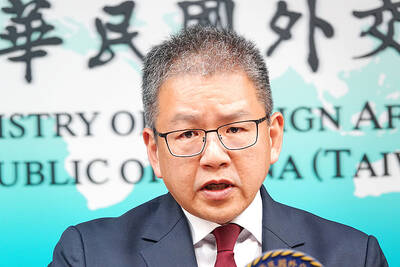
Taiwan is still in the process of assessing the possibility of recruiting workers from Eswatini, the Ministry of Foreign Affairs said yesterday, adding that its goal is to help Eswatini upgrade its vocational training centers. If there are plans to recruit workers from Eswatini, safeguarding national security, protecting public health and ensuring the employment rights of Taiwanese would be prerequisites, Department of West Asian and African Affairs Director-General Yen Chia-liang (顏嘉良) told a news conference. Key considerations would also include filling labor shortages in specific industries, and fostering bilateral professional and technical exchanges, he said. Yen was asked about the progress of labor
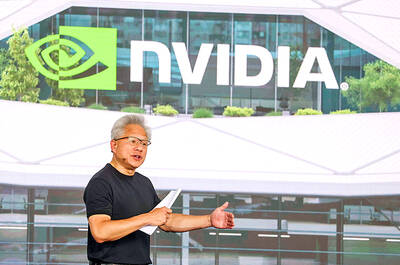
‘BOOMING’: ’ The number of partners we have here is incredible. You can see from their stock prices. They’re doing so well, they’re so happy,’ Jensen Huang said Nvidia Corp’s spending in Taiwan has ballooned to about US$150 billion a year, 10 times the US$10 billion to US$15 billion the company spent five years ago, Nvidia chief executive officer Jensen Huang (黃仁勳) said yesterday, suggesting Taiwan’s strategic importance in the global artificial intelligence (AI) supply chain. “Taiwan is the epicenter of the AI revolution. This is where the chips come, packaging comes. This is where the systems are made. This is where AI supercomputers were created,” Huang said at a meeting for the company’s employees in Beitou-Shilin Technology Park (北投士林科技園區) in Taipei, the planned site of Nvidia’s Taipei headquarters. “Taiwan


 RSS
RSS