


Taiwan would participate in the 2026 APEC summit to be hosted by China after Beijing promised it would ensure the personal safety of attendees, Taiwanese national security sources said yesterday.
The APEC Leaders’ Machu Picchu Declaration announced yesterday said that China would host the APEC summit in 2026.
Beijing proposed hosting the summit shortly before this year’s gathering began on Friday, a national security official said, speaking on condition of anonymity.
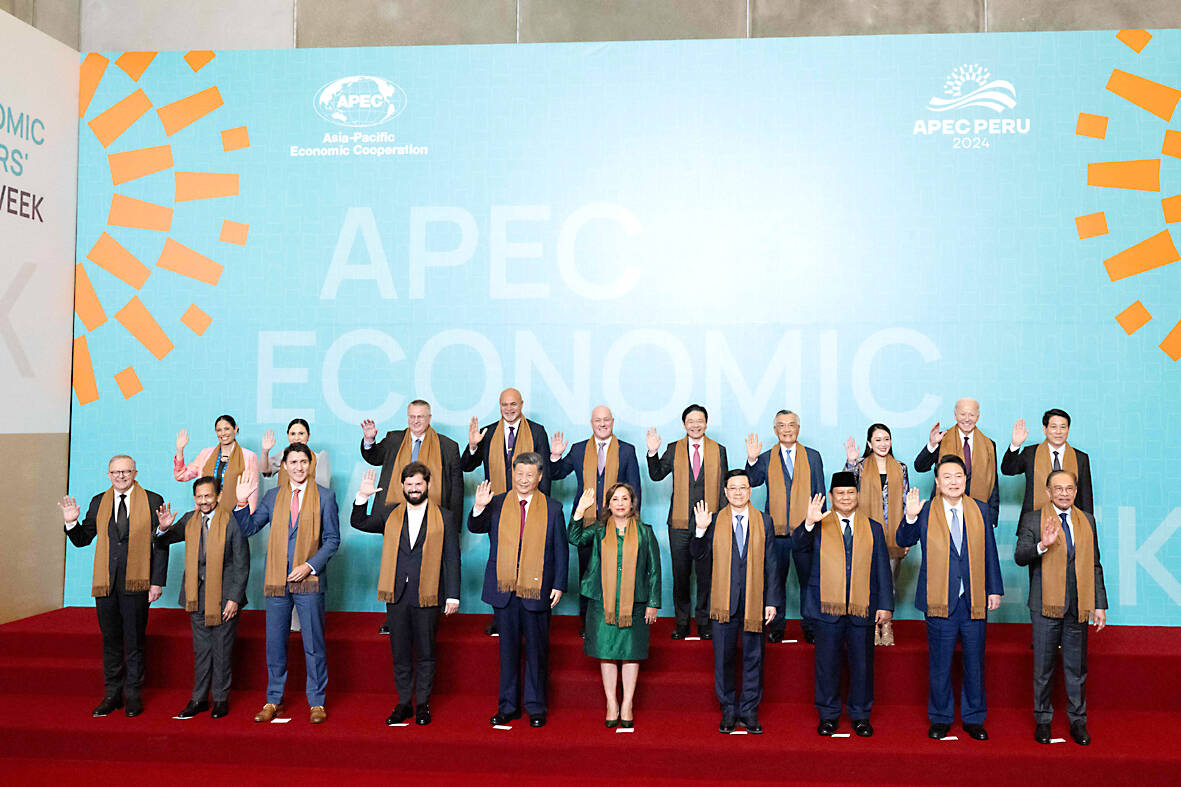
Photo: AFP
Many APEC members expressed concerns about China hosting the event and said that prior communication over the decision was insufficient, the official said.
Taiwan brought up concerns about legal “guidelines” China announced in June that impose the death penalty on “die-hard” Taiwanese independence advocates, they said.
While Chinese courts have no jurisdiction over Taiwan, Taipei had expressed worries the guidelines would be used against not only Taiwanese officials in China, but also those from other APEC members as well, they said.
As APEC decisions are made based on consensus, the announcement in the leaders’ declaration that China was hosting the 2026 summit means that members had reached a consensus on the issue, the official said.
That would require that Beijing properly respond to the concerns raised by each member and fulfill its promises to them, including equal treatment of member nations, conformity to APEC rules and protection of personal security, they said.
“Other APEC members have similar concerns, so the fact that a consensus was reached [on China hosting the forum] means Beijing has made promises in response to all members’ relevant concerns,” National Security Council Deputy Secretary-General Hsu Szu-Chien (徐斯儉) told a news conference on Saturday.
Meanwhile, Taiwan’s APEC envoy, Lin Hsin-i (林信義), on Saturday said that he greeted Chinese President Xi Jinping (習近平) with a wave at the summit, but there was no handshake or conversation, a sign of the tensions between Taipei and Beijing.
Taiwan does not send its president to summits due to China’s objections. The forum is one of the few international meetings that both Taiwan and China take part in, and where officials from the two sides can interact, even if just to exchange pleasantries.
Lin said that while Taiwan held bilateral talks with many APEC members, with the Chinese president, there was just a greeting gesture across the room where leaders were gathered.
“The motion of a greeting has no details,” he said, adding that they did not shake hands.
The lack of interaction with Xi contrasts with Lin’s meeting with US President Joe Biden the previous day, which the Taiwanese delegation described as a “lively” exchange of views.
Last year, Taiwan representative Morris Chang (張忠謀), founder of Taiwan Semiconductor Manufacturing Co (台積電), also spoke with Biden, but not Xi.
In 2022, then 91-year-old Chang had a “very pleasant” and “polite” interaction with Xi at an APEC forum in Bangkok, where Xi asked about Chang’s health and Chang congratulated Xi on the success of the Chinese Communist Party’s 20th National Congress.

‘NO SECURITY RISK’: The Railway Bureau reassured the public that the technicians’ activities were limited to technical guidance and did not involve sensitive systems The Railway Bureau yesterday said it had invited eight Chinese technicians to assist with an airport MRT construction project. The bureau issued the confirmation after an Internet user said Chinese nationals had entered the construction zone of Taiwan Taoyuan International Airport’s Terminal 3 project. They asked why “individuals from an enemy state” were allowed access to such a major national infrastructure project, which raised serious concerns over Taiwan’s industrial safety, sensitive systems and information security. The bureau’s Northern Region Engineering Branch Office said subcontractor Taiwan Handle Industrial Co (台灣手把工業) of the Taoyuan airport MRT’s “Contract No. CU05 Project A14 Station Civil, MEP &

A signaling system malfunction disrupted high-speed rail (HSR) services beginning at 8am today, with trains temporarily reduced to three northbound and three southbound trains per hour as authorities conduct inspections. The malfunction occurred on a section of track in Miaoli County during pre-operation checks early this morning, forcing northbound and southbound trains to use a single track, the HSR operator said. The regular schedule has been replaced with three hourly trains offering only nonreserved seating in each direction, stopping at every station, it said, adding that business class cars would still have reserved seating. Departures from terminal stations are scheduled at the top

Taiwan is still in the process of assessing the possibility of recruiting workers from Eswatini, the Ministry of Foreign Affairs said yesterday, adding that its goal is to help Eswatini upgrade its vocational training centers. If there are plans to recruit workers from Eswatini, safeguarding national security, protecting public health and ensuring the employment rights of Taiwanese would be prerequisites, Department of West Asian and African Affairs Director-General Yen Chia-liang (顏嘉良) told a news conference. Key considerations would also include filling labor shortages in specific industries, and fostering bilateral professional and technical exchanges, he said. Yen was asked about the progress of labor

A US uncrewed surface vessel (USV) encountered multiple Chinese warships during an autonomous transit of the Taiwan Strait, US defense company Seasats said in a statement on Wednesday. Seasats announced that a Lightfish USV had completed the first autonomous transit of the Taiwan Strait. Over five days, the USV traversed the entire length of the Strait while constantly monitoring surface vessel traffic, the company said. The Lightfish encountered multiple Chinese warships, one of which was a Chinese People’s Liberation Army Navy (PLAN) Type 056 corvette, it said. The Chinese vessels were operating “well within Taiwan’s exclusive economic zone without transmitting their identity via the


 RSS
RSS