


Taiwan’s envoy to the APEC summit, Lin Hsin-i (林信義), on Friday invited US President Joe Biden to visit Taiwan.
During the APEC Leaders’ Informal Dialogue, Lin, who represented President William Lai (賴清德) at the summit, spoke with Biden and expressed gratitude to the outgoing US president for his contribution to improving bilateral ties between Taipei and Washington over the past four years, the Ministry of Foreign Affairs said.
Lin and Biden exchanged views during the conversation, with Lin extending an invitation to Biden to visit Taiwan, it said.
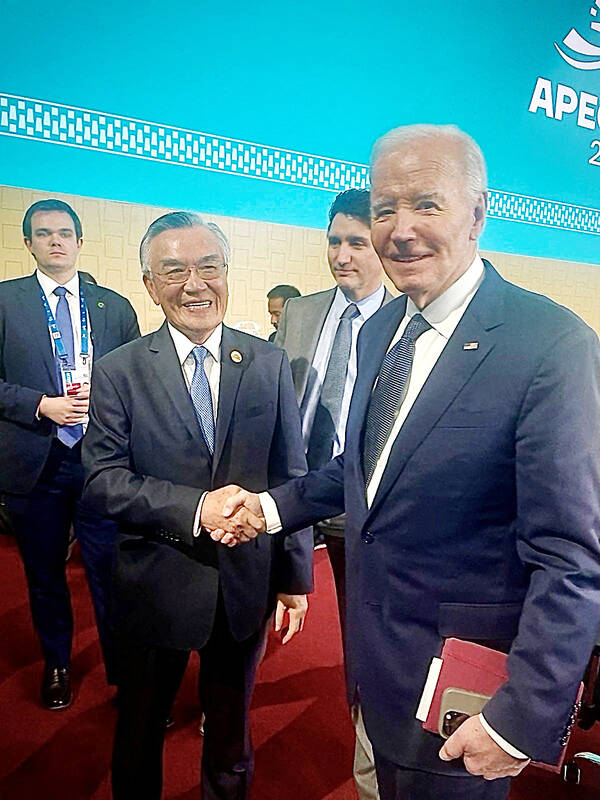
Photo courtesy of Taiwan’s APEC delegation
Biden is to step down in January next year, when US president-elect Donald Trump is to return to the White House for a second term.
A photograph showed Canadian Prime Minister Justin Trudeau looking on during the conversation between Lin and Biden.
The annual APEC Economic Leaders’ Meeting is the most important event for the 21-member regional trade bloc, with the heads of government from countries around the Pacific Rim attending to hold talks on the sidelines.
The organization is one of the few intergovernmental pacts in which Taiwan has full membership, but it still has to send special envoys in place of presidents to the annual leaders’ meeting due to pressure from China.
Taiwan joined APEC in 1991 under the name “Chinese Taipei.”
A Biden administration official downplayed the interaction, describing it as a “just a handshake” in the plenary room.
The White House did not immediately respond to a request for comment on whether Biden planned to visit.
Lin on Friday attended the APEC Leaders’ Informal Dialogue in the morning before a luncheon with representatives to the APEC Business Advisory Council followed by a dinner with leaders, the ministry said.
On Thursday, Lin held talks with US Secretary of State Antony Blinken ahead of the leaders’ meeting.
The two discussed ways to continue enhancing bilateral partnerships and ensuring regional peace and stability, while exchanging views on issues such as promoting the development of Taiwan’s diplomatic allies in the region, the ministry said.
Blinken also posted a photograph of the two shaking hands on social media, and wrote that their talks touched upon “our growing economic relationship and our enduring shared commitment to foster an open, dynamic and peaceful Indo-Pacific.”
Lin previously attended APEC meetings in Brunei in 2000, China in 2001 and South Korea in 2005, during the administration of thenpresident Chen Shui-bian (陳水扁).
Lin — a senior presidential adviser and chairman of Taiwania Capital Management Corp (台杉投資管理), a government-led investment vehicle — was economic affairs minister from 2000 to 2002 and vice premier from 2002 to 2004.
Additional reporting by Reuters

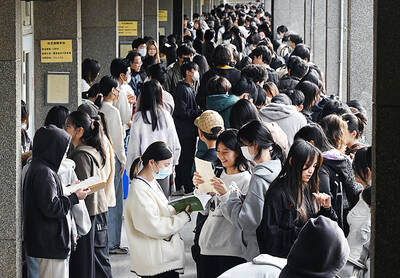
A global survey showed that 60 percent of Taiwanese had attained higher education, second only to Canada, the Ministry of the Interior said. Taiwan easily surpassed the global average of 43 percent and ranked ahead of major economies, including Japan, South Korea and the US, data from the Organisation for Economic Co-operation and Development (OECD) for 2024 showed. Taiwan has a high literacy rate, data released by the ministry showed. As of the end of last year, Taiwan had 20.617 million people aged 15 or older, accounting for 88.5 percent of the total population, with a literacy rate of 99.4 percent, the data
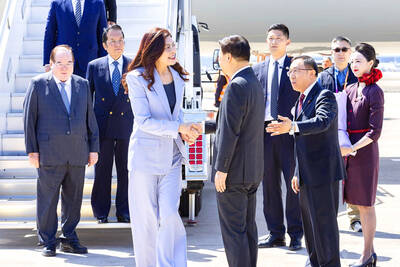
CCP ‘PAWN’? Beijing could use the KMT chairwoman’s visit to signal to the world that many people in Taiwan support the ‘one China’ principle, an academic said Chinese Nationalist Party (KMT) Chairwoman Cheng Li-wun (鄭麗文) yesterday arrived in China for a “peace” mission and potential meeting with Chinese President Xi Jinping (習近平), while a Taiwanese minister detailed the number of Chinese warships currently deployed around the nation. Cheng is visiting at a time of increased Chinese military pressure on Taiwan, as the opposition-dominated Legislative Yuan stalls a government plan for US$40 billion in extra defense spending. Speaking to reporters before going to the airport, Cheng said she was going on a “historic journey for peace,” but added that some people felt uneasy about her trip. “If you truly love Taiwan,
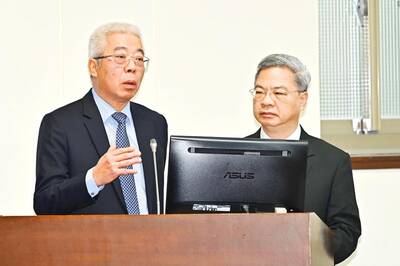
Taiwan has arranged for about 8 million barrels of crude oil, or about one-third of its monthly needs, to be shipped from the Red Sea this month to bypass the Strait of Hormuz and ease domestic supply pressures, CPC Corp, Taiwan (CPC, 台灣中油) said yesterday. The state-run oil company has worked with Middle Eastern suppliers to secure routes other than the Strait of Hormuz, through which about 20 percent of the world’s oil and liquefied natural gas typically passes, CPC chairman Fang Jeng-zen (方振仁) said at a meeting of the legislature’s Economics Committee in Taipei. Suppliers in Saudi Arabia have indicated they

NEW LOW: The council in 2024 based predictions on a pessimistic estimate for the nation’s total fertility rate of 0.84, but last year that rate was 0.69, 17 percent lower An expected National Development Council (NDC) report expects the nation’s population to drop below 12 million by 2065, with the old-age dependency ratio to top 100 percent sooner than 2070, sources said yesterday. The council is slated to release its latest population projections in August, using an ultra-low fertility model, the sources said. The previous report projected that Taiwan’s population would fall to 14.37 million by 2070, but based on a new estimate of the total fertility rate (TFR) — the average number of children born to a woman over her lifetime — the population is expected to reach 12 million by


 RSS
RSS