


Taiwan’s envoy to the upcoming APEC summit should emphasize the nation’s “positive contributions” in artificial intelligence (AI) and health, and commitment to continuing those efforts, President William Lai (賴清德) said yesterday.
At a news conference at the Presidential Office in Taipei, Lai laid out the tasks he expected the Taiwanese delegation, led by APEC envoy Lin Hsin-i (林信義), to undertake during the regional trade bloc’s Economic Leaders’ Week slated for Sunday to Saturday next week in Lima, Peru.
The delegation should aim to “promote Taiwan’s positive contributions to APEC,” highlighting the nation’s achievements in and contributions to AI, health and other fields over the years, Lai said.
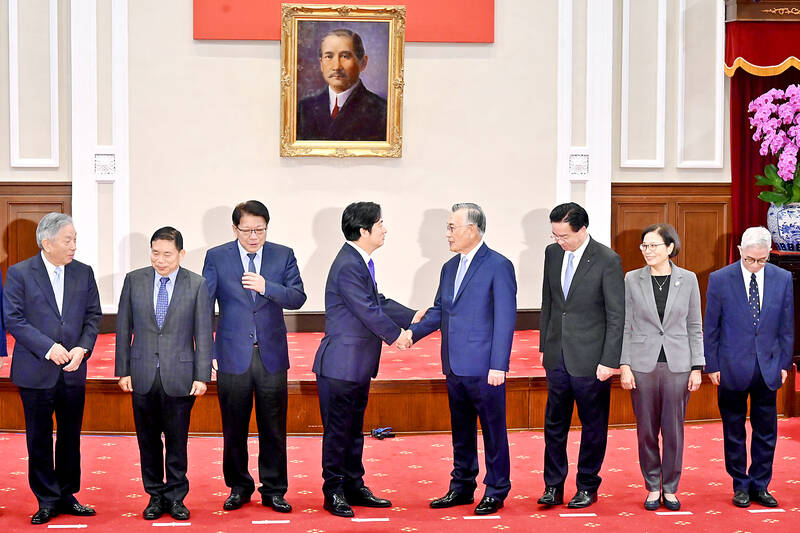
Photo: George Tsorng, Taipei Times
At the same time, Taiwan supports “a fairer and more inclusive international trade order,” Lai said, adding that the delegation should also express the nation’s “strong willingness” to work with APEC partners to promote the development of digital trade.
“I believe that Lin, with his professional skills and extensive experience, will be able to effectively convey Taiwan’s voice and perspectives to the other APEC economies,” he added.
Lin — chair of Taiwania Capital Management Corp (台杉投資管理), a government-funded venture capital firm, and a senior adviser to the president — is to attend the APEC summit on behalf of Taiwan for the second time.
The 77-year-old businessman previously served the same role in 2005 during the administration of former president Chen Shui-bian (陳水扁).
Lin served as economics minister from 2000 and 2002 and vice premier from 2002 to 2004 during Chen’s administration.
Lin said he would strive to fulfill the tasks entrusted by Lai and look for opportunities to have meetings or exchanges with other APEC leaders on the sidelines of the summit.
There have been challenges and opportunities for Taiwan given the volatile global economic and geopolitical situation, Lin said, adding that the delegation would showcase Taiwan as “a reliable member of the international community” and seek more support for the country.
Other members of the delegation include National Development Council Minister Liu Chin-ching (劉鏡清) and Taiwan’s top trade negotiator, Yang Jen-ni (楊珍妮).
Many heads of government, including the US and China, are expected to attend APEC’s Economic Leaders’ Meeting and hold talks on the sidelines next week.
Taiwan, which joined APEC in 1991 under the name “Chinese Taipei,” has sent special envoys in its presidents’ stead to the APEC summits over the years due to pressure from China.

The Tourism Administration yesterday announced that it would reward repeat international visitors with incentives of up to NT$8,000 to boost inbound tourism. The incentives are available to all international tourists, it said, adding that repeat visitors would be rewarded with NT$5,000 and would receive an additional NT$3,000 if they bring travel companions. The nation received 2,990,657 inbound visitors during the first quarter, marking a 3.8 percent increase from the same period last year, agency data showed. Japanese nationals are among groups visiting Taiwan the most. About 1.48 million Japanese tourists arrived last year, a year-on-year increase of more than 12
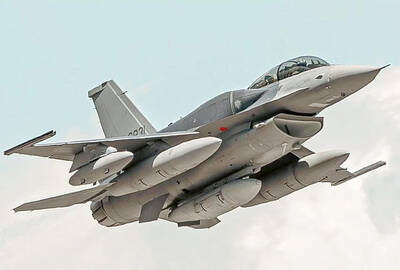
66 FIGHTER JETS: The aircraft is likely undergoing preparations for its transfer to Taiwan — a significant step forward in the nation’s modernization program, a lawmaker said The first of Taiwan’s order of F-16V Block 70 aircraft has been sighted in Texas ahead of delivery, Democratic Progressive Party (DPP) Legislator Wang Ting-yu (王定宇) said. Taiwan’s first F-16V Block 70 two-seat aircraft, tail number 6831, was seen flying from Lockheed Martin’s production facility in Greenville, South Carolina, to Naval Air Station Joint Reserve Base Fort Worth in Texas, Wang wrote on Facebook yesterday. The plane is likely undergoing preparations for its transfer to Taiwan, marking a significant step forward in the Republic of China Air Force’s modernization program, Wang said, citing military analysts. The F-16V Block 70 is a new-build version
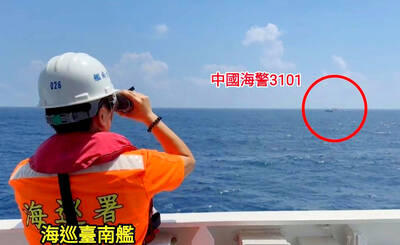
‘BRAZEN’: The holiday did not stop China from activities that infringe on Taiwan’s maritime jurisdiction, but the CGA is ready to defend the nation, Kuan Bi-ling said Beijing is intensifying maritime pressure on Taiwan, but the nation will never yield, Ocean Affairs Council Deputy Minister Sung Chen-en (宋承恩) said. The Coast Guard Administration (CGA) has adopted a “shadowing and monitoring” approach to avoid falling into a Chinese trap to escalate tensions and deepen the conflict, Sung said in an interview published yesterday in the Chinese-language Liberty Times (the Taipei Times’ sister newspaper). China Coast Guard formations patrolling waters east of Taiwan, as well as official Chinese vessels entering areas around Itu Aba Island (Taiping Island, 太平島) and Pratas Islands (Dongsha Islands, 東沙群島) show Beijing’s attempts to significantly step up
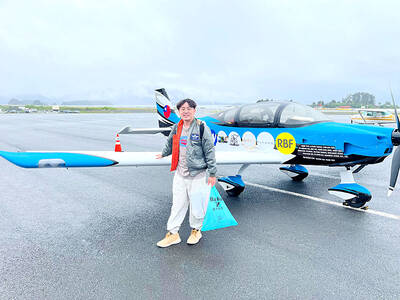
Taiwanese aviator Roger Lin (林睿哲) returned to Taiwan on Saturday after completing a nine-day round-the-world journey in a single-engine aircraft, becoming the first Taiwanese pilot to achieve the feat. Lin departed on June 5 from Los Angeles, California, and continued through Alaska, Japan, Taiwan, the Philippines, Indonesia, Malaysia, Thailand, Nepal, Jordan, Norway, Iceland and Canada before landing at the Taipei International Airport (Songshan) via Los Angeles and Japan. Lin shared numerous photos and videos of his journey on a Facebook page titled “Pilot Roger’s Around the World Flight,” including a video showing his aircraft flying over the Danjiang Bridge and


 RSS
RSS