


Taiwan’s population could fall below 15 million by 2070, suggesting that issues with the nation’s aging population and declining birthrate would not improve, the National Development Council (NDC) said in its latest population projection released yesterday.
The council publishes its population projections every two years using household registration data, with this year being the first that it included a survey of experts to help model more accurate fertility trends.
Taiwan’s aging population has already started to affect all aspects of society, the council said, adding that it would continue to collaborate with ministries to address demographic issues.
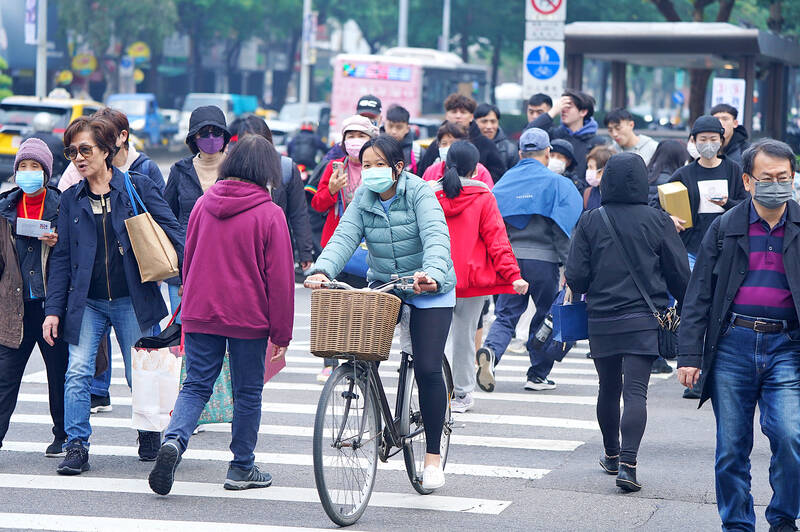
Photo: CNA
According to the latest projections, if each woman only has one child over the course of her lifetime, the short-term projections would remain in line with estimates.
Long-term, the consequences of an aging society would become increasingly severe, it said.
Taiwan is not alone in this.
About one-quarter of countries’ populations are expected to decline this year, including Taiwan, China, Japan and South Korea, the council said.
Taiwan’s population could drop from 23.4 million this year to 14.97 million by 2070, a decline of 8.4 million people, it said.
Broken down by age group, there is a projected decline of 1.71 million in the zero-to-14 age group, a decline of 9.2 million in the 15-to-64 working-age population and an increase of 2.48 million for those aged 65 or older, it said.
By next year, Taiwan is expected to be a “super-aged society,” meaning that 20 percent of the population is 65 or older, it added.
In March, the NDC announced that six of Taiwan’s 22 administrative regions were already “super-aged.”
As of this year, 40 countries and regions globally fit the criteria of “super-aged societies,” including Japan, Germany and France, the NDC said.
Taiwan’s demographic dividend — the economic benefit of a large population of workers relative to dependents, such as children or elderly family members — is projected to end by 2028, when the proportion of people in the working-age category is expected to drop below two-thirds of the population, it said.
Due to the combination of increased life expectancies and declining birthrates, the share of the population that is 65 or older is expected to rise from 19.2 percent to 46.5 percent in 2070, while the median age is to increase to 62.4 from 45.1, it said.
Additionally, the ratio of 3.6 working-age people to each elderly person would decline to one-to-one, it said.

Taiwan Semiconductor Manufacturing Co (TSMC, 台積電), the world’s largest foundry service provider, yesterday said that global semiconductor revenue is projected to hit US$1.5 trillion in 2030, after the figure exceeds US$1 trillion this year, as artificial intelligence (AI) demand boosts consumption of token and compute power. “We are still at the beginning of the AI revolution, but we already see a significant impact across the whole semiconductor ecosystem,” TSMC deputy cochief operating officer Kevin Zhang (張曉強) said at the company’s annual technology symposium in Hsinchu City. “It is fair to say that in the past decade, smartphones and other mobile devices were
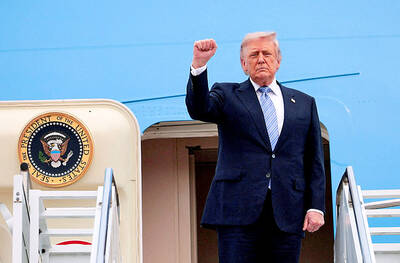
US-CHINA SUMMIT: MOFA welcomed US reassurance of no change in its Taiwan policy; Trump said he did not comment when Xi talked of opposing independence US President Donald Trump yesterday said he has not made a decision on whether to move forward with a major arms package for Taiwan after hearing concerns about it from Chinese President Xi Jinping (習近平). Trump’s comments on Taiwan came as he flew back to Washington after wrapping up critical talks in which both leaders said important progress was made in stabilizing US-China relations even as deep differences persist between the world’s two biggest powers on Iran and Taiwan. “I will make a determination,” Trump said, adding: “I’ll be making decisions. But, you know, I think the last thing we need right

TAIWAN ISSUE: US treasury secretary Scott Bessent said on the first day of meetings that ‘it wouldn’t be a US-China summit without the Taiwan issue coming up’ There were no surprises on the first day of the summit between US President Donald Trump and Chinese President Xi Jinping (習近平), the Mainland Affairs Council (MAC) said yesterday, as the government reiterated that cross-strait stability is crucial to the Asia-Pacific region, as well as the world. As the two presidents met for a highly anticipated summit yesterday, Chinese state media reported that Xi warned Trump that missteps regarding Taiwan could push their two countries into “conflict.” Trump arrived in China with accolades for his host, calling Xi a “great leader” and “friend,” and extending an invitation to visit the White House
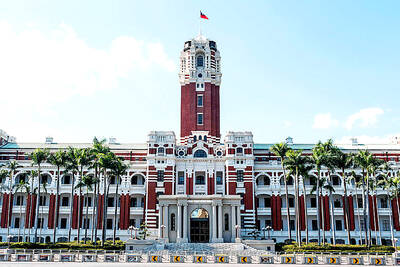
SECURITY: Taipei presses the US for arms supplies, saying the arms sales are not only a reflection of the US security commitment to Taiwan but also serve as a mutual deterrent against regional threats Taiwan is committed to preserving the cross-strait “status quo” and contributing to regional peace and stability, the Presidential Office said yesterday. “It is an undeniable fact that the Republic of China is a sovereign and independent democratic nation,” Presidential Office spokeswoman Karen Kuo (郭雅慧) reiterated, adding that Beijing has no right to claim sovereignty over Taiwan. The statements came after US President Donald Trump warned against Taiwanese independence. Trump wrapped up a state visit to Beijing on Friday, during which Chinese President Xi Jinping (習近平) had pressed him not to support Taiwan. Taiwan depends heavily on US security backing to deter China from carrying


 RSS
RSS