


The outer rim of Typhoon Krathon made landfall in Taitung County and the Hengchun Peninsula (恆春半島) at about noon yesterday, the Central Weather Administration (CWA) said, adding that the eye of the storm was expected to hit land tomorrow.
The CWA at 2:30pm yesterday issued a land alert for Krathon after issuing a sea alert on Sunday. It also expanded the scope of the sea alert to include waters north of Taiwan Strait, in addition to its south, from the Bashi Channel to the Pratas Islands (Dongsha Islands, 東沙群島).
As of 6pm yesterday, the typhoon’s center was 160km south of Oluanpi (鵝鑾鼻), Taiwan’s southernmost point, and was moving northwest at 6kph, CWA senior weather forecaster Wu Wan-hua (吳婉華) said.
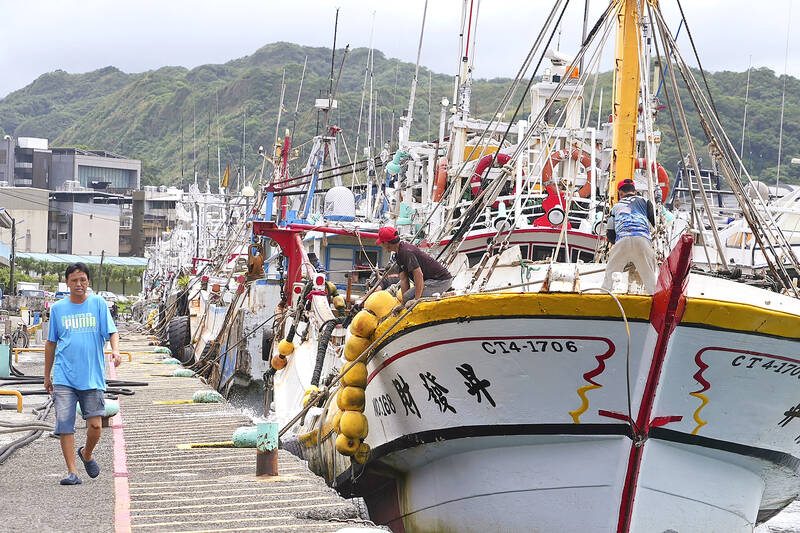
Photo: Johnson Lai, AP
The maximum wind speed near the typhoon’s center topped 162km, with its radius reaching 200km, CWA data showed.
“Based on its projected path of movement, it could turn into a strong typhoon or even a super typhoon if the atmospheric environment facilitates that development,” Wu said.
Krathon’s intensity and structure would remain intact before it begins to affect the nation, and it would not start moving north until this afternoon, she said.
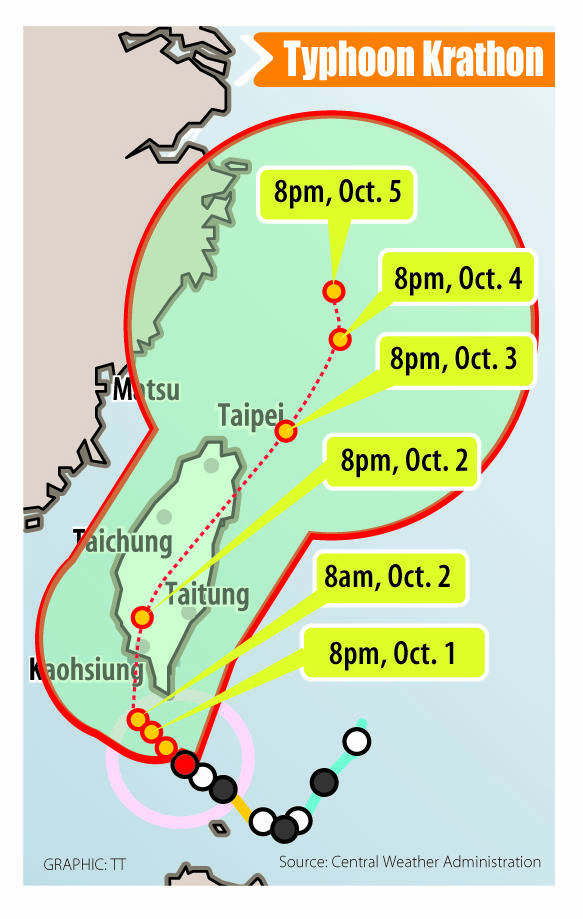
“However, the typhoon is not likely to move very fast after it makes landfall in southern Taiwan. It is expected to move northeasterly before departing from Taiwan and to influence the country until Thursday,” she said.
As the typhoon approaches, chances for extremely heavy rainfall are high today and tomorrow in Hualien and Taitung counties, the Hengchun Peninsula, as well as in mountainous areas in central, southern and northeastern Taiwan, she said.
CWA had detected a 7m high tide near Orchid Island (Lanyu, 蘭嶼), she added.
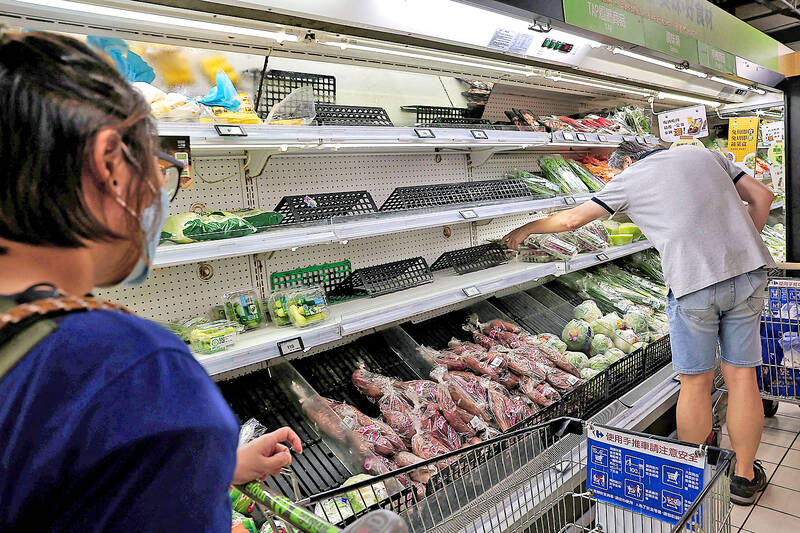
Photo: Ann Wang, Reuters
The agency’s forecast showed tides around Taiwan could reach 2m to 4m today, while tides in Hualien, Taitung and the Hengchun Peninsula could exceed 6m.
People in Tainan, Kaohsiung, Pingtung and Chiayi counties should expect saltwater intrusion and other negative impacts, the agency said.
Heavy rainfall is forecast in Hualien, Taitung and Hengchun Peninsula today, with the wind and rain getting stronger in southern Taiwan at night, it said.
Tomorrow, rain would persist in Hualien and Taitung, and stronger rain and winds would also batter northern Taiwan, it said.
Although the typhoon is expected to move away from Taiwan on Thursday, the chances of extremely heavy rain are high in northern Taiwan, while the rain is expected to ease in Hualien, Taitung and southern Taiwan, it said.
Winds in coastal areas remain strong. About 15,000 military personnel are ready to participate in rescue operations and disaster relief work.
The air force said it has canceled its drills tomorrow and on Thursday.
Tainan and Kaohsiung, as well as Taitung, Pingtung, Hualien and Chiayi counties announced that school and work would be canceled today.
Work and school continue as usual today in the rest of the nation.
Taiwan Railway Corp has also adjusted operations of eastbound trains via North Link and South Link lines. The Alishan Forest Railway would be closed tomorrow and on Thursday.
As of 10am yesterday, 22 domestic flights had been canceled, as well as ferry services connecting Taiwan proper and outlying islands.


RESILIENCE: Taiwan plays a key role in semiconductors, energy, information infrastructure and advanced manufacturing, AIT Director Raymond Greene said Taiwan’s continued investment in deterrence and resilience remains vital, especially in uncrewed systems and other emerging technologies, American Institute in Taiwan (AIT) Director Raymond Greene said yesterday. Greene made the remarks at the annual National Strategic Summit on Supply Chain Resilience held by the Research Institute for Democracy, Society and Emerging Technology (DSET), a government-backed think tank. As Taiwan last year became the US’ fourth-largest trading partner and supply chain security is becoming more important, cooperation in emerging technologies continues to deepen between the two countries, he said. The US is committed to accelerating innovation, building key infrastructure, strengthening cooperation

The National Chungshan Institute of Science and Technology yesterday showcased its locally developed variants of the Vision 60 robotic patrol dog, which it plans to deploy on the nation’s outlying territories in the South China Sea. The variants were produced under the Joint Lab project — created by the institute and domestic companies — and assembled with domestically produced motors, lenses and artificial intelligence (AI) systems alongside licensed tech from the US, Missile and Rocket Systems Research Division deputy director Jen Kuo-kang (任國光) told the media event at a military base in Taipei’s Dazhi (大直) area. Taiwan has built up its strengths

RIGHT DIRECTION: Taiwan’s efforts to prevent forced labor include a proposal to ‘fully prohibit’ employers from withholding workers’ documents, an official said Taiwan is to establish a mechanism to restrict imports of goods linked to forced labor, the Executive Yuan said yesterday, after the US proposed imposing additional tariffs on Taiwanese goods over labor concerns. “The Ministry of Labor and the Ministry of Economic Affairs are to establish an interministerial review procedure,” Executive Yuan spokesperson Michelle Lee (李慧芝) said at a news briefing in Taipei. “The government is to use the Foreign Trade Act [貿易法] as the legal basis to restrict imports of goods produced with forced labor” and bring its supply chain governance more in line with international standards on human rights, resilience

NOT IMMEDIATE: Taiwan has a chance to appeal the proposed 10 percent tariff before it starts, while other countries face a 12.5 percent tariff from the trade office Taiwan is among 60 economies determined by the US to have failed to impose or enforce a ban on the importation of goods produced with forced labor, according to a notice released on Tuesday by the Office of the US Trade Representative (USTR), which proposed imposing an additional 10 percent or more tariff on them. The USTR in a statement said that following an investigation, it had determined under Section 301 of the Trade Act of 1974 that the failure of the 60 economies to impose and effectively enforce a prohibition on the importation of goods produced with forced labor is


 RSS
RSS