


Prosecutors yesterday requested the detention of a Taipei City councilor and a businessman in connection to a corruption case embroiling former Taipei mayor and Taiwan People’s Party (TPP) Chairman Ko Wen-je (柯文哲).
Prosecutors requested pretrial detention for Taipei City Councilor Angela Ying (應曉薇) of the Chinese Nationalist Party (KMT) and Core Pacific Group (威京集團) chairman Sheen Ching-jing (沈慶京) for their suspected involvement in bribery related to real-estate dealings.
Ying was arrested on Tuesday night at Taichung International Airport as she was about to board a flight to Hong Kong.
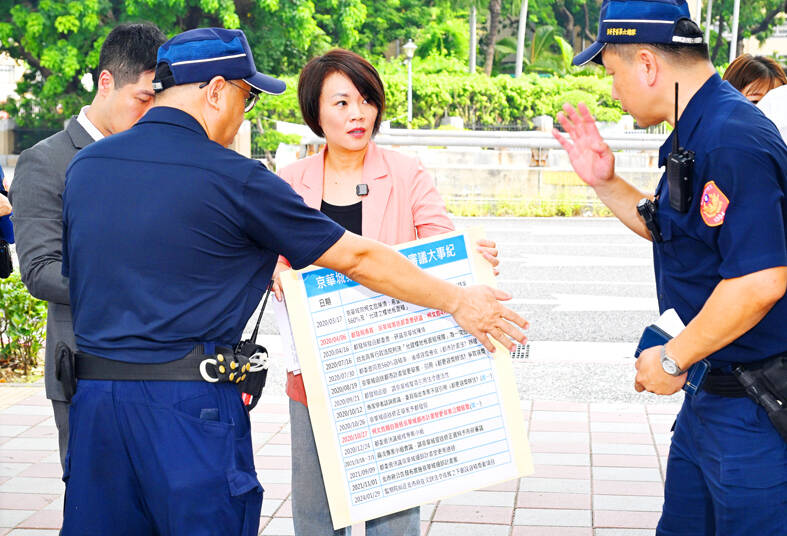
Photo: Liao Chen-huei, Taipei Times
Several of their associates were released on bail, while a request to detain Ying’s assistant, Wu Shun-min (吳順民), was approved.
Six suspects have been named in the case, and 12 witnesses had been questioned as of Wednesday evening.
In the ongoing investigation by Taipei prosecutors and the Ministry of Justice’s Agency Against Corruption, evidence reportedly pointed to Sheen making several transfers totaling NT$45 million (US$1.41 million) to Ying, who allegedly conducted five negotiations with the Taipei City Government regarding Sheen’s Living Mall redevelopment project.
The investigation also found Sheen had allegedly set up a special fund of about NT$300 million for “public relations expenses” which the prosecutors suspect served as bribe money for other city councilors and officials.
When questioned on Wednesday, Sheen was quoted as saying that government officials from the administration of former Taipei mayor Hau Lung-bin (郝龍斌) and Ko had met with him, asking to pay bribes to approve a redevelopment project with increased floor area ratio (FAR), allegedly for Core Pacific Group to add more than NT$40 billion to its financial gains.
Ying allegedly acted as an intermediary between Ko and Sheen, with city government records showing that Ying had arranged for three lunch meetings between the two.
As a city councilor, she also allegedly lobbied for approval of the project and pressured city officials during meetings to grant a higher FAR, raising it to 392 percent and finally to 840 percent, other city councilors said.
KMT Taipei City Councilor Chung Hsiao-ping (鍾小平) said that Ying had had good relations with Sheen for decades, as their families had known each other.
Ying has served four terms as city councilor, with Sheen being the main financial backer for her campaigns, Chung said.
After preliminary investigations in May, Ko was listed as a suspect in the case for possible contravention of the Anti-Corruption Act (貪污治罪條例).
News reports said that prosecutors would serve summons to Ko for questioning early next week.
Meanwhile, other city councilors from the KMT and the Democratic Progressive Party have alleged over the past few days that Ko had made several personal visits to venues owned by Sheen.
Asked about the allegation, Ko said that he went to a private dinner and an event held by Sheen, but only after the presidential election in January, while denying having other meetings with him.

The National Chungshan Institute of Science and Technology yesterday showcased its locally developed variants of the Vision 60 robotic patrol dog, which it plans to deploy on the nation’s outlying territories in the South China Sea. The variants were produced under the Joint Lab project — created by the institute and domestic companies — and assembled with domestically produced motors, lenses and artificial intelligence (AI) systems alongside licensed tech from the US, Missile and Rocket Systems Research Division deputy director Jen Kuo-kang (任國光) told the media event at a military base in Taipei’s Dazhi (大直) area. Taiwan has built up its strengths

RIGHT DIRECTION: Taiwan’s efforts to prevent forced labor include a proposal to ‘fully prohibit’ employers from withholding workers’ documents, an official said Taiwan is to establish a mechanism to restrict imports of goods linked to forced labor, the Executive Yuan said yesterday, after the US proposed imposing additional tariffs on Taiwanese goods over labor concerns. “The Ministry of Labor and the Ministry of Economic Affairs are to establish an interministerial review procedure,” Executive Yuan spokesperson Michelle Lee (李慧芝) said at a news briefing in Taipei. “The government is to use the Foreign Trade Act [貿易法] as the legal basis to restrict imports of goods produced with forced labor” and bring its supply chain governance more in line with international standards on human rights, resilience

NOT IMMEDIATE: Taiwan has a chance to appeal the proposed 10 percent tariff before it starts, while other countries face a 12.5 percent tariff from the trade office Taiwan is among 60 economies determined by the US to have failed to impose or enforce a ban on the importation of goods produced with forced labor, according to a notice released on Tuesday by the Office of the US Trade Representative (USTR), which proposed imposing an additional 10 percent or more tariff on them. The USTR in a statement said that following an investigation, it had determined under Section 301 of the Trade Act of 1974 that the failure of the 60 economies to impose and effectively enforce a prohibition on the importation of goods produced with forced labor is

TIT-FOR-TAT: The US allegedly revoked the visa of a Chinese national working at Xinhua News Agency in the US in response to Beijing’s expulsion of Vivian Wang The Presidential Office yesterday condemned China for expelling a New York Times correspondent from Beijing following the newspaper’s interview with President William Lai (賴清德), saying the move highlighted Beijing’s suppression of press freedom and its threat to international news media. Taiwan has noted a series of recent incidents in which Beijing used similar tactics to “threaten and pressure international media outlets and journalists,” Presidential Office spokeswoman Karen Kuo (郭雅慧) said in a statement. “This concerns not only press freedom and freedom of expression, but also the safety of journalists, and Taiwan and relevant partners are paying close attention to the situation,” she


 RSS
RSS