


Pakistan is trying to stay relevant through “terrorism” and “proxy war,” but its “unholy plans” would never succeed, Indian Prime Minister Narendra Modi said yesterday.
The South Asian neighbors share an uneasy relationship and India has, for decades, accused Pakistan of backing Islamist militants fighting its rule in Kashmir, the Himalayan region both claim in full, but rule only in part.
Pakistan denies the accusations, saying it only provides diplomatic and moral support to Kashmiris seeking self-determination in the Muslim-majority region.
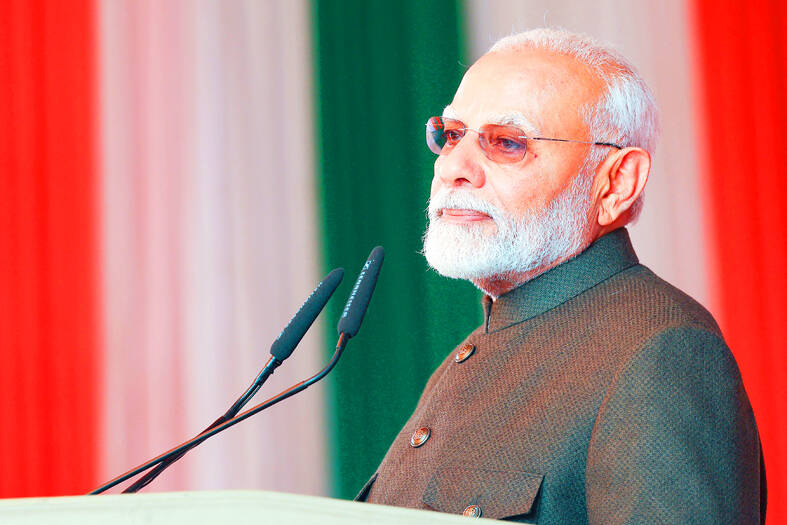
Photo: AFP / Indian Press Information Bureau
Modi’s comments came at an event to mark the 25th anniversary of India’s short military conflict with Pakistan in the Himalayan region of Kargil.
The rivals have also fought three wars, two of them over Kashmir.
They also come in the aftermath of a spate of militant attacks in the Hindu-majority Jammu region of Jammu & Kashmir — as the territory is formally called — with almost a dozen Indian soldiers killed this year.
Modi said that Pakistan was humiliated whenever it tried to further its plans, but had “not learned anything from its history.”
“I want to tell these patrons of terrorism that their unholy plans will never be successful... Our brave [forces] will squash terrorism, the enemy will be given a befitting reply,” he said.
The Pakistani Ministry of Foreign Affairs did not respond immediately to a request for comment.
India-Pakistan relations have been largely frozen as the two countries downgraded their diplomatic ties in tit-for-tat moves in August 2019 after New Delhi scrapped Kashmir’s special status and split it into two federally administered territories.
Ties were further strained after a suicide bombing of an Indian military convoy in Kashmir was traced to Pakistan-based militants, prompting India to carry out an airstrike on what it said was a militant base in Pakistan.
Earlier this year, Pakistan said there was credible evidence linking Indian agents to the killing of people on its soil — accusations that India termed “fake.”
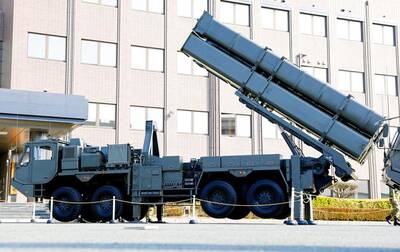
Japan has deployed long-range missiles in a southwestern region near China, the Japanese defense minister said yesterday, at a time when ties with Beijing are at their lowest in recent years. The missiles were installed in Kumamoto in the southern region of Kyushu, as Japan is attempting to shore up its military capacity as China steps up naval activity in the East China Sea. “Standoff defense capabilities enable us to counter the threat of enemy forces attempting to invade our country ... while ensuring the safety of our personnel,” Japanese Minister of Defense Shinjiro Koizumi said. “This is an extremely important initiative for

Chinese Nationalist Party (KMT) Chairwoman Cheng Li-wun (鄭麗文) today accepted an invitation from Chinese President Xi Jinping (習近平) to lead a delegation to China next month, saying she hopes to promote the peaceful development of cross-strait relations and bring stability to the Taiwan Strait. “I am grateful and happy to accept this invitation,” Cheng said in a statement from the KMT chairperson’s office. Cheng said she hopes both sides can work together to promote the peaceful development of cross-strait relations, enhance exchange and cooperation, bring stability to the Taiwan Strait and improve people’s livelihoods. At today's news conference, Cheng said any efforts to

MORE POPULAR: Taiwan Pass sales increased by 59 percent during the first quarter compared with the same period last year, the Tourism Administration said The Tourism Administration yesterday said that it has streamlined the Taiwan Pass, with two versions available for purchase beginning today. The tourism agency has made the pass available to international tourists since 2024, allowing them to access the high-speed rail, Taiwan Railway Corp services, four MRT systems and four Taiwan Tourist Shuttles. Previously, five types of Taiwan Pass were available, but some tourists have said that the offerings were too complicated. The agency said only two types of Taiwan Pass would be available, starting from a three-day pass with the high-speed rail and a three-day pass with Taiwan Railway Corp. The former costs NT$2,800

The nation’s fastest supercomputer, Nano 4 (晶創26), is scheduled to be launched in the third quarter, and would be used to train large language models in finance and national defense sectors, the National Center for High-Performance Computing (NCHC) said. The supercomputer, which would operate at about 86.05 petaflops, is being tested at a new cloud computing center in the Southern Taiwan Science Park in Tainan. The exterior of the server cabinet features chip circuitry patterns overlaid with a map of Taiwan, highlighting the nation’s central position in the semiconductor industry. The center also houses Taiwania 2, Taiwania 3, Forerunner 1 and


 RSS
RSS