


Taiwan and the US should invest in low-cost, long-range drones to be deployed en masse in the event of a Taiwan-China military conflict, a US think tank said in a recent report.
In a report titled “Swarms over the Strait: Drone Warfare in a Future Fight to Defend Taiwan,” released on Thursday last week, Washington-based think tank the Center for a New American Security said a diversified fleet of drones could help stave off a Chinese invasion of Taiwan.
“The United States needs a diverse fleet of aerial drones that includes a mix of higher-end and cheaper systems,” the report said.
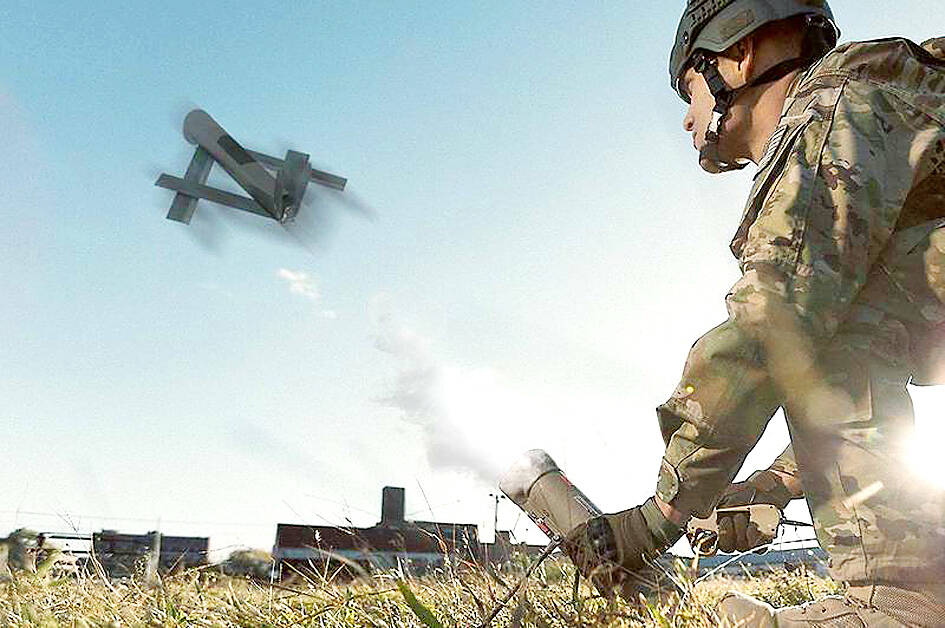
Photo: Screen grab from AeroVironment’s Facebook page
That mix should include “‘good enough’ long-range drones for target acquisition and strike,” as well as “a smaller number of stealthy drones that can conduct surveillance in highly contested airspace,” along with “more sophisticated drones ... as a part of the collaborative combat aircraft program,” it said.
However, as the US alone could not compete with China in drone production, Taiwan would also need to invest heavily in building its own drone fleet, the report said.
“Chinese forces are better positioned to leverage drones than the United States or Taiwan. China already has a large and diverse fleet of relatively inexpensive drones that it could employ to find and attack US and Taiwanese forces,” it said.
The US would need to acquire more long-range drones, Taiwan would need to build up its fleet of short and medium-range drones, and both would need to develop “more sophisticated and autonomous drones for the future,” it said.
If a conflict broke out today in the Taiwan Strait, China would have an advantage due to its larger drone fleet and ability to manufacture military drones at a lower cost, the report said.
The US Department of Defense should “explore efforts to repurpose existing technologies, such as the Vampire system created for Ukraine, and find gun or cannon-based systems that can be fielded quickly and are much cheaper than missile interceptors,” it said.
The US military would also face a geographical disadvantage, as it would need to operate drones from bases farther away from the conflict than China would, it said.
“I don’t know if this is a fair fight,” Center for a New American Security senior fellow and defense program director Stacie Pettyjohn said.
In the Taiwan Strait scenario, many factors would work against the US, but its forces could do a lot to level the playing field to some extent, Pettyjohn said.
For example, the US could prioritize the development of “good enough” long-range drones that are cheap and can be purchased and replaced in large quantities, she said.
Such an approach would be diametrically opposed to the US Department of Defense’s current approach, which uses long and medium-range precision drones such as the RQ-4 Global Hawk and the MQ-9 Reaper, she said.
Those types of drones are in high demand and provide valuable tracking and strike capabilities, but over time are likely to be shot down, she said.
As an example of cheaper, but effective, drones that could be used for Taiwan’s defense, the US and Taiwan could employ loitering munitions, also known as exploding or suicide drones, which could attack Chinese ships in the Strait, the report said.
Taiwan could also use multilayered defense systems capable of disabling Chinese drones, it said.
The report recommended that the US establish a rigorous training program for drone pilots and develop operational concepts and tactics for the use of drones throughout the Indo-Pacific region.
Meanwhile, Taiwan could cultivate its commercial drone industry, invest in suicide drones and study how to integrate drones with ground firepower, it said.
Taiwan could also focus on maritime drones and inexpensive first-person view drone systems, which are commonly used by amateurs to film videos, but could also be used as single-use attack drones, it said.
“Ultimately, the United States must recognize that while drones alone would not win a war against China to defend Taiwan, they have become a key part of the competition and the United States cannot afford to remain behind,” the report said.
“Drones provide affordable airpower, but they have not replaced traditional air forces or been used to obtain air superiority,” it said.

The Legislative Yuan’s Finance Committee yesterday approved proposed amendments to the Amusement Tax Act (娛樂稅法) that would abolish taxes on films, cultural activities and competitive sporting events, retaining the fee only for dance halls and golf courses. The proposed changes would set the maximum tax rate for dance halls and golf courses at 50 and 20 percent respectively, with local governments authorized to suspend the levies. Article 2 of the act says that “amusement tax shall be levied on tickets sold or fees charged by amusement places, facilities or activities” in six categories: “Cinema; professional singing, story-telling, dancing, circus, magic show, acrobatics

Tainan, Taipei and New Taipei City recorded the highest fines nationwide for illegal accommodations in the first quarter of this year, with fines issued in the three cities each exceeding NT$7 million (US$220,639), Tourism Administration data showed. Among them, Taipei had the highest number of illegal short-term rental units, with 410. There were 3,280 legally registered hotels nationwide in the first quarter, down by 14 properties, or 0.43 percent, from a year earlier, likely indicating operators exiting the market, the agency said. However, the number of unregistered properties rose to 1,174, including 314 illegal hotels and 860 illegal short-term rental
INFLATION UP? The IMF said CPI would increase to 1.5 percent this year, while the DGBAS projected it would rise to 1.68 percent, with GDP per capita of US$44,181 The IMF projected Taiwan’s real GDP would grow 5.2 percent this year, up from its 2.1 percent outlook in January, despite fears of global economic disruptions sparked by the US-Iran conflict. Taiwan’s consumer price index (CPI) is projected to increase to 1.5 percent, while unemployment would be 3.4 percent, roughly in line with estimates for Asia as a whole, the international body wrote in its Global Economic Outlook Report published in the US on Monday. The figures are comparatively better than the IMF outlook for the rest of the world, which pegged real GDP growth at 3.1 percent, down from 3.3 percent

ECONOMIC COERCION: Such actions are often inconsistently applied, sometimes resumed, and sometimes just halted, the Presidential Office spokeswoman said The government backs healthy and orderly cross-strait exchanges, but such arrangements should not be made with political conditions attached and never be used as leverage for political maneuvering or partisan agendas, Presidential Office spokeswoman Karen Kuo (郭雅慧) said yesterday. Kuo made the remarks after China earlier in the day announced 10 new “incentive measures” for Taiwan, following a landmark meeting between Chinese President Xi Jinping (習近平) and Chinese Nationalist Party (KMT) Chairwoman Cheng Li-wun (鄭麗文) in Beijing on Friday. The measures, unveiled by China’s Xinhua news agency, include plans to resume individual travel by residents of Shanghai and China’s Fujian


 RSS
RSS