


US President Joe Biden and French President Emmanuel Macron agreed on the need to better cooperate to counter China’s economic practices, a topic that has sometimes caused friction between the two leaders.
Macron on Saturday hosted Biden in Paris for a state visit, where they discussed steps the US and Europe could take to make their economies more resilient against Chinese imports.
“We voiced the same concerns about China’s potentially unfair practices, which result in the creation of overcapacity, a subject of such importance to the global economy that we need to act in a coordinated manner,” Macron told reporters.
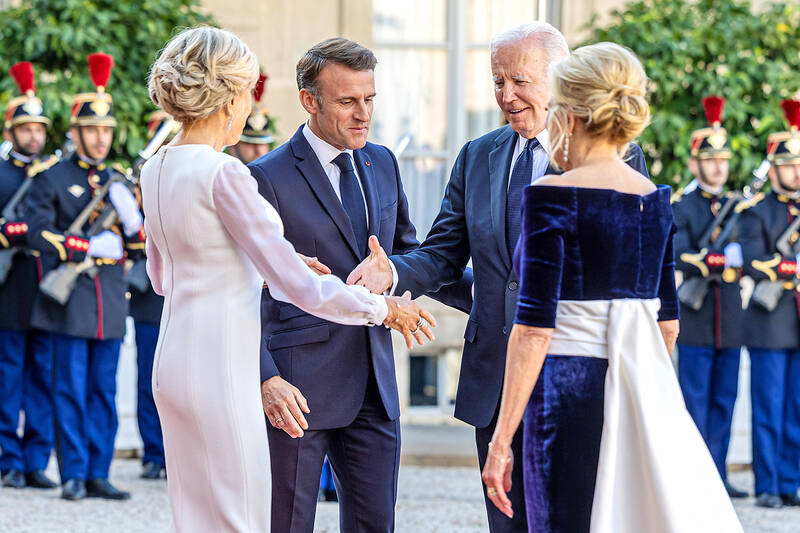
Photo: EPA-EFE
Biden did not raise the topic while being questioned by journalists with Macron.
However, while chatting earlier under an umbrella in a courtyard of the Elysee Palace, Biden told Macron that the US and Europe ought to “coordinate together” on domestic investments.
Reporters heard Biden tell Macron about his last discussion with Chinese President Xi Jinping (習近平), who Biden said had objected to US tariffs on Chinese electric vehicles.
The US president said he defended the import duties during the conversation.
Biden’s signature Inflation Reduction Act has irked European leaders, including Macron, who worry that the billions of dollars in subsidies it authorized to make the US clean-energy sector more competitive against China’s could disadvantage European firms. Biden has touted the measure as the largest-ever US investment in fighting climate change.
“We’re working together to accelerate the transition to net zero. It is the existential threat to humanity,” Biden said on Saturday, referring to global warming.
Biden traveled to France to mark the 80th anniversary of the D-Day landings on Thursday.
The state visit began on Saturday with a ceremony at the Arc de Triomphe, including a wreath-laying at France’s tomb of the unknown soldier, and a military parade along the Champs-Elysees leading to the Elysee Palace, where the two held official meetings and delivered public statements.
Macron and French first lady Brigitte Macron, hosted a state dinner at the palace for Biden and US first lady Jill Biden.
“United we stand, divided we fall,” Emmanuel Macron said in toasting Joe Biden at the dinner. “Allied we are and allied we will stay.”
Joe Biden followed by saying the US and France have been “unyielding as well as unwavering in our partnership.”
“That’s what democracies do,” he added.
The two presidents put the war in Ukraine at the top of Saturday’s agenda.
Despite disagreements over whether to send allies trainers onto Ukrainian soil to support the country’s defense against Russia’s invasion, Emmanuel Macron said: “I think we see eye to eye on this war raging in Ukraine... Thank you for being at Europe’s side.”
He expressed hope that when the G7 leaders meet this week in Italy they would agree to a US$50 billion “solidarity fund” for Ukraine that would be backed by sanctioned Russian assets.

‘NO SECURITY RISK’: The Railway Bureau reassured the public that the technicians’ activities were limited to technical guidance and did not involve sensitive systems The Railway Bureau yesterday said it had invited eight Chinese technicians to assist with an airport MRT construction project. The bureau issued the confirmation after an Internet user said Chinese nationals had entered the construction zone of Taiwan Taoyuan International Airport’s Terminal 3 project. They asked why “individuals from an enemy state” were allowed access to such a major national infrastructure project, which raised serious concerns over Taiwan’s industrial safety, sensitive systems and information security. The bureau’s Northern Region Engineering Branch Office said subcontractor Taiwan Handle Industrial Co (台灣手把工業) of the Taoyuan airport MRT’s “Contract No. CU05 Project A14 Station Civil, MEP &

A US uncrewed surface vessel (USV) encountered multiple Chinese warships during an autonomous transit of the Taiwan Strait, US defense company Seasats said in a statement on Wednesday. Seasats announced that a Lightfish USV had completed the first autonomous transit of the Taiwan Strait. Over five days, the USV traversed the entire length of the Strait while constantly monitoring surface vessel traffic, the company said. The Lightfish encountered multiple Chinese warships, one of which was a Chinese People’s Liberation Army Navy (PLAN) Type 056 corvette, it said. The Chinese vessels were operating “well within Taiwan’s exclusive economic zone without transmitting their identity via the
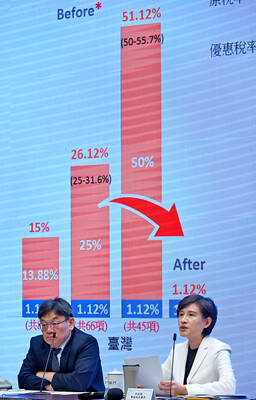
GREATER REACH? Auto parts and wood products would face tariffs of up to 15%, matching those targeting the EU, Japan and South Korea, Vice Premier said The US has announced that preferential tariff treatment for Taiwan’s non-semiconductor Section 232 goods would take effect retroactively from May 1, the Executive Yuan said yesterday. The US government yesterday posted a notice on the Federal Register’s public inspection Web site previewing tariff concessions for Taiwan under a memorandum of understanding (MOU) on Taiwan-US investment after two months of negotiations. The MOU signed on Jan. 15 stipulated three major preferential tariff arrangements: a 15 percent “reciprocal” tariff rate for Taiwan without stacking most-favored nation (MFN) rates; preferential Section 232 treatment for semiconductors and related products; and preferential Section 232 treatment for non-semiconductor

TIT-FOR-TAT: The US allegedly revoked the visa of a Chinese national working at Xinhua News Agency in the US in response to Beijing’s expulsion of Vivian Wang The Presidential Office yesterday condemned China for expelling a New York Times correspondent from Beijing following the newspaper’s interview with President William Lai (賴清德), saying the move highlighted Beijing’s suppression of press freedom and its threat to international news media. Taiwan has noted a series of recent incidents in which Beijing used similar tactics to “threaten and pressure international media outlets and journalists,” Presidential Office spokeswoman Karen Kuo (郭雅慧) said in a statement. “This concerns not only press freedom and freedom of expression, but also the safety of journalists, and Taiwan and relevant partners are paying close attention to the situation,” she


 RSS
RSS