


Indian Prime Minister Narendra Modi and his allies yesterday were heading for election victory, but the opposition said they had “punished” the ruling party to confound predictions and reduce their parliamentary majority.
Commentators and exit polls had projected an overwhelming victory for Modi, whose campaign wooed the Hindu majority to the concern of the nation’s 200-million-plus Muslim community, but for the first time in a decade Modi’s Bharatiya Janata Party (BJP) could fail to secure an overall majority of its own, figures from the election commission projected, meaning it would need to rely on its alliance partners.
The main opposition Congress party was set to nearly double its parliamentary seats, in a remarkable turnaround largely driven by deals to field single candidates against the BJP’s electoral juggernaut.
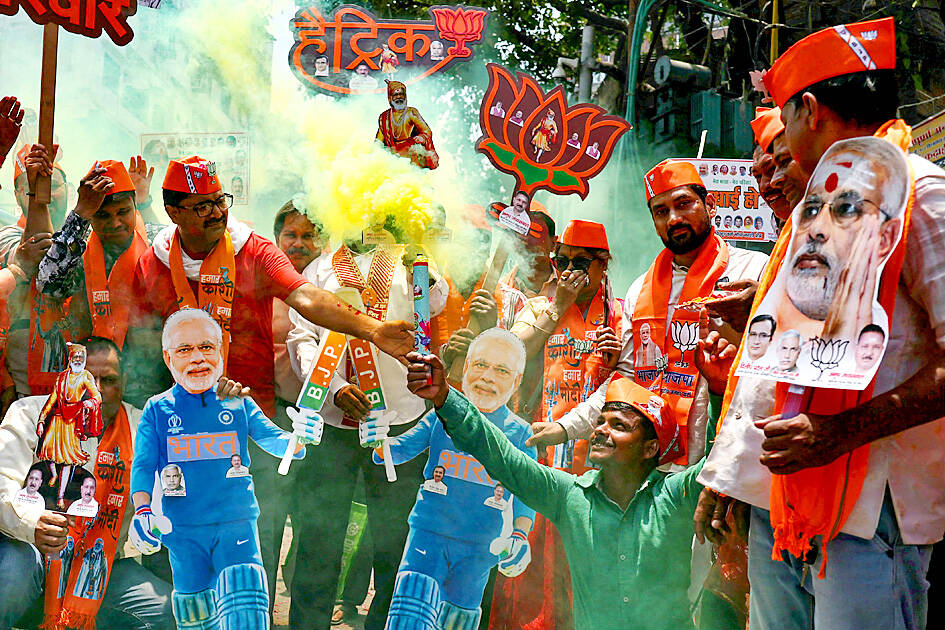
Photo: AFP
“Voters have punished the BJP,” Congress leader Rahul Gandhi told reporters. “I was confident that the people of this country would give the right response.”
With more than 95 percent of votes counted, the BJP’s vote share at 36.9 percent was marginally lower than it was in the last election in 2019.
Modi was re-elected to his constituency representing the Hindu holy city of Varanasi by a margin of 152,000 votes — compared with nearly 500,000 votes five years ago.
The election commission figures showed the BJP and its allies leading in at least 292 seats out of a total of 543, enough for a parliamentary majority, but the BJP itself had won or was leading in only 240, well down from the 303 it took five years ago, while Congress had won or was ahead in 98, up from 52.
Celebrations had already begun at the headquarters of Modi’s BJP before the full announcement of results, but the mood at the Congress headquarters in New Delhi was also one of jubilation.
“BJP has failed to win a big majority on its own,” Congress lawmaker Rajeev Shukla told reporters. “It’s a moral defeat for them.”
Modi’s opponents have struggled to counter the BJP’s well-oiled and well-funded campaign machine, and have been hamstrung by what they say are politically motivated criminal cases aimed at hobbling challengers.
US think tank Freedom House said this year that the BJP had “increasingly used government institutions to target political opponents.”
Many of India’s Muslim minority are increasingly uneasy about their futures and their community’s place in the constitutionally secular nation.

Japan has deployed long-range missiles in a southwestern region near China, the Japanese defense minister said yesterday, at a time when ties with Beijing are at their lowest in recent years. The missiles were installed in Kumamoto in the southern region of Kyushu, as Japan is attempting to shore up its military capacity as China steps up naval activity in the East China Sea. “Standoff defense capabilities enable us to counter the threat of enemy forces attempting to invade our country ... while ensuring the safety of our personnel,” Japanese Minister of Defense Shinjiro Koizumi said. “This is an extremely important initiative for

Chinese Nationalist Party (KMT) Chairwoman Cheng Li-wun (鄭麗文) today accepted an invitation from Chinese President Xi Jinping (習近平) to lead a delegation to China next month, saying she hopes to promote the peaceful development of cross-strait relations and bring stability to the Taiwan Strait. “I am grateful and happy to accept this invitation,” Cheng said in a statement from the KMT chairperson’s office. Cheng said she hopes both sides can work together to promote the peaceful development of cross-strait relations, enhance exchange and cooperation, bring stability to the Taiwan Strait and improve people’s livelihoods. At today's news conference, Cheng said any efforts to

MORE POPULAR: Taiwan Pass sales increased by 59 percent during the first quarter compared with the same period last year, the Tourism Administration said The Tourism Administration yesterday said that it has streamlined the Taiwan Pass, with two versions available for purchase beginning today. The tourism agency has made the pass available to international tourists since 2024, allowing them to access the high-speed rail, Taiwan Railway Corp services, four MRT systems and four Taiwan Tourist Shuttles. Previously, five types of Taiwan Pass were available, but some tourists have said that the offerings were too complicated. The agency said only two types of Taiwan Pass would be available, starting from a three-day pass with the high-speed rail and a three-day pass with Taiwan Railway Corp. The former costs NT$2,800

The nation’s fastest supercomputer, Nano 4 (晶創26), is scheduled to be launched in the third quarter, and would be used to train large language models in finance and national defense sectors, the National Center for High-Performance Computing (NCHC) said. The supercomputer, which would operate at about 86.05 petaflops, is being tested at a new cloud computing center in the Southern Taiwan Science Park in Tainan. The exterior of the server cabinet features chip circuitry patterns overlaid with a map of Taiwan, highlighting the nation’s central position in the semiconductor industry. The center also houses Taiwania 2, Taiwania 3, Forerunner 1 and


 RSS
RSS