


President William Lai (賴清德) yesterday told visiting US lawmakers that Taipei would work with Washington to counter “authoritarian expansionism,” days after China staged major military drills around Taiwan.
Lai has been labeled by Beijing as a “traitor” and “saboteur of peace and stability” since he vowed to defend the nation’s sovereignty and democracy in his inaugural speech on Monday last week.
Three days after he was sworn into office, warships and fighter jets encircled Taiwan in drills China said were “punishment” for Lai’s “confession of Taiwan independence” and a test of its ability to seize control of the nation.
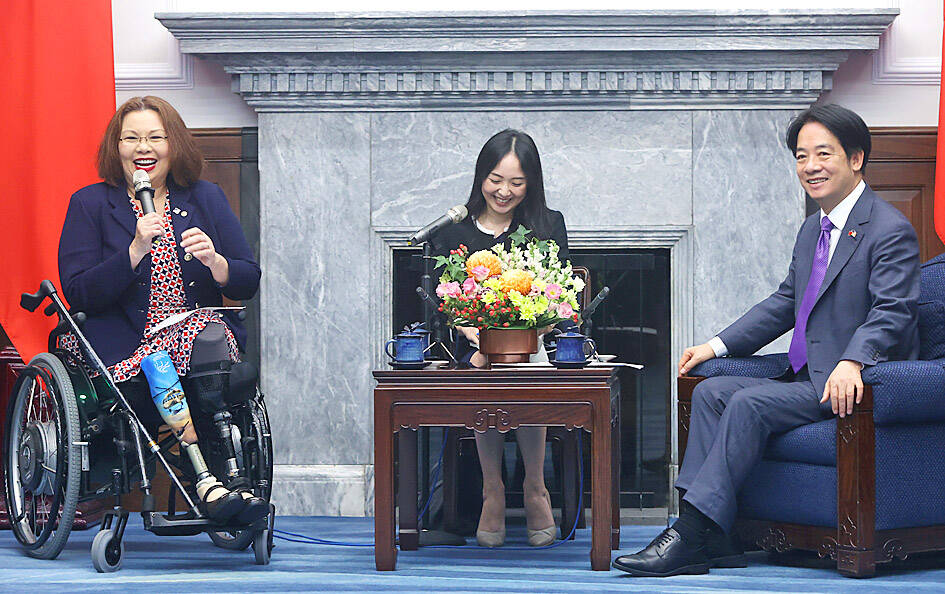
Photo: CNA
Speaking yesterday to the first bipartisan delegation from the US Senate to visit since his inauguration, Lai appealed for continued support from the nation’s most powerful ally.
“Facing the challenge of the [COVID-19] pandemic, we supported one another. Now facing authoritarian expansionism, we continue to work together,” Lai said. “Looking ahead, we will continue to do all we can to safeguard democracy so that democratic Taiwan can continue to shine its light upon the world.”
US Senator Tammy Duckworth, an Iraq war veteran and head of the delegation, responded by telling Lai: “You can count on us to always show up for Taiwan.”
Duckworth, a Democrat, also announced that she would be joining Republican US Senator Dan Sullivan’s proposed “Stand With Taiwan Act,” a bill to impose economic, energy and financial sanctions on China in the event of a military invasion or other use of force against Taiwan.
“I hope [I am] the first Democratic senator on that bill, and I hope he would be able to introduce that when we get back to Washington,” she said.
Duckworth’s weigh-in was “a huge outcome of our trip to Taiwan already,” Sullivan said, adding that their visit underlined “our rock-solid, principled bipartisan support for Taiwan.”
The delegation, which also included US senators Chris Coons and Laphonza Butler, both Democrats, was the second group of US lawmakers Lai received this week. On Monday, he met with a six-member delegation from the US House of Representatives.
The delegation of US senators also met with Vice President Hsiao Bi-khim (蕭美琴) yesterday.
Taiwanese would forever be grateful after Duckworth, Sullivan and Coons visited Taiwan on June 6, 2021, and announced Washington’s donation of COVID-19 vaccines to the nation, Hsiao said.
She said she was happy Butler joined the original delegation, adding that their latest visit underscored the strength of the friendship between the people of Taiwan and the US.
Taiwan is fortunate to have the support of US congressional members regarding issues that affect the nation’s security, trade and ability to participate in international organizations, Hsiao said.
Authoritarian expansion by China, Russia, Iran and North Korea poses a grave challenge, Sullivan said, adding that the threat was evident in Beijing’s latest round of military exercises around Taiwan.
He and Duckworth are advancing the “Stand With Taiwan Act” to bolster Taiwan’s and the US’ ability to deter China in the Taiwan Strait, Sullivan said.
Solidarity and cooperation are needed to achieve that goal, he said.
At its heart, the bill aims to deter acts of aggression by China by making it clear that it would face severe sanctions targeting its economy and energy supply, he said.
The US delegation is next to attend the Shangri-la Dialogue in Singapore, and will urge other democracies to adopt similar laws to strengthen deterrence against China, Sullivan said, adding that regional peace can be maintained if nations work together.
Taipei made a difficult decision in reinstating one-year military conscription, but that would provide Taiwan with trained soldiers capable of responding to natural disasters and defending the nation, Duckworth said.
This is essential to achieving a sufficient level of deterrence for regional peace and stability, she said.
Taipei and Washington have ample opportunities to collaborate, including in the chipmaking sector, Duckworth said.
Concerns in Taiwan that sharing technology with the US would result in the loss of its “silicon shield” underestimates the depth of the two nations’ ties and the numerous domains that figure into their relationship, she said.

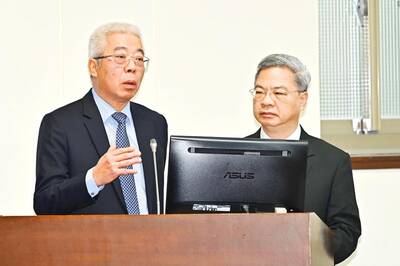
Taiwan has arranged for about 8 million barrels of crude oil, or about one-third of its monthly needs, to be shipped from the Red Sea this month to bypass the Strait of Hormuz and ease domestic supply pressures, CPC Corp, Taiwan (CPC, 台灣中油) said yesterday. The state-run oil company has worked with Middle Eastern suppliers to secure routes other than the Strait of Hormuz, through which about 20 percent of the world’s oil and liquefied natural gas typically passes, CPC chairman Fang Jeng-zen (方振仁) said at a meeting of the legislature’s Economics Committee in Taipei. Suppliers in Saudi Arabia have indicated they

South Korea has adjusted its electronic arrival card system to no longer list Taiwan as a part of China, a move that the Ministry of Foreign Affairs said would help facilitate exchanges between the two sides. South Korea previously listed “Taiwan” as “Taiwan (China)” in the drop-down menus of its online arrival card system, where people had to fill out where they came from and their next destination. The ministry had requested South Korea make a revision and said it would change South Korea’s name on Taiwan’s online immigration system from “Republic of Korea” to “Korea (South),” should the issue not be

Tainan, Taipei and New Taipei City recorded the highest fines nationwide for illegal accommodations in the first quarter of this year, with fines issued in the three cities each exceeding NT$7 million (US$220,639), Tourism Administration data showed. Among them, Taipei had the highest number of illegal short-term rental units, with 410. There were 3,280 legally registered hotels nationwide in the first quarter, down by 14 properties, or 0.43 percent, from a year earlier, likely indicating operators exiting the market, the agency said. However, the number of unregistered properties rose to 1,174, including 314 illegal hotels and 860 illegal short-term rental
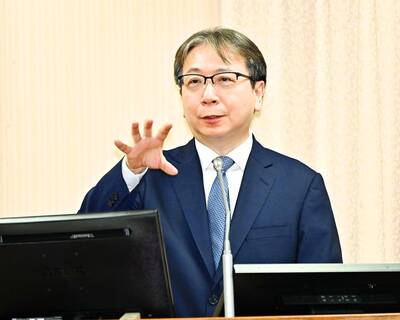
AIR ALERT: China’s reservation of airspace over the Yellow Sea and East China Sea could be an attempt to test the US’ response ahead of a Trump-Xi meeting, the NSB head said China’s attempts to infiltrate Taiwan are systematic, planned and targeted, with activity shifting from recruiting mid-level military officers to rank-and-file enlisted personnel, National Security Bureau (NSB) Director-General Tsai Ming-yen (蔡明彥) said yesterday. The Chinese Communist Party’s (CCP) integrates national security, intelligence operations and “united front” efforts into a dense network to conduct intelligence gathering and espionage in Taiwan, Tsai said at a meeting of the legislature’s Foreign Affairs and National Defense Committee. It uses specific networks to screen targets through exchange activities and recruiting local collaborators to establish intelligence-gathering organizations, he said. China is also shifting who it targets to lower-ranking military personnel,


 RSS
RSS