


British Prime Minister Rishi Sunak and Labour leader Keir Starmer yesterday launched their election campaigns, each arguing that only they can snap the UK out of its economic and political malaise.
Sunak, whose Conservative Party has trailed Labour by about 20 percentage points in opinion polls since he became prime minister in October 2022, shocked and angered many in his party when he gambled on a July 4 election, calling it months earlier than expected.
He yesterday argued that the economy was turning a corner and he had a plan to tackle illegal immigration. However, with prices in the shops up 21 percent in the past three years and the National Health Service buckling under record waiting times, it might be hard to persuade voters that the UK is on the right track.
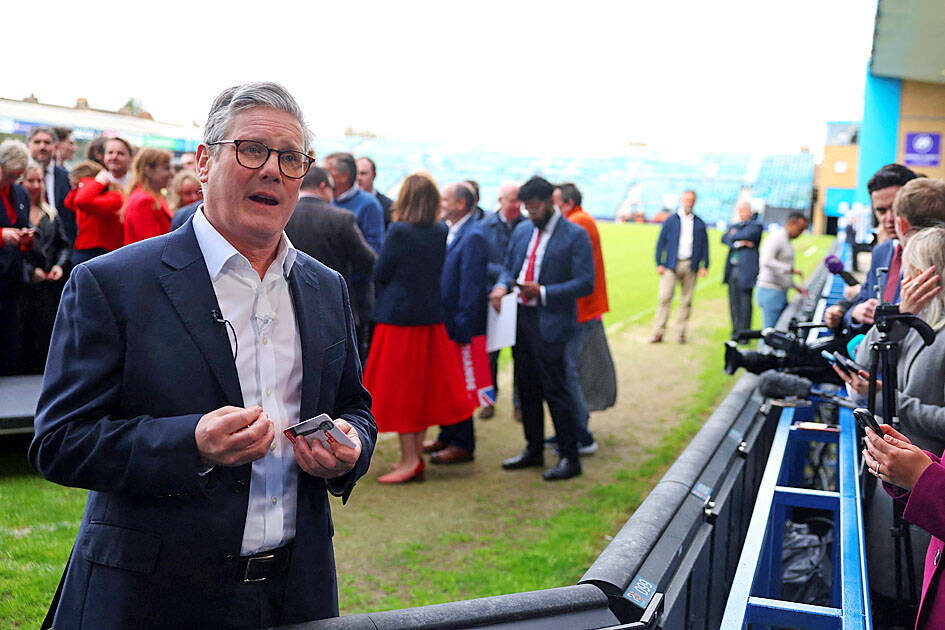
Photo: Reuters
Sunak also admitted the first flights sending illegal migrants to Rwanda, a flagship policy, would not take off before the election. Legal challenges are already lined up.
The former investment banker on Wednesday announced his decision in the pouring rain in Downing Street, having to shout over protesters blaring the song Things Can Only Get Better — an anthem associated with Labour’s crushing 1997 election victory under former British prime minister Tony Blair that ended the last long period of Conservative rule.
“Economic stability is now returning to the country,” Sunak told GB News television. “Although I know not everyone is feeling the full benefits of that yet, it’s clear that we have turned a corner. Now is the moment to look to the future.”
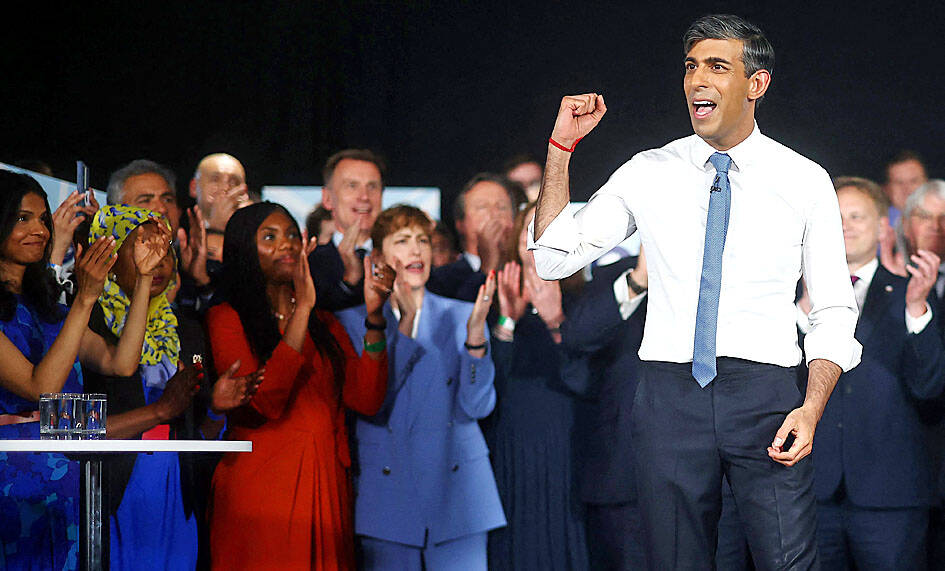
Photo: AFP
At stake is control of the world’s sixth-largest economy which has endured years of low growth and high inflation, is still battling to make a success of its 2016 decision to leave the EU, and is slowly recovering from twin shocks of the COVID-19 pandemic and an energy price spike caused by the war in Ukraine.
That backdrop makes the economy one of the most important electoral battlegrounds. The two parties are also likely to focus on who can control migration numbers, tax, and spending and security.
Polls show voters want change, even if they are not hugely enthused by Starmer and his Labour Party, after 14 years of Conservative government marked by unprecedented levels of political turmoil and so-called culture war issues.
Coffee shop worker Kitty McMurray, on her way to work, said the UK needed an election because it felt like everything was falling apart.
“Bring it on,” the 29-year-old said.
Both party leaders are expected to hit the campaign trail, seeking to seize the early initiative by meeting voters and pressing the messages they hope would earn them enough seats in parliament to form a majority government on July 5.
Starmer, the former chief prosecutor who has pulled Labour’s politics back to the center ground after it lurched to the left under his predecessor, has vowed to bring stability — and change — to a disgruntled electorate.
“Labour will stop the chaos, turn the page and get Britain’s future back,” he said in an early campaign message to party members, describing the election as “the fight of our lives.”
Were Labour to win the election, Starmer would become Britain’s sixth prime minister in eight years, the first time that has happened since the 1830s, underscoring the level of turmoil that has gripped a kingdom once known for its political stability and pragmatism.
While the electioneering gets underway, activity in parliament is expected to pick up too as the government works out which of the pieces of legislation in process would be rushed through, and which would fall by the wayside.
Laws under discussion include Sunak’s plan to impose some of the world’s strictest anti-smoking rules by banning anyone aged 15 and under from ever buying cigarettes.
TRAGEDY STRIKES TAIPEI: The suspect died after falling off a building after he threw smoke grenades into Taipei Main Station and went on a killing spree in Zhongshan A 27-year-old suspect allegedly threw smoke grenades in Taipei Main Station and then proceeded to Zhongshan MRT Station in a random killing spree that resulted in the death of the suspect and two other civilians, and seven injured, including one in critical condition, as of press time last night. The suspect, identified as a man surnamed Chang Wen (張文), allegedly began the attack at Taipei Main Station, the Taipei Fire Department said, adding that it received a report at 5:24pm that smoke grenades had been thrown in the station. One man in his 50s was rushed to hospital after a cardiac arrest
A car bomb killed a senior Russian general in southern Moscow yesterday morning, the latest high-profile army figure to be blown up in a blast that came just hours after Russian and Ukrainian delegates held separate talks in Miami on a plan to end the war. Kyiv has not commented on the incident, but Russian investigators said they were probing whether the blast was “linked” to “Ukrainian special forces.” The attack was similar to other assassinations of generals and pro-war figures that have either been claimed, or are widely believed to have been orchestrated, by Ukraine. Russian Lieutenant General Fanil Sarvarov, 56, head

SAFETY FIRST: Double the number of police were deployed at the Taipei Marathon, while other cities released plans to bolster public event safety Authorities across Taiwan have stepped up security measures ahead of Christmas and New Year events, following a knife and smoke bomb attack in Taipei on Friday that left four people dead and 11 injured. In a bid to prevent potential copycat incidents, police deployments have been expanded for large gatherings, transport hubs, and other crowded public spaces, according to official statements from police and city authorities. Taipei Mayor Chiang Wan-an (蔣萬安) said the city has “comprehensively raised security readiness” in crowded areas, increased police deployments with armed officers, and intensified patrols during weekends and nighttime hours. For large-scale events, security checkpoints and explosives
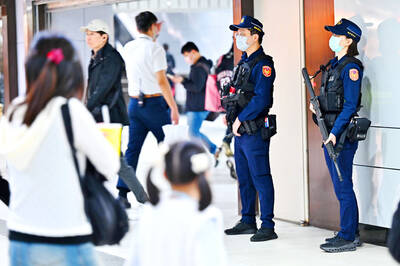
PUBLIC SAFETY: The premier said that security would be tightened in transport hubs, while President Lai commended the public for their bravery The government is to deploy more police, including rapid response units, in crowded public areas to ensure a swift response to any threats, President William Lai (賴清德) said yesterday after a knife attack killed three people and injured 11 in Taipei the previous day. Lai made the remarks following a briefing by the National Police Agency on the progress of the investigation, saying that the attack underscored the importance of cooperation in public security between the central and local governments. The attack unfolded in the early evening on Friday around Taipei Main Station’s M7 exit and later near the Taipei MRT’s Zhongshan


 RSS
RSS