


The British government yesterday said it had summoned Chinese Ambassador to the UK Zheng Zeguang (鄭澤光), a day after three people were charged in the latest Beijing-linked alleged espionage case.
The UK’s Foreign, Commonwealth and Development Office was “unequivocal in setting out that the recent pattern of behaviour directed by China against the UK, including cyberattacks, reports of espionage links and the issuing of bounties, is not acceptable,” a spokesperson said.
The office said that the summons followed Monday’s announcement that three people had been charged with assisting Hong Kong’s intelligence service.
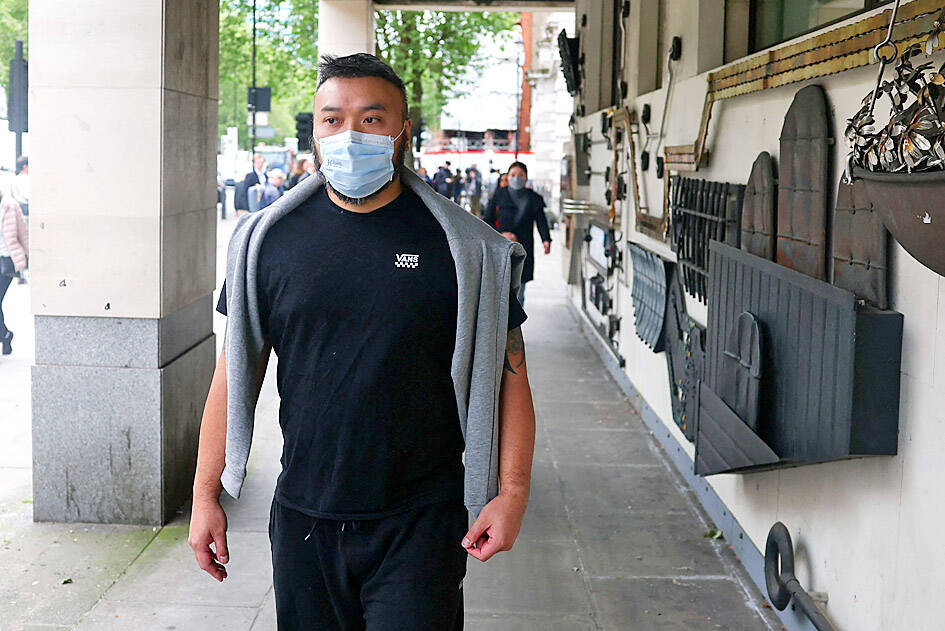
Photo: Reuters
The three are: Bill Yuen Chung-biu (袁松彪), 63, the office manager of the Hong Kong Economic and Trade Office in London; Wai Chi-leung or Peter Wai (衛志良), 38, a dual British and Chinese national who is a UK Border Force officer and ran his own private security firm; and Matthew Trickett, 37, a former Royal Marine commando who runs a private security firm.
They are charged with assisting a foreign intelligence service between December last year and this month by “agreeing to undertake information gathering, surveillance and acts of deception” in Britain, according to the charges brought in court. They are also charged with conducting “foreign interference” by forcing entry into a residential home.
All the offenses fall under the UK’s National Security Act, which introduced new measures last year against foreign threats, including espionage and interference. The charges do not name the specific Hong Kong intelligence service.
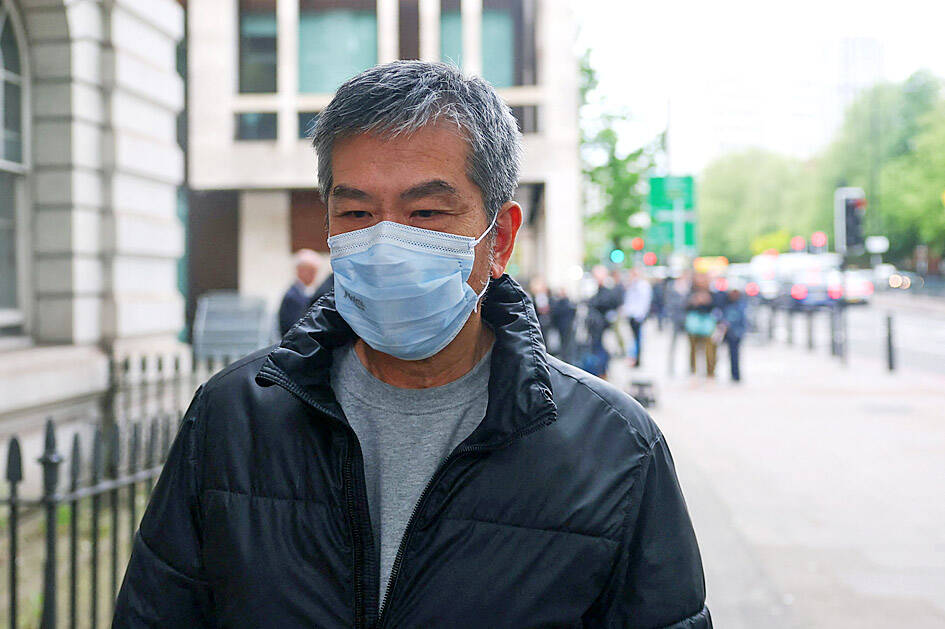
Photo: Reuters
They face a maximum possible sentence of 14 years for each charge. They were not asked to enter any pleas and are next to appear at London’s Old Bailey court on May 24. The men were granted bail, but have curfew and travel restrictions.
British Prime Minister Rishi Sunak’s Downing Street office called the charges “deeply concerning.”
However, the Commissioner’s Office of China’s Foreign Ministry in Hong Kong “strongly condemned” the UK for “cooking up charges” and accused it of a “vicious intention to interfere” in Hong Kong’s affairs.
It warned that Britain would receive “China’s firm and strong retaliation.”
Earlier yesterday, Hong Kong Chief Executive John Lee (李家超) called for full information from British authorities on the arrests of three men.
Speaking to reporters, Lee confirmed that one of the men, Yuen, was a university classmate who was photographed with Lee in a group graduation photograph from 2002.
Lee cited a statement from the Chinese embassy in London rejecting what it called “the UK’s fabrication” of the case and its “unwarranted accusation” against the Hong Kong government.
Asked whether Hong Kong authorities had spent any resources to perform surveillance on individuals in Britain, including Hong Kong activists, Lee did not directly address the question.
Separately, the head of the Government Communications Headquarters (GCHQ), the UK’s intelligence, security and cyberagency, yesterday warned that China posed a “genuine and increasing cyber risk.”
“China has built an advanced set of cybercapabilities and is taking advantage of a growing commercial ecosystem of hacking outfits and data brokers at its disposal,” GCHQ Director Anne Keast-Butler said at the Cyber UK conference in Birmingham, England.
“Through their coercive and destabilizing actions, the PRC [People’s Republic of China] poses a significant risk to international norms and values,” she added.
The GCHQ now devotes “more resource to China than any other single mission,” she said.

Japan has deployed long-range missiles in a southwestern region near China, the Japanese defense minister said yesterday, at a time when ties with Beijing are at their lowest in recent years. The missiles were installed in Kumamoto in the southern region of Kyushu, as Japan is attempting to shore up its military capacity as China steps up naval activity in the East China Sea. “Standoff defense capabilities enable us to counter the threat of enemy forces attempting to invade our country ... while ensuring the safety of our personnel,” Japanese Minister of Defense Shinjiro Koizumi said. “This is an extremely important initiative for
Chinese Nationalist Party (KMT) Chairwoman Cheng Li-wun (鄭麗文) today accepted an invitation from Chinese President Xi Jinping (習近平) to lead a delegation to China next month, saying she hopes to promote the peaceful development of cross-strait relations and bring stability to the Taiwan Strait. “I am grateful and happy to accept this invitation,” Cheng said in a statement from the KMT chairperson’s office. Cheng said she hopes both sides can work together to promote the peaceful development of cross-strait relations, enhance exchange and cooperation, bring stability to the Taiwan Strait and improve people’s livelihoods. At today's news conference, Cheng said any efforts to

MORE POPULAR: Taiwan Pass sales increased by 59 percent during the first quarter compared with the same period last year, the Tourism Administration said The Tourism Administration yesterday said that it has streamlined the Taiwan Pass, with two versions available for purchase beginning today. The tourism agency has made the pass available to international tourists since 2024, allowing them to access the high-speed rail, Taiwan Railway Corp services, four MRT systems and four Taiwan Tourist Shuttles. Previously, five types of Taiwan Pass were available, but some tourists have said that the offerings were too complicated. The agency said only two types of Taiwan Pass would be available, starting from a three-day pass with the high-speed rail and a three-day pass with Taiwan Railway Corp. The former costs NT$2,800

The nation’s fastest supercomputer, Nano 4 (晶創26), is scheduled to be launched in the third quarter, and would be used to train large language models in finance and national defense sectors, the National Center for High-Performance Computing (NCHC) said. The supercomputer, which would operate at about 86.05 petaflops, is being tested at a new cloud computing center in the Southern Taiwan Science Park in Tainan. The exterior of the server cabinet features chip circuitry patterns overlaid with a map of Taiwan, highlighting the nation’s central position in the semiconductor industry. The center also houses Taiwania 2, Taiwania 3, Forerunner 1 and


 RSS
RSS