


Australia, the UK and the US are set to begin talks on bringing new members into their AUKUS security pact as Washington pushes for Japan to be involved as a deterrent against China, the Financial Times reported.
The countries’ defense ministers are today to announce discussions on “Pillar Two” of the pact, which commits the members to jointly developing quantum computing, undersea, hypersonic, artificial intelligence and cyber technology, the newspaper reported on Saturday, citing people familiar with the situation.
They are not considering expanding the first pillar, which is designed to deliver nuclear-powered attack submarines to Australia, the Financial Times said.
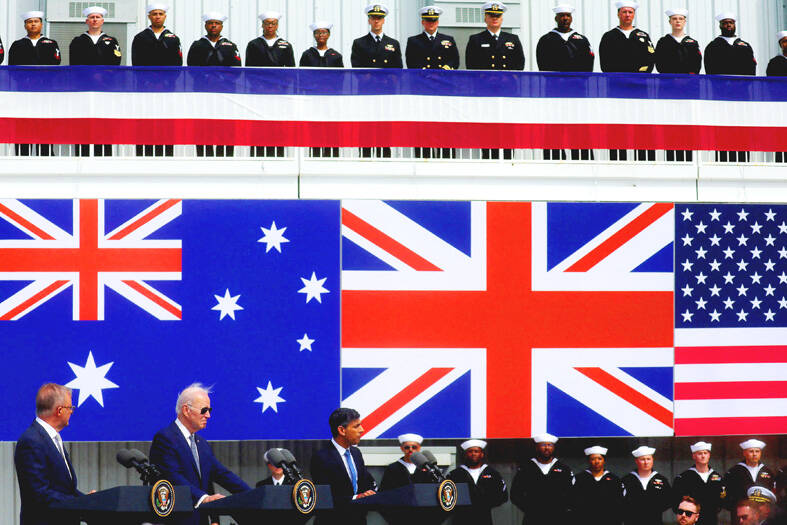
Photo: Reuters
US Deputy Secretary of State Kurt Campbell on Wednesday said that the submarine project could help deter any Chinese move against Taiwan.
AUKUS, formed by the three countries in 2021, is part of their efforts to push back against China’s growing power in the Indo-Pacific region. China has called the pact dangerous and warned it could spur a regional arms race.
US President Joe Biden has sought to step up partnerships with US allies in Asia, including Japan and the Philippines, amid China’s historic military buildup and its growing territorial assertiveness.
US Ambassador to Japan Rahm Emanuel wrote in an opinion piece published on Wednesday in the Wall Street Journal that Japan was “about to become the first additional Pillar II partner.”
A senior US administration official told Reuters on Wednesday that some sort of announcement could be expected in the coming week about Japan’s involvement, but gave no details.
Biden and Japanese Prime Minister Fumio Kishida would likely discuss expanding AUKUS to include Japan when the president hosts the prime minister in Washington on Wednesday, a source with knowledge of the talks said.
However, Canberra is wary of beginning new projects until more progress has been made on supplying Australia with nuclear-powered submarines, said the source, who asked not to be identified because they are not authorized to speak to the media.
Australian Minister for Defence Richard Marles has said they would “seek opportunities to engage close partners in AUKUS Pillar II” and any involvement of more countries would be decided and announced by the three partners, a spokesperson from his office said.
While the US is keen to see Japanese involvement in Pillar Two, officials and experts say obstacles remain, given a need for Japan to introduce better cyberdefenses and stricter rules for guarding secrets.
Campbell, an architect of US Indo-Pacific policy, said the US was encouraging Japan to do more to protect intellectual property and hold officials accountable for secrets.
“It’s fair to say that Japan has taken some of those steps, but not all of them,” he said.

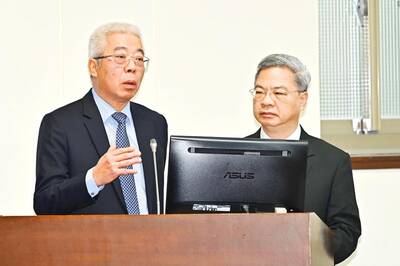
Taiwan has arranged for about 8 million barrels of crude oil, or about one-third of its monthly needs, to be shipped from the Red Sea this month to bypass the Strait of Hormuz and ease domestic supply pressures, CPC Corp, Taiwan (CPC, 台灣中油) said yesterday. The state-run oil company has worked with Middle Eastern suppliers to secure routes other than the Strait of Hormuz, through which about 20 percent of the world’s oil and liquefied natural gas typically passes, CPC chairman Fang Jeng-zen (方振仁) said at a meeting of the legislature’s Economics Committee in Taipei. Suppliers in Saudi Arabia have indicated they
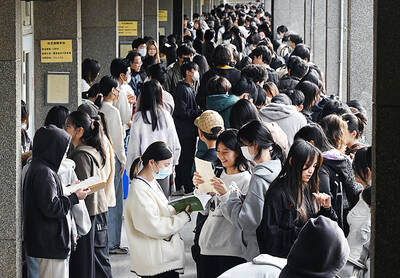
A global survey showed that 60 percent of Taiwanese had attained higher education, second only to Canada, the Ministry of the Interior said. Taiwan easily surpassed the global average of 43 percent and ranked ahead of major economies, including Japan, South Korea and the US, data from the Organisation for Economic Co-operation and Development (OECD) for 2024 showed. Taiwan has a high literacy rate, data released by the ministry showed. As of the end of last year, Taiwan had 20.617 million people aged 15 or older, accounting for 88.5 percent of the total population, with a literacy rate of 99.4 percent, the data
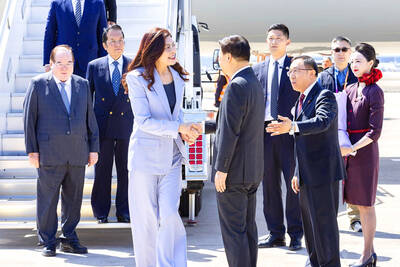
CCP ‘PAWN’? Beijing could use the KMT chairwoman’s visit to signal to the world that many people in Taiwan support the ‘one China’ principle, an academic said Chinese Nationalist Party (KMT) Chairwoman Cheng Li-wun (鄭麗文) yesterday arrived in China for a “peace” mission and potential meeting with Chinese President Xi Jinping (習近平), while a Taiwanese minister detailed the number of Chinese warships currently deployed around the nation. Cheng is visiting at a time of increased Chinese military pressure on Taiwan, as the opposition-dominated Legislative Yuan stalls a government plan for US$40 billion in extra defense spending. Speaking to reporters before going to the airport, Cheng said she was going on a “historic journey for peace,” but added that some people felt uneasy about her trip. “If you truly love Taiwan,

NEW LOW: The council in 2024 based predictions on a pessimistic estimate for the nation’s total fertility rate of 0.84, but last year that rate was 0.69, 17 percent lower An expected National Development Council (NDC) report expects the nation’s population to drop below 12 million by 2065, with the old-age dependency ratio to top 100 percent sooner than 2070, sources said yesterday. The council is slated to release its latest population projections in August, using an ultra-low fertility model, the sources said. The previous report projected that Taiwan’s population would fall to 14.37 million by 2070, but based on a new estimate of the total fertility rate (TFR) — the average number of children born to a woman over her lifetime — the population is expected to reach 12 million by


 RSS
RSS