

Former president Ma Ying-jeou (馬英九) yesterday arrived in China with a student delegation on an 11-day trip, which he said would deliver a message of friendship and peace.
Unlike his visit to China last year, this time he plans to stop in Beijing, which has sparked speculation that he could meet with Chinese President Xi Jinping (習近平). Reuters has reported that such a meeting is to take place on Monday next week.
Speaking to reporters before boarding his flight at Taiwan Taoyuan International Airport, Ma said that amid current cross-strait tensions, he would try to convey Taiwanese’s love of peace, and voice hope that the two sides can increase exchanges and avoid war.
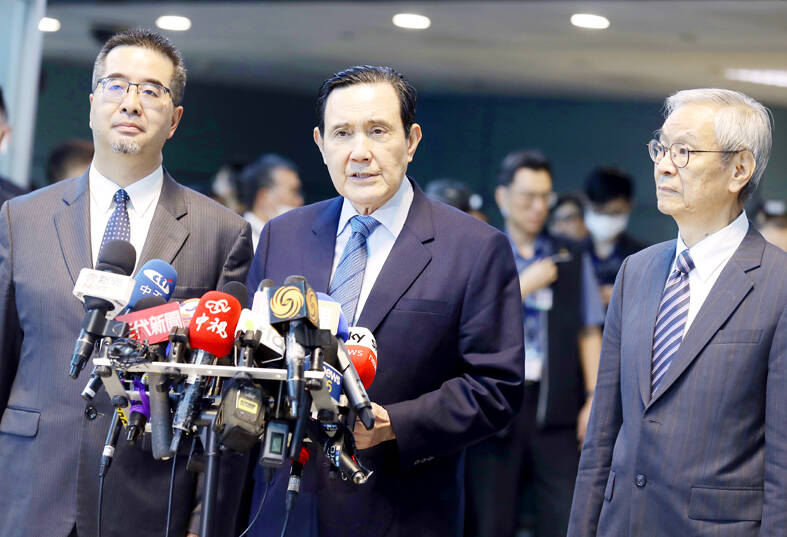
Photo: Chiang Ying-ying, AP
“This is a trip of peace and a trip of friendship,” he said.
Having left the presidency eight years ago, and holding no government or political office, “I can only do my best as an individual to promote cross-strait student exchanges, and help reduce enmity and build goodwill between the two sides’ people,” Ma said.
Last week, the Ma Ying-jeou Foundation said that the former president would lead a group of 20 students on a trip to China until Thursday next week.
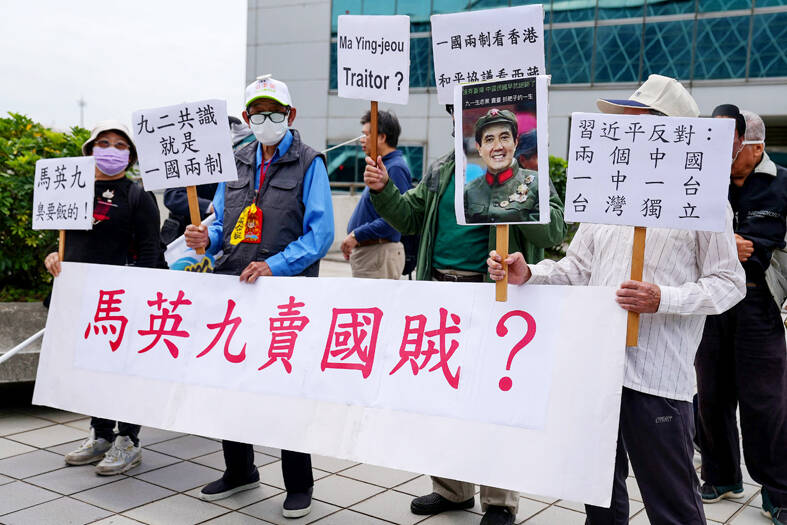
Photo: Zhao Yan, AFP
The visit is to include meetings with Chinese students, company tours, and trips to sites of historical or cultural significance, it said.
Ma met with China’s Taiwan Affairs Office Director Song Tao (宋濤) shortly after arriving in Shenzhen yesterday.
Song relayed a “kind regard to Mr Ma” on Xi’s behalf, while Ma in response said he could feel that between the two sides of the Taiwan Strait “blood is thicker than water.”
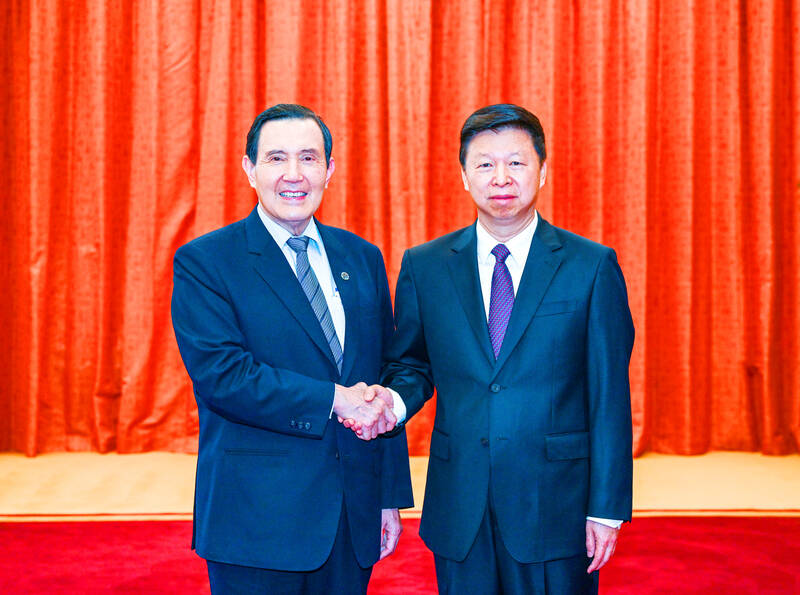
Photo courtesy of Ma’s office via CNA
Ma added that peace and stability are needed in cross-strait relations to ensure the well-being of the people on both sides.
The delegation is to spend three days in Guangdong Province, before traveling to Shaanxi Province tomorrow night and Beijing on Sunday, the foundation said.
Ma, who was president from 2008 to 2016, held a historic meeting with Xi in Singapore in 2015, the first gathering of leaders from the two sides of the Taiwan Strait since the Chinese Civil War in 1949.
Asked last week about the possibility of another such meeting, foundation director Hsiao Hsu-tsen (蕭旭岑) said that Ma hopes there will be an opportunity to “see an old friend,” but would leave the exact arrangements up to the Chinese side, as they are his hosts.
Commenting on Ma’s visit, Kuo Yu-jen (郭育仁), a professor at the Institute of China and Asia-Pacific Studies at National Sun Yat-sen University, said that to the Chinese Communist Party (CCP), Ma is working right into its “united front” strategy targeting Taiwan.
The Taiwan Statebuilding Party also criticized Ma in a news conference in Taipei yesterday, saying that the former president no longer has the mandate of voters and is now a mouthpiece of the CCP.
Additional reporting by Chen Yu-fu
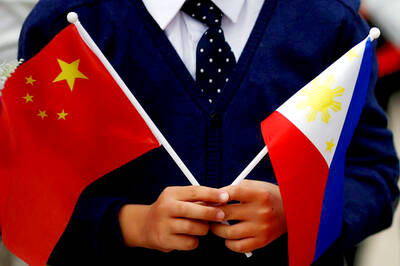
The Philippine Coast Guard yesterday said it has deployed its largest vessel and an aircraft to challenge a Chinese research ship operating off northern Batanes near Taiwan, adding that a Chinese coast guard vessel had also moved in. The Philippine operation “disrupted the vessel’s unauthorized marine scientific research and compelled it to leave its loitering position,” said Jay Tarriela, Philippine Coast Guard spokesperson on South China Sea issues. The Philippine Coast Guard said the BRP Teresa Magbanua and an aircraft were deployed to counter the Chinese vessel, which it said had remained about 37 nautical miles northwest of Itbayat Island since Monday. The
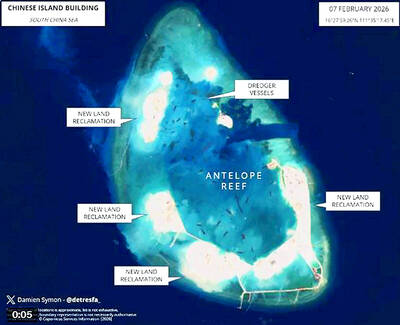
RUNWAY: Analysts said the first aircraft landing is expected by the middle of next year, while Chinese state media said it would serve civilian needs Chinese construction of a runway on Antelope Reef (Lingyang Reef, 羚羊礁) in the Paracel Islands (Xisha Islands, 西沙群島), is well under way with analysts estimating it could be completed by the middle of next year, strengthening Beijing’s military control over the disputed South China Sea. Satellite images reviewed by Reuters show grading work, piles of gravel and concrete, and compaction cranes in operation to build a full-scale runway that military attaches and security analysts say could be one of China’s most important offshore bases in the region. The images, taken on Friday last week by commercial satellite imagery provider Vantor, also show

SHIFTING COOPERATION: With the new arrangement, US representatives would be able to participate directly in defense discussions, including weapons procurement Taiwan-US military cooperation is deepening, with the Pentagon expected to station personnel at the Ministry of National Defense (MND), sources said. The NT$470 million (US$14.77 million) joint program is scheduled to run from this year through 2028, under which the Pentagon would dispatch representatives from the Office of the Under Secretary of Defense for Policy and the Institute for Defense Analyses, a senior military official said on condition of anonymity, adding that one representative from each organization would be stationed at the ministry’s headquarters. The Office of the Under Secretary of Defense for Policy is one of the US’ bodies responsible for

The Presidential Office today condemned China's transnational repression after an alleged Chinese foreign agent was arrested in California yesterday on suspicion of surveilling President William Lai's (賴清德) son, Lai Ting-yu (賴廷與), the FBI said. The 34-year-old woman, named Wanying Heather Zhang (張婉瑩), was arrested on suspicion of acting as an unregistered foreign agent, US news agency CBS reported. She was apprehended at Los Angeles International Airport yesterday attempting to fly to Shanghai, it said. This represents a “typical case” of China’s transnational repression, Presidential Office spokeswoman Karen Kuo (郭雅慧) said today. "Our country expresses the strongest condemnation of such barbaric conduct that


 RSS
RSS