


The central bank yesterday unexpectedly raised its policy rate by 0.125 percentage points in a bid to ward off inflation, which is expected to gain speed after an across-the-board increase in electricity rates next month.
“The move was a surprise, with one director who favored a policy hold opposing it, but all other [directors] backed it to curb inflationary expectations,” central bank Governor Yang Chin-long (楊金龍) told a news conference in Taipei after the bank’s quarterly policymaking meeting.
The monetary policymaker is now forecasting a 2.16 percent increase in the consumer price index for this year, up from the 1.89 percent it forecast in December last year.
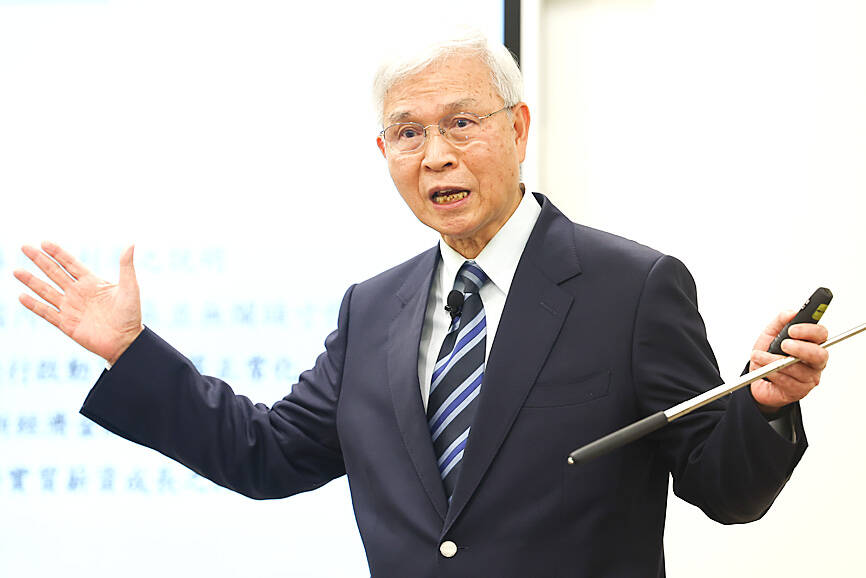
Photo: CNA
It expects GDP to grow by 3.22 percent, slightly faster than its previous estimate of 3.12 percent.
Research institutes at home and abroad expected the central bank to hold rates steady, as the US Federal Reserve and the European Central Bank (ECB) have opted to maintain the status quo and hinted that rate cuts might come later this year.
“It is better to tame inflationary expectations before they take root, which would then become difficult to tackle,” as the central bank cannot ignore the impact of the coming electricity price hikes, Yang said.
The Ministry of Economic Affairs is holding an electricity price review committee meeting today to decide on price adjustments. The new rates are to take effect next month to help keep debt-ridden Taiwan Power Co (Taipower, 台電) afloat.
The pace of the interest rate hike assumes a 10 percent increase in electricity rates, Yang said, adding that there is little room for further tightening, as its peers are mulling monetary easing.
The central bank decided to raise its discount rate to 2 percent, which Yang said remains moderate, as the bank has adopted a gradual approach in fighting inflation, whereas the Fed and ECB chose a drastic strategy.
Effective today, interest rates for secured lending would rise to 2.375 percent and borrowing costs for unsecured loans would climb to 4.25 percent.
The central bank did not introduce new measures to cool the property market, saying that the latest rate hikes and previous credit controls on domestic lending should keep mortgage operations and asset quality at healthy levels.
Despite the surprise rate hike, Yang dismissed concerns over the inverse relationship between Taiwanese equities and the New Taiwan dollar’s exchange rate.
The local currency has softened against the greenback this year even as the TAIEX soared to new heights, closing above 20,000 points yesterday for the first time in history.
Foreign institutional players tend to buy local shares via foreign exchange swaps — moves that would not affect the NT dollar, Yang said, adding that they recently realized gains from locally listed exchange-traded funds (ETFs) that offer high dividends.
The NT dollar has also weakened due to aggressive purchases by local investors of ETFs targeting US bonds, the governor said.
Yang hesitated to comment if the rate hike was meant to calm the stock market fever except to say that a bull market lends support to the wealth effect.
In the US, the wealth effect usually stems from property price gains, he said.
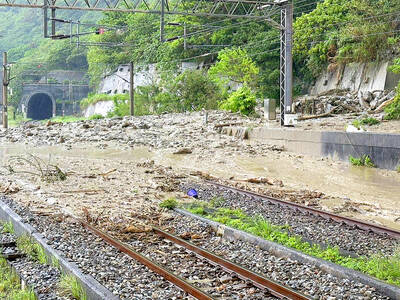
ROLLER-COASTER RIDE: More than five earthquakes ranging from magnitude 4.4 to 5.5 on the Richter scale shook eastern Taiwan in rapid succession yesterday afternoon Back-to-back weather fronts are forecast to hit Taiwan this week, resulting in rain across the nation in the coming days, the Central Weather Administration said yesterday, as it also warned residents in mountainous regions to be wary of landslides and rockfalls. As the first front approached, sporadic rainfall began in central and northern parts of Taiwan yesterday, the agency said, adding that rain is forecast to intensify in those regions today, while brief showers would also affect other parts of the nation. A second weather system is forecast to arrive on Thursday, bringing additional rain to the whole nation until Sunday, it
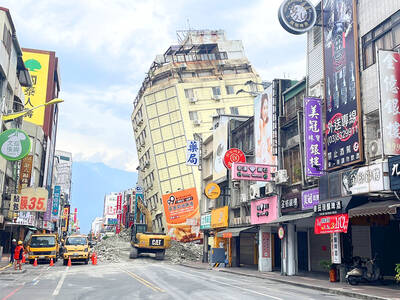
LANDSLIDES POSSIBLE: The agency advised the public to avoid visiting mountainous regions due to more expected aftershocks and rainfall from a series of weather fronts A series of earthquakes over the past few days were likely aftershocks of the April 3 earthquake in Hualien County, with further aftershocks to be expected for up to a year, the Central Weather Administration (CWA) said yesterday. Based on the nation’s experience after the quake on Sept. 21, 1999, more aftershocks are possible over the next six months to a year, the agency said. A total of 103 earthquakes of magnitude 4 on the local magnitude scale or higher hit Hualien County from 5:08pm on Monday to 10:27am yesterday, with 27 of them exceeding magnitude 5. They included two, of magnitude

OVERWHELMING SUPPORT: The bill with US$2 billion in Foreign Military Financing Program funds and US$1.9 billion to replenish defense articles passed the House 385-34 Taiwan is to continue working with the US to ensure peace in the Taiwan Strait, the Ministry of National Defense said yesterday after the US House of Representatives approved a US$95 billion foreign aid package with funding for Taiwan. The bills were passed with bipartisan support in a rare Saturday session after votes had been delayed for months by House Republicans. After clearing the House, the bills — containing US$8 billion for Taiwan and the Indo-Pacific region, along with US$60.8 billion for Kyiv, and US$26 billion for Israel and humanitarian aid for civilians in conflict zones — would be combined into a

The navy next month is expected to commission into service two more domestically built Tuo Chiang-class stealth missile corvettes, a source said yesterday. The Hsu Chiang (旭江, PGG-621) and the Wu Chiang (武江, PGG-623) would be officially commissioned in a ceremony early next month, the source said, speaking on condition of anonymity. The corvettes, launched in February and June last year respectively, were delivered to the navy in February. They are the third and fourth Tuo Chiang-class stealth missile corvettes to be produced. The Tuo Chiang-class corvette is a domestically designed and manufactured class of fast and stealthy multipurpose corvette built for the


 RSS
RSS