


Southeast Asian and Australian leaders yesterday warned against actions that “endanger peace” in the South China Sea, following fresh confrontations between Beijing and the Philippines in contested waters.
Simmering tensions in the trade corridor threatened to boil over this week when Chinese boats near the Spratly Islands (Nansha Islands, 南沙群島), were accused of hounding Philippines vessels.
Beijing yesterday accused the US of using the Philippines as a “pawn to stir up trouble in the South China Sea” as hostilities between the Asian nations escalate over their territorial dispute.
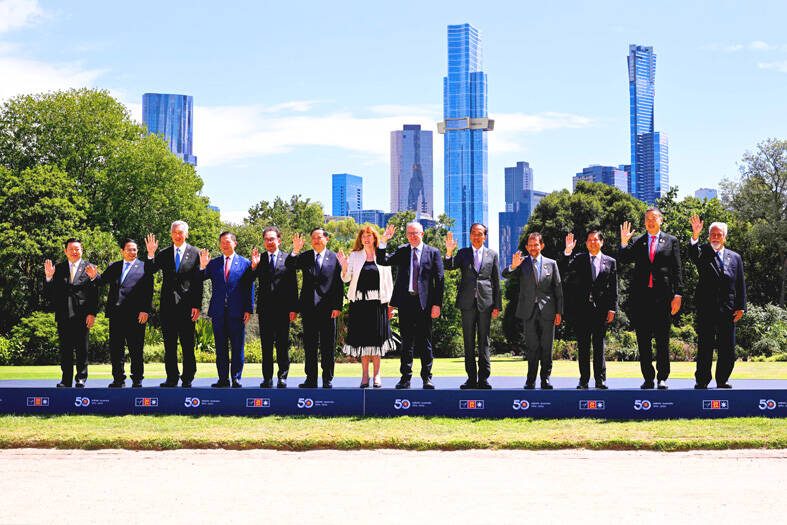
Photo: AFP
China claims almost the entirety of the South China Sea, ignoring legal precedents and competing claims from Taiwan and a host of Southeast Asian nations.
The festering dispute poses one of the region’s most vexing security challenges, looming large during a three-day summit between Australia and the 10-nation ASEAN bloc.
“We encourage all countries to avoid any unilateral actions that endanger peace, security and stability in the region,” a joint declaration prepared by ASEAN members and Australia said.
“We recognize the benefits of having the South China Sea as a sea of peace, stability and prosperity,” it said.
When the summit began on Monday morning, Philippine Secretary of Foreign Affairs Enrique Manalo delivered a simple request to Beijing: “Stop harassing us.”
The following day, China Coast Guard boats were accused of harassing a flotilla of Philippine ships on a resupply mission.
The Chinese vessels were involved in two separate collisions and blasted one of the resupply boats with a water cannon, the Philippine Coast Guard said.
Bound to act by consensus, the ASEAN forum has long struggled to make inroads on the overlapping claims staked throughout the South China Sea, but the fraught atmosphere hanging over the region has some nations now pushing for the bloc to take a firmer stance.
Australia has proven increasingly willing to speak out against China.
“I am very concerned and Australia is concerned about any unsafe and destabilizing behavior in the South China Sea,” Australian Prime Minister Anthony Albanese said on the sidelines of the summit. “We need to make sure that activity in the South China Sea alleviates any tensions and doesn’t add to it.”
The surging conflict in junta-ruled Myanmar also continued to frustrate ASEAN leaders, whose efforts to resolve the crisis remain largely fruitless.
Junta leaders have essentially ignored the bloc’s five-point peace plan released in 2021.
“We strongly condemn the continued acts of violence and call for immediate cessation,” the joint declaration said.
“We call for effective humanitarian assistance and inclusive national dialogue,” it added.

AGING: As of last month, people aged 65 or older accounted for 20.06 percent of the total population and the number of couples who got married fell by 18,685 from 2024 Taiwan has surpassed South Korea as the country least willing to have children, with an annual crude birthrate of 4.62 per 1,000 people, Ministry of the Interior data showed yesterday. The nation was previously ranked the second-lowest country in terms of total fertility rate, or the average number of children a woman has in her lifetime. However, South Korea’s fertility rate began to recover from 2023, with total fertility rate rising from 0.72 and estimated to reach 0.82 to 0.85 by last year, and the crude birthrate projected at 6.7 per 1,000 people. Japan’s crude birthrate was projected to fall below six,
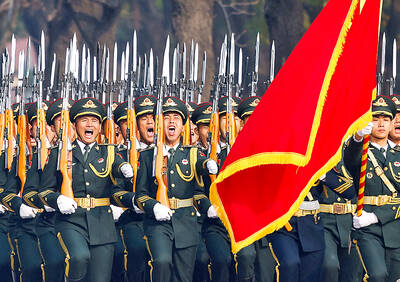
Conflict with Taiwan could leave China with “massive economic disruption, catastrophic military losses, significant social unrest, and devastating sanctions,” a US think tank said in a report released on Monday. The German Marshall Fund released a report titled If China Attacks Taiwan: The Consequences for China of “Minor Conflict” and “Major War” Scenarios. The report details the “massive” economic, military, social and international costs to China in the event of a minor conflict or major war with Taiwan, estimating that the Chinese People’s Liberation Army (PLA) could sustain losses of more than half of its active-duty ground forces, including 100,000 troops. Understanding Chinese
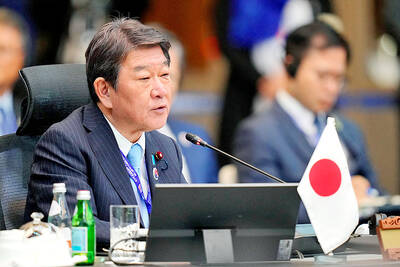
SELF-DEFENSE: Tokyo has accelerated its spending goal and its defense minister said the nation needs to discuss whether it should develop nuclear-powered submarines China is ramping up objections to what it sees as Japan’s desire to acquire nuclear weapons, despite Tokyo’s longstanding renunciation of such arms, deepening another fissure in the two neighbors’ increasingly tense ties. In what appears to be a concerted effort, China’s foreign and defense ministries issued statements on Thursday condemning alleged remilitarism efforts by Tokyo. The remarks came as two of the country’s top think tanks jointly issued a 29-page report framing actions by “right-wing forces” in Japan as posing a “serious threat” to world peace. While that report did not define “right-wing forces,” the Chinese Ministry of Foreign Affairs was
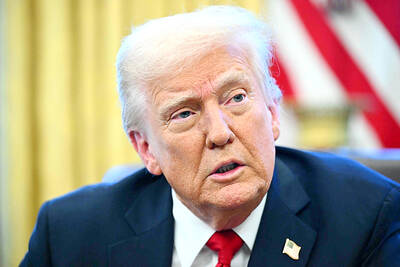
US President Donald Trump in an interview with the New York Times published on Thursday said that “it’s up to” Chinese President Xi Jinping (習近平) what China does on Taiwan, but that he would be “very unhappy” with a change in the “status quo.” “He [Xi] considers it to be a part of China, and that’s up to him what he’s going to be doing, but I’ve expressed to him that I would be very unhappy if he did that, and I don’t think he’ll do that. I hope he doesn’t do that,” Trump said. Trump made the comments in the context


 RSS
RSS