


A total of 68,780 people attended the two exhibition games to celebrate the 90th anniversary of Japan’s Yomiuri Giants in the Taipei Dome this weekend, but politicians and spectators complained that crowd control was lacking and the roof leaked.
Organizers and Taipei Dome operator Farglory Group (遠雄集團) said they had passed the most severe test of the stadium on Saturday.
A sellout crowd of 37,890 attended the first game between the Taichung-based CTBC Brothers and the Giants, setting a new record for the largest turnout at a baseball game in Taiwan. The previous record was 25,000 at Kaohsiung’s Chengcing Lake Baseball Stadium during a 2001 Baseball World Cup game between Taiwan and the US.
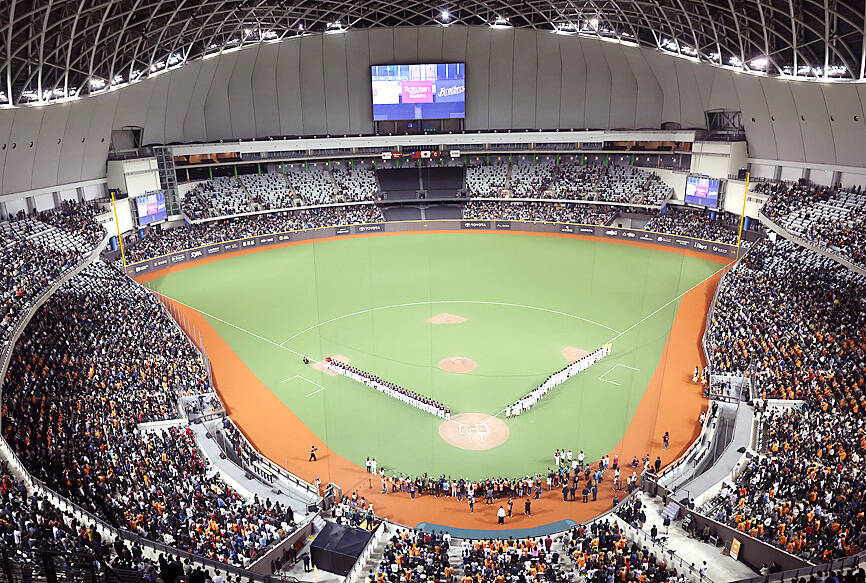
Photo: CNA
Saturday was also the first time that more than 36,000 seats were made available at the Taipei Dome since it opened in December last year for the Asian Baseball Championship.
Last night, 30,890 people attended the second game between the Taoyuan-based Rakuten Monkeys and the Giants — the stadium’s second-largest turnout. Despite the smaller crowd, people still reported congestion inside the venue.
At the first game, spectators said crowd flow management was poor, there was a lack of clear signage and two escalators broke down, leading to further congestion.
A limited number of gates were open, resulting in congestion on the B1 level for those wanting to get to the infield and outfield seats above that, spectators said.
The most noticeable problem was water leaking from the roof onto fourth-floor seats in zone 209.
A group of four people who said they had been affected by the leak said no staff came to assist them until after the first inning, so they had to use an umbrella.
They wrote online that the workers were not eager to solve the problem, and only offered them fold-out seats in the walkway, which they did not accept.
Later another, more senior staffer tried to convince them to sit in the walkway, but they demanded to see a manager, they said.
Farglory Group general manager Jacky Yang (楊舜欽) issued an apology yesterday.
An electricity surge meant there was no power going to the two escalators, and the leak came from the piping, not from cracks in the roof, Yang said.
The leak “affected about 10 spectators, and we apologized to them and took them to another seating area ... and offered other compensation,” Yang said.
An inspection found three leaks, two in outfield areas and one near the infield, Yang added.
“It is an international embarrassment,” Democratic Progressive Party Taipei City Councilor Chien Shu-pei (簡舒培) said, adding that the current and previous Taipei administrations should be held accountable.
Chinese Nationalist Party (KMT) Taipei City Councilor Chan Wei-yuan (詹為元) said that the city government must launch an investigation.
“Before approval was given for the Dome to operate, city councilors demanded that Farglory carry out a complete inspection to root out all potential flaws, but they did not do so,” Chan said.
People attending the game also complained that Taipei Mass Transit Corp (臺北大眾捷運) did not open the special access that would allow them to enter the venue directly from the MRT station, resulting in them having to go outside in the rain.
Additional reporting by CNA

‘NO SECURITY RISK’: The Railway Bureau reassured the public that the technicians’ activities were limited to technical guidance and did not involve sensitive systems The Railway Bureau yesterday said it had invited eight Chinese technicians to assist with an airport MRT construction project. The bureau issued the confirmation after an Internet user said Chinese nationals had entered the construction zone of Taiwan Taoyuan International Airport’s Terminal 3 project. They asked why “individuals from an enemy state” were allowed access to such a major national infrastructure project, which raised serious concerns over Taiwan’s industrial safety, sensitive systems and information security. The bureau’s Northern Region Engineering Branch Office said subcontractor Taiwan Handle Industrial Co (台灣手把工業) of the Taoyuan airport MRT’s “Contract No. CU05 Project A14 Station Civil, MEP &

A US uncrewed surface vessel (USV) encountered multiple Chinese warships during an autonomous transit of the Taiwan Strait, US defense company Seasats said in a statement on Wednesday. Seasats announced that a Lightfish USV had completed the first autonomous transit of the Taiwan Strait. Over five days, the USV traversed the entire length of the Strait while constantly monitoring surface vessel traffic, the company said. The Lightfish encountered multiple Chinese warships, one of which was a Chinese People’s Liberation Army Navy (PLAN) Type 056 corvette, it said. The Chinese vessels were operating “well within Taiwan’s exclusive economic zone without transmitting their identity via the
GREATER REACH? Auto parts and wood products would face tariffs of up to 15%, matching those targeting the EU, Japan and South Korea, Vice Premier said The US has announced that preferential tariff treatment for Taiwan’s non-semiconductor Section 232 goods would take effect retroactively from May 1, the Executive Yuan said yesterday. The US government yesterday posted a notice on the Federal Register’s public inspection Web site previewing tariff concessions for Taiwan under a memorandum of understanding (MOU) on Taiwan-US investment after two months of negotiations. The MOU signed on Jan. 15 stipulated three major preferential tariff arrangements: a 15 percent “reciprocal” tariff rate for Taiwan without stacking most-favored nation (MFN) rates; preferential Section 232 treatment for semiconductors and related products; and preferential Section 232 treatment for non-semiconductor

TIT-FOR-TAT: The US allegedly revoked the visa of a Chinese national working at Xinhua News Agency in the US in response to Beijing’s expulsion of Vivian Wang The Presidential Office yesterday condemned China for expelling a New York Times correspondent from Beijing following the newspaper’s interview with President William Lai (賴清德), saying the move highlighted Beijing’s suppression of press freedom and its threat to international news media. Taiwan has noted a series of recent incidents in which Beijing used similar tactics to “threaten and pressure international media outlets and journalists,” Presidential Office spokeswoman Karen Kuo (郭雅慧) said in a statement. “This concerns not only press freedom and freedom of expression, but also the safety of journalists, and Taiwan and relevant partners are paying close attention to the situation,” she


 RSS
RSS