


Tuvalu’s new government yesterday reaffirmed that it would continue to formally recognize Taiwan, instead of switching its allegiance to China following a national election last month.
“The new government wishes to reaffirm its commitment to the long-term and lasting special relationship between Tuvalu and the Republic of China, Taiwan,” said a government document posted on X by Tuvaluan Minister for Transport, Energy, Communication and Innovation Simon Kofe.
The new government “intends to reassess options that would strengthen and lift it to a more durable, lasting, and mutually beneficial relationship,” said the document, titled “Statement of Priorities for the New Government of Tuvalu after the National General Elections on 26 January 2024.”
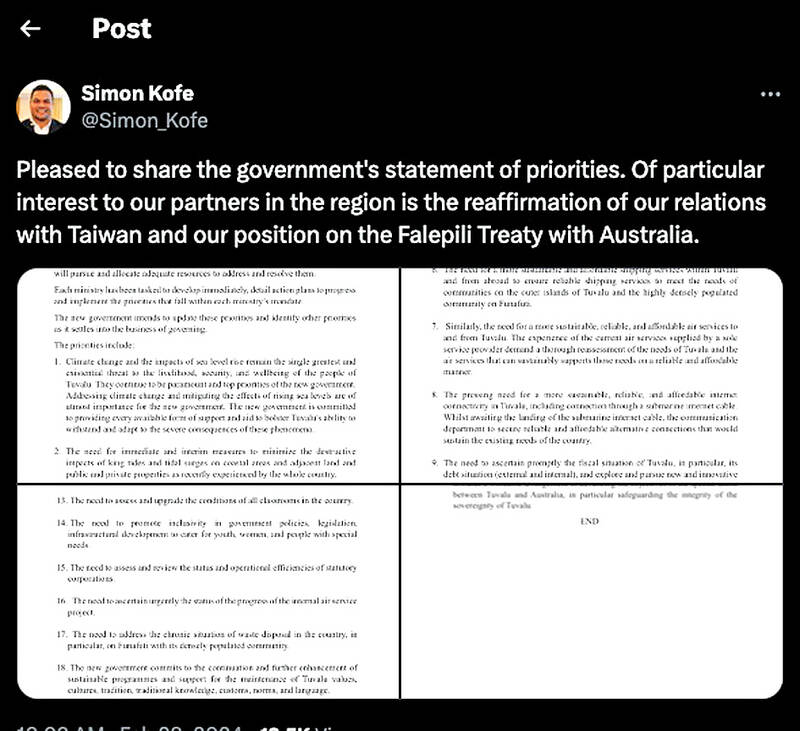
Photo: screen grab from Simon Kofe’s X account
Tuvalu, a Pacific Island nation of about 11,200 people, is one of Taiwan’s three remaining Pacific allies, after Nauru last month switched recognition to Beijing, which had promised more development assistance.
“Of particular interest to our partners in the region is the reaffirmation of our relations with Taiwan and our position on the Falepili Treaty with Australia,” Kofe wrote.
A former Tuvaluan minister for justice, communication and foreign affairs known for his Taiwan-friendly stance, Kofe was yesterday appointed to his new role by new Tuvaluan Prime Minister Feleti Teo.
Kofe most recently visited Taiwan in May last year.
A former attorney general and fisheries official, Teo was elected on Monday, after a general election closely watched by Taiwan, China, the US and Australia, amid a geopolitical tussle for influence in the South Pacific.
After taking office, Teo met with Ambassador to Tuvalu Andrew Lin (林東亨), affirming that “the diplomatic alliance between Taiwan and Tuvalu is solid and that all sectors of Tuvalu share a long-standing consensus on supporting official bilateral relations,” the Ministry of Foreign Affairs said in a statement.
“The two governments will continue to jointly promote substantive cooperation projects aimed at enhancing the welfare of both their peoples,” the statement quoted Teo as saying.
In Taipei, ministry spokesman Jeff Liu (劉永健) on Tuesday said that the government is expected to invite Teo to attend president-elect William Lai’s (賴清德) inauguration ceremony on May 20.
There were concerns before Teo was appointed on Monday that Taiwan’s ties with Tuvalu could be in jeopardy.
Former Tuvaluan minister of finance Seve Paeniu, who was a contender for the country’s leadership, last month said that Tuvalu’s ties with Taiwan “need to be debated and reviewed in the new parliament.”
Tuvaluans wanted more financial support from the international community to help the island nation address climate change and other issues, Paeniu said.

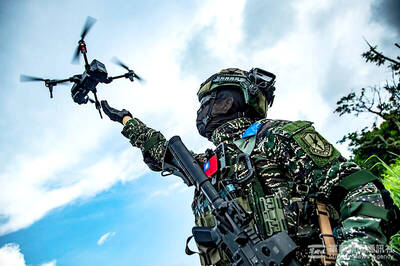
RESILIENCE: Taiwan plays a key role in semiconductors, energy, information infrastructure and advanced manufacturing, AIT Director Raymond Greene said Taiwan’s continued investment in deterrence and resilience remains vital, especially in uncrewed systems and other emerging technologies, American Institute in Taiwan (AIT) Director Raymond Greene said yesterday. Greene made the remarks at the annual National Strategic Summit on Supply Chain Resilience held by the Research Institute for Democracy, Society and Emerging Technology (DSET), a government-backed think tank. As Taiwan last year became the US’ fourth-largest trading partner and supply chain security is becoming more important, cooperation in emerging technologies continues to deepen between the two countries, he said. The US is committed to accelerating innovation, building key infrastructure, strengthening cooperation

The National Chungshan Institute of Science and Technology yesterday showcased its locally developed variants of the Vision 60 robotic patrol dog, which it plans to deploy on the nation’s outlying territories in the South China Sea. The variants were produced under the Joint Lab project — created by the institute and domestic companies — and assembled with domestically produced motors, lenses and artificial intelligence (AI) systems alongside licensed tech from the US, Missile and Rocket Systems Research Division deputy director Jen Kuo-kang (任國光) told the media event at a military base in Taipei’s Dazhi (大直) area. Taiwan has built up its strengths
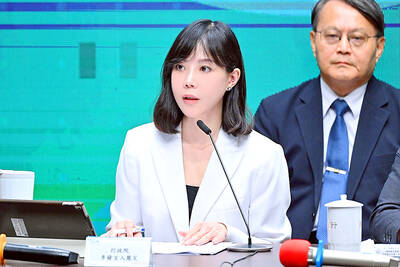
RIGHT DIRECTION: Taiwan’s efforts to prevent forced labor include a proposal to ‘fully prohibit’ employers from withholding workers’ documents, an official said Taiwan is to establish a mechanism to restrict imports of goods linked to forced labor, the Executive Yuan said yesterday, after the US proposed imposing additional tariffs on Taiwanese goods over labor concerns. “The Ministry of Labor and the Ministry of Economic Affairs are to establish an interministerial review procedure,” Executive Yuan spokesperson Michelle Lee (李慧芝) said at a news briefing in Taipei. “The government is to use the Foreign Trade Act [貿易法] as the legal basis to restrict imports of goods produced with forced labor” and bring its supply chain governance more in line with international standards on human rights, resilience

NOT IMMEDIATE: Taiwan has a chance to appeal the proposed 10 percent tariff before it starts, while other countries face a 12.5 percent tariff from the trade office Taiwan is among 60 economies determined by the US to have failed to impose or enforce a ban on the importation of goods produced with forced labor, according to a notice released on Tuesday by the Office of the US Trade Representative (USTR), which proposed imposing an additional 10 percent or more tariff on them. The USTR in a statement said that following an investigation, it had determined under Section 301 of the Trade Act of 1974 that the failure of the 60 economies to impose and effectively enforce a prohibition on the importation of goods produced with forced labor is


 RSS
RSS