


The Republican chairman of the US House of Representatives Committee on Foreign Affairs on Friday said he supported funding for US-allied Pacific Island nations as a way to counter the influence of China, and would push to include them in any supplemental security aid bill.
“That’s such a critical part of our countering the malign influence of China, with the island nations that they’re buying off, as you know, one by one,” US Representative Michael McCaul said at meeting with journalists sponsored by the Christian Science Monitor.
The Federated States of Micronesia, and Taiwan’s diplomatic allies the Marshall Islands and Palau agreed to new 20-year funding programs with the US last year under which Washington provides economic assistance, while gaining exclusive military access to strategic swaths of the Pacific that China covets.
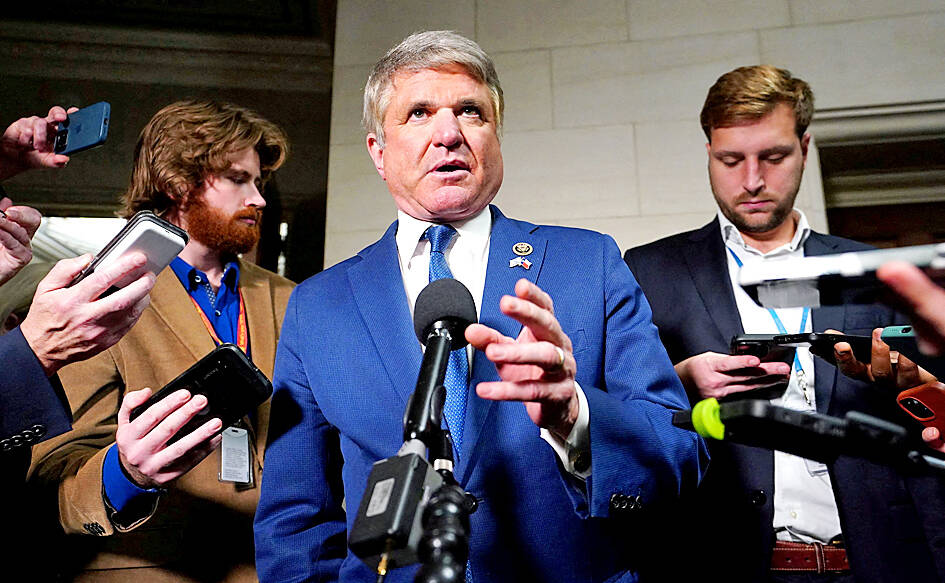
Photo: Reuters
However, despite bipartisan support for the new programs, known as Compacts of Free Association (COFAs), the US Congress has yet to approve the funding, even though the additional amount needed is a relatively small US$2.3 billion, worrying the islands’ leaders.
McCaul said he has advocated for a US$900 million package for COFAs, but was open to other figures.
The US Senate last week passed a US$95 billion foreign aid supplemental spending bill for Taiwan, Ukraine and Israel that did not include the COFA funding.
McCaul said he would work to ensure the money was included in whatever was voted on in the House, likely in the middle of next month.
“The House is going to want to have its own imprimatur on this. Right? We’re not just going to rubber-stamp the Senate supplemental,” he said.
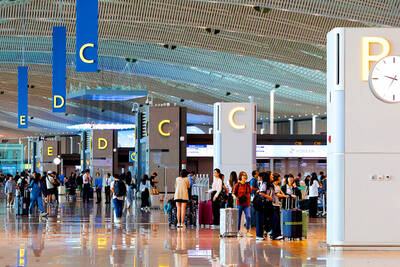
South Korea has adjusted its electronic arrival card system to no longer list Taiwan as a part of China, a move that the Ministry of Foreign Affairs said would help facilitate exchanges between the two sides. South Korea previously listed “Taiwan” as “Taiwan (China)” in the drop-down menus of its online arrival card system, where people had to fill out where they came from and their next destination. The ministry had requested South Korea make a revision and said it would change South Korea’s name on Taiwan’s online immigration system from “Republic of Korea” to “Korea (South),” should the issue not be

The Legislative Yuan’s Finance Committee yesterday approved proposed amendments to the Amusement Tax Act (娛樂稅法) that would abolish taxes on films, cultural activities and competitive sporting events, retaining the fee only for dance halls and golf courses. The proposed changes would set the maximum tax rate for dance halls and golf courses at 50 and 20 percent respectively, with local governments authorized to suspend the levies. Article 2 of the act says that “amusement tax shall be levied on tickets sold or fees charged by amusement places, facilities or activities” in six categories: “Cinema; professional singing, story-telling, dancing, circus, magic show, acrobatics

Tainan, Taipei and New Taipei City recorded the highest fines nationwide for illegal accommodations in the first quarter of this year, with fines issued in the three cities each exceeding NT$7 million (US$220,639), Tourism Administration data showed. Among them, Taipei had the highest number of illegal short-term rental units, with 410. There were 3,280 legally registered hotels nationwide in the first quarter, down by 14 properties, or 0.43 percent, from a year earlier, likely indicating operators exiting the market, the agency said. However, the number of unregistered properties rose to 1,174, including 314 illegal hotels and 860 illegal short-term rental
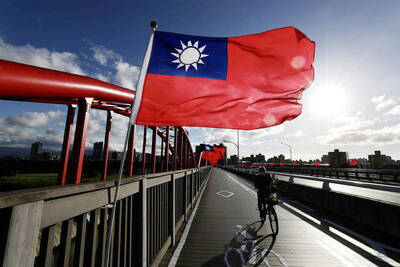
INFLATION UP? The IMF said CPI would increase to 1.5 percent this year, while the DGBAS projected it would rise to 1.68 percent, with GDP per capita of US$44,181 The IMF projected Taiwan’s real GDP would grow 5.2 percent this year, up from its 2.1 percent outlook in January, despite fears of global economic disruptions sparked by the US-Iran conflict. Taiwan’s consumer price index (CPI) is projected to increase to 1.5 percent, while unemployment would be 3.4 percent, roughly in line with estimates for Asia as a whole, the international body wrote in its Global Economic Outlook Report published in the US on Monday. The figures are comparatively better than the IMF outlook for the rest of the world, which pegged real GDP growth at 3.1 percent, down from 3.3 percent


 RSS
RSS