


Top diplomats from the US and China on Friday held a “candid and constructive” discussion on issues vexing their strained relations over Taiwan and Russia’s war in Ukraine, the US Department of State said.
The meeting between US Secretary of State Antony Blinken and Chinese Minister of Foreign Affairs Wang Yi (王毅) on the sidelines of the Munich Security Conference in Germany marked the latest and highest-level meeting between the two sides since US President Joe Biden and Chinese President Xi Jinping (習近平) held talks late last year in California.
Blinken emphasized the importance of maintaining peace and stability across the Taiwan Strait and in the South China Sea, State Department spokesman Matthew Miller said.
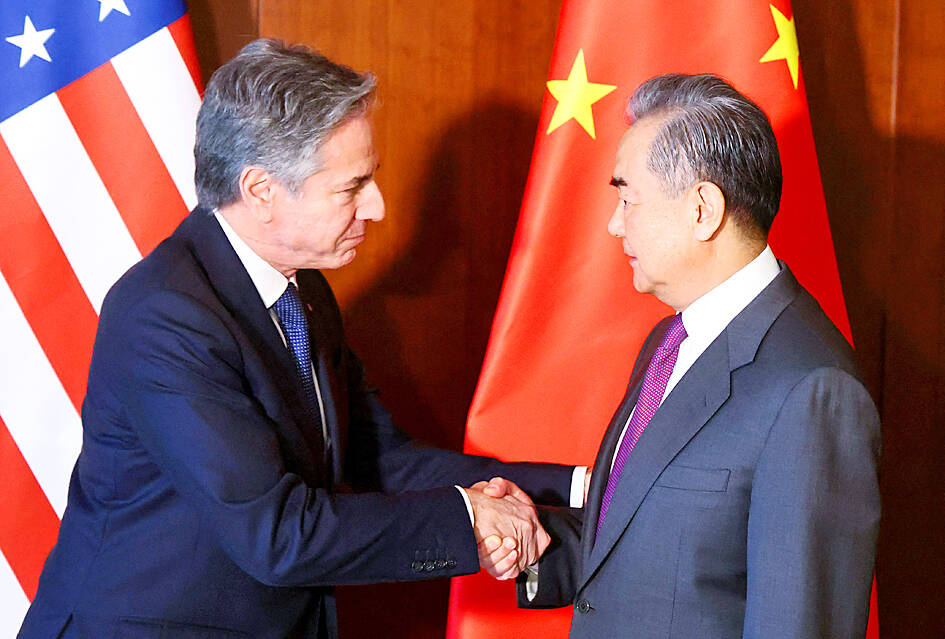
Photo: AFP
He also raised concerns about China’s support for Russia’s defense industrial base that Washington sees as helping Moscow’s military operations against Ukraine, as well as the need to expand on nascent counternarcotics efforts, he said.
“The two sides had a candid and constructive discussion on a range of bilateral, regional and global issues as part of ongoing efforts to maintain open lines of communication and responsibly manage competition in the relationship,” Miller said.
The Chinese Ministry of Foreign Affairs said Wang called on the US to remove sanctions against Chinese companies and individuals.
Wang said that Washington’s policy of “derisking” economically from Beijing “has become ‘desinicizing,’ ‘building a tall fence’ and ‘de-coupling from China’” and “will come back to bite the US itself,” a ministry readout yesterday morning said.
He also called on the US to stop searches of Chinese nationals.
Chinese state media recently published reports of Chinese citizens being searched at the US border.
In one prominent case, a group of students led by their professor from Beijing Foreign Studies University were interrogated for three hours upon arriving at Chicago’s O’Hare International Airport, Xinhua news agency reported.
Wang affirmed that cooperation to combat the spread of fentanyl was going “positively” and would continue, as well as the agreement to keep military-to-military communications.
Both sides also discussed the Israel-Hamas war and the war in Ukraine.
Blinken “reiterated that the United States will stand up for our interests and values and those of our allies and partners,” Miller said.
The situations in the Middle East and with North Korea were also topics of conversation, he added.
“Both sides recognized the importance of maintaining open lines of communication between the United States and [China] across a range of strategic issues, including consultations and high-level meetings in key areas in the coming months,” he said.
Additional reporting by AFP

The Legislative Yuan’s Finance Committee yesterday approved proposed amendments to the Amusement Tax Act (娛樂稅法) that would abolish taxes on films, cultural activities and competitive sporting events, retaining the fee only for dance halls and golf courses. The proposed changes would set the maximum tax rate for dance halls and golf courses at 50 and 20 percent respectively, with local governments authorized to suspend the levies. Article 2 of the act says that “amusement tax shall be levied on tickets sold or fees charged by amusement places, facilities or activities” in six categories: “Cinema; professional singing, story-telling, dancing, circus, magic show, acrobatics

Tainan, Taipei and New Taipei City recorded the highest fines nationwide for illegal accommodations in the first quarter of this year, with fines issued in the three cities each exceeding NT$7 million (US$220,639), Tourism Administration data showed. Among them, Taipei had the highest number of illegal short-term rental units, with 410. There were 3,280 legally registered hotels nationwide in the first quarter, down by 14 properties, or 0.43 percent, from a year earlier, likely indicating operators exiting the market, the agency said. However, the number of unregistered properties rose to 1,174, including 314 illegal hotels and 860 illegal short-term rental
INFLATION UP? The IMF said CPI would increase to 1.5 percent this year, while the DGBAS projected it would rise to 1.68 percent, with GDP per capita of US$44,181 The IMF projected Taiwan’s real GDP would grow 5.2 percent this year, up from its 2.1 percent outlook in January, despite fears of global economic disruptions sparked by the US-Iran conflict. Taiwan’s consumer price index (CPI) is projected to increase to 1.5 percent, while unemployment would be 3.4 percent, roughly in line with estimates for Asia as a whole, the international body wrote in its Global Economic Outlook Report published in the US on Monday. The figures are comparatively better than the IMF outlook for the rest of the world, which pegged real GDP growth at 3.1 percent, down from 3.3 percent
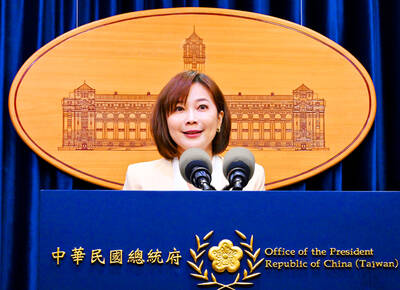
ECONOMIC COERCION: Such actions are often inconsistently applied, sometimes resumed, and sometimes just halted, the Presidential Office spokeswoman said The government backs healthy and orderly cross-strait exchanges, but such arrangements should not be made with political conditions attached and never be used as leverage for political maneuvering or partisan agendas, Presidential Office spokeswoman Karen Kuo (郭雅慧) said yesterday. Kuo made the remarks after China earlier in the day announced 10 new “incentive measures” for Taiwan, following a landmark meeting between Chinese President Xi Jinping (習近平) and Chinese Nationalist Party (KMT) Chairwoman Cheng Li-wun (鄭麗文) in Beijing on Friday. The measures, unveiled by China’s Xinhua news agency, include plans to resume individual travel by residents of Shanghai and China’s Fujian


 RSS
RSS