


Greece on Thursday became the first Orthodox Christian country to legalize same-sex civil marriage, despite opposition from the influential, socially conservative Greek Church.
A cross-party majority of 176 lawmakers in the 300-seat parliament late on Thursday voted in favor of the landmark bill drafted by Greek Prime Minister Kyriakos Mitsotakis’ center-right government. Another 76 rejected the reform, while two abstained from the vote and 46 were not present in the house.
Mitsotakis wrote on X after the vote that Greece “is proud to become the 16th [EU] country to legislate marriage equality.”

Photo: Bloomberg
“This is a milestone for human rights, reflecting today’s Greece — a progressive, and democratic country, passionately committed to European values,” he wrote.
Scores of supporters of the reform who had gathered outside parliament and were watching the debate on a screen cheered loudly and hugged as the vote result was announced.
“This took a long time to be adopted in our country ... but at least it happened and that’s what is important,” said a man who only gave his first name, Nikolas. “We are no longer invisible.”
Earlier, people opposed the bill had also protested nearby, holding prayer books and religious icons.
Opinion polls suggest that most Greeks support the reform by a narrow margin, and the issue has failed to trigger deep divisions in a country more worried about the high cost of living.
The bill was backed by four left-wing parties, including the main opposition Syriza.
“This law doesn’t solve every problem, but it is a beginning,” said Spiros Bibilas, a lawmaker from the small left-wing Passage to Freedom party, who is openly gay.
It was approved despite several majority and left-wing lawmakers abstaining or voting against the reform. Three small far-right parties and the Stalinist-rooted Communist Party rejected the draft law from the start of the two-day debate.
“People who have been invisible will finally be made visible around us. And with them, many children [will] finally find their rightful place,” Mitsotakis told lawmakers ahead of the evening vote.
“Both parents of same-sex couples do not yet have the same legal opportunities to provide their children with what they need,” he added. “To be able to pick them up from school, to be able to travel, to go to the doctor, or take them to the hospital ... that is what we are fixing.”
The bill confers full parental rights on married same-sex partners with children. However, it precludes gay couples from parenthood through surrogate mothers in Greece — an option available to women who cannot have children for health reasons.
Many LGBTQ+ rights advocates have criticized that limitation, as well as the absence of any provision for transgender people.
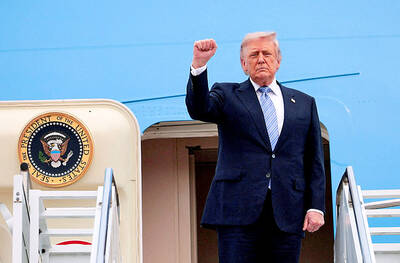
US-CHINA SUMMIT: MOFA welcomed US reassurance of no change in its Taiwan policy; Trump said he did not comment when Xi talked of opposing independence US President Donald Trump yesterday said he has not made a decision on whether to move forward with a major arms package for Taiwan after hearing concerns about it from Chinese President Xi Jinping (習近平). Trump’s comments on Taiwan came as he flew back to Washington after wrapping up critical talks in which both leaders said important progress was made in stabilizing US-China relations even as deep differences persist between the world’s two biggest powers on Iran and Taiwan. “I will make a determination,” Trump said, adding: “I’ll be making decisions. But, you know, I think the last thing we need right
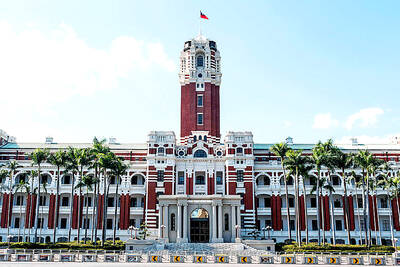
SECURITY: Taipei presses the US for arms supplies, saying the arms sales are not only a reflection of the US security commitment to Taiwan but also serve as a mutual deterrent against regional threats Taiwan is committed to preserving the cross-strait “status quo” and contributing to regional peace and stability, the Presidential Office said yesterday. “It is an undeniable fact that the Republic of China is a sovereign and independent democratic nation,” Presidential Office spokeswoman Karen Kuo (郭雅慧) reiterated, adding that Beijing has no right to claim sovereignty over Taiwan. The statements came after US President Donald Trump warned against Taiwanese independence. Trump wrapped up a state visit to Beijing on Friday, during which Chinese President Xi Jinping (習近平) had pressed him not to support Taiwan. Taiwan depends heavily on US security backing to deter China from carrying
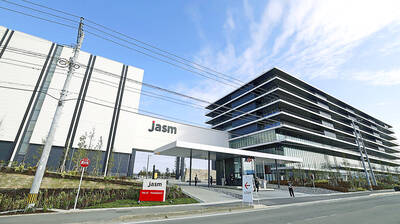
The subsidiary of Taiwan Semiconductor Manufacturing Co (TSMC, 台積電) in Kumamoto, Japan, turned a profit in the first quarter of this year, marking the first time the first fab of the unit has become profitable since mass production started at the end of 2024. According to the contract chipmaker’s financial statement released on Friday, Japan Advanced Semiconductor Manufacturing Inc (JASM), a joint venture running the fab in Kumamoto, posted NT$951 million (US$30.19 million) in profit in the January-to-March period, compared with a loss of NT$1.39 billion in the previous quarter, and a loss of NT$3.25 billion in the first quarter of
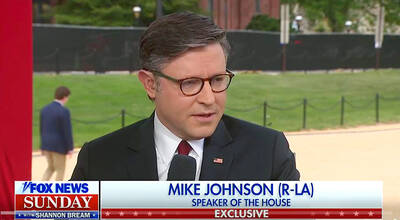
RESOLUTE BACKING: Two Republican senators are planning to introduce legislation that would impose immediate sanctions on China if it attempts to invade Taiwan US House of Representatives Speaker Mike Johnson on Sunday reaffirmed US congressional support for Taiwan, saying the US and “all freedom-loving people” have a stake in preventing China from seizing Taiwan by force. Johnson made the remarks in an interview with Fox News Sunday on US President Donald Trump’s summit with Chinese President Xi Jinping (習近平) last week. In an interview that aired on Friday on Fox News, just as Trump wrapped up a high-stakes visit to China, he said he has yet to green-light a new US$14 billion arms package to Taiwan and that it “depends on China.” “It’s a very good


 RSS
RSS