


The Ministry of National Defense has awarded a NT$2.49 billion (US$79.4 million) contract to DCI Group of France for ship combat system platform components, a government procurement notice dated yesterday showed.
The limited tender is being implemented in Kaohsiung from Jan. 18 to the same day next year, the notice said.
The contract would likely supply components to one of Taiwan’s six Kang Ding-class guided missile frigates, as DCI Group is the supplier of original equipment manufacturer parts for Laffeyette-class warships, on which they are based.
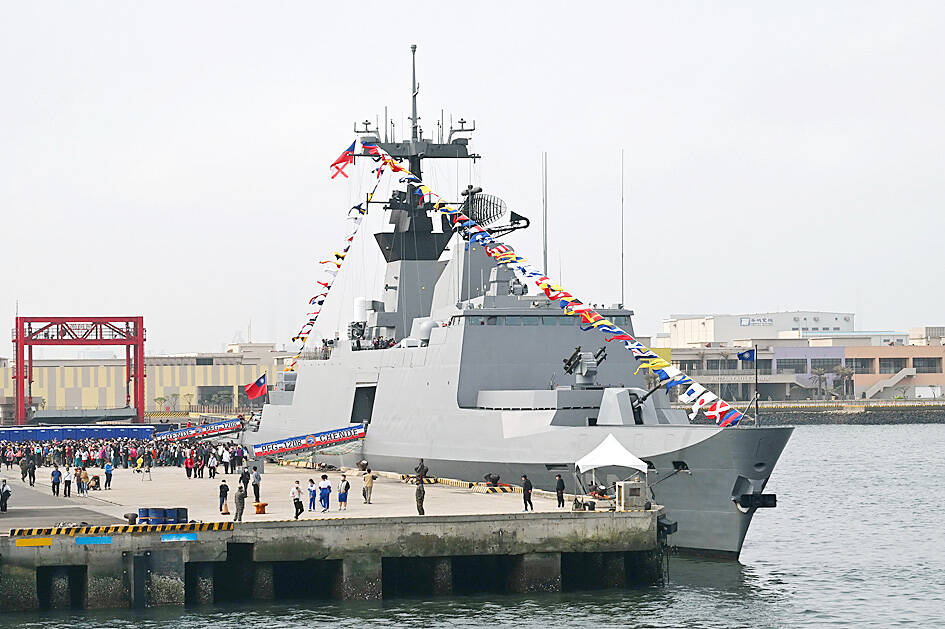
Photo: Liao Yao-tung, Taipei Times
The Kang Ding-class frigates — which comprise the navy’s 124th Fleet headquartered in Kaohsiung’s Zuoying Naval Base — are mainly employed in air defense, anti-submarine warfare, escort, anti-blockade and joint surface interception roles.
The navy has allocated a total of NT$43.2 billion to modernize the Kang Ding-class ships by 2030 with battle management system upgrades, new radars and vertical launch systems developed by the Chungshan Institute of Science and Technology’s Huayang Project.
The launch system would enable the frigates to fire indigenous Hai Chien II (“Sea Sword”) and Hai Kung III (“Sea Bow”) missiles instead of the aging Chaparral missile systems that originally equipped the class.
Taiwanese navy frigate the Chen De (承德), which was last seen being refitted at a dock in Kaohsiung last year, was the first Kang Ding-class warship to receive the upgrades. The listed completion time for the refitting is between next year and 2026.
The modernization program, with a budget of NT$5.76 billion for this year, is probably the source of funding for the latest contract with DCI Group, although the ministry did not specify whether the parts would be used for the Chen De or another ship.
The remainder of this year’s Kang Ding-class modernization budget is likely to be utilized for domestically developed systems and weapons.

‘NO SECURITY RISK’: The Railway Bureau reassured the public that the technicians’ activities were limited to technical guidance and did not involve sensitive systems The Railway Bureau yesterday said it had invited eight Chinese technicians to assist with an airport MRT construction project. The bureau issued the confirmation after an Internet user said Chinese nationals had entered the construction zone of Taiwan Taoyuan International Airport’s Terminal 3 project. They asked why “individuals from an enemy state” were allowed access to such a major national infrastructure project, which raised serious concerns over Taiwan’s industrial safety, sensitive systems and information security. The bureau’s Northern Region Engineering Branch Office said subcontractor Taiwan Handle Industrial Co (台灣手把工業) of the Taoyuan airport MRT’s “Contract No. CU05 Project A14 Station Civil, MEP &

A US uncrewed surface vessel (USV) encountered multiple Chinese warships during an autonomous transit of the Taiwan Strait, US defense company Seasats said in a statement on Wednesday. Seasats announced that a Lightfish USV had completed the first autonomous transit of the Taiwan Strait. Over five days, the USV traversed the entire length of the Strait while constantly monitoring surface vessel traffic, the company said. The Lightfish encountered multiple Chinese warships, one of which was a Chinese People’s Liberation Army Navy (PLAN) Type 056 corvette, it said. The Chinese vessels were operating “well within Taiwan’s exclusive economic zone without transmitting their identity via the
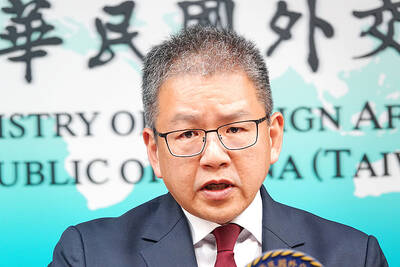
Taiwan is still in the process of assessing the possibility of recruiting workers from Eswatini, the Ministry of Foreign Affairs said yesterday, adding that its goal is to help Eswatini upgrade its vocational training centers. If there are plans to recruit workers from Eswatini, safeguarding national security, protecting public health and ensuring the employment rights of Taiwanese would be prerequisites, Department of West Asian and African Affairs Director-General Yen Chia-liang (顏嘉良) told a news conference. Key considerations would also include filling labor shortages in specific industries, and fostering bilateral professional and technical exchanges, he said. Yen was asked about the progress of labor
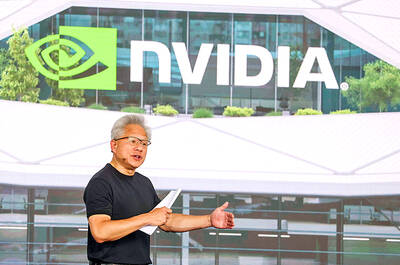
‘BOOMING’: ’ The number of partners we have here is incredible. You can see from their stock prices. They’re doing so well, they’re so happy,’ Jensen Huang said Nvidia Corp’s spending in Taiwan has ballooned to about US$150 billion a year, 10 times the US$10 billion to US$15 billion the company spent five years ago, Nvidia chief executive officer Jensen Huang (黃仁勳) said yesterday, suggesting Taiwan’s strategic importance in the global artificial intelligence (AI) supply chain. “Taiwan is the epicenter of the AI revolution. This is where the chips come, packaging comes. This is where the systems are made. This is where AI supercomputers were created,” Huang said at a meeting for the company’s employees in Beitou-Shilin Technology Park (北投士林科技園區) in Taipei, the planned site of Nvidia’s Taipei headquarters. “Taiwan


 RSS
RSS