


Cambodian authorities yesterday held a news conference to present evidence implicating two Taiwanese in staging a fake kidnapping video in Sihanoukville last week.
The two suspects are Taiwanese streamers Chen Neng-chuan (陳能釧), also known as "Goodnight Chicken" (晚安小雞), and Lu Tsu-hsien (魯祖顯), also known as “Anow” (阿鬧).
Lu reportedly did the filming as the duo traveled together to Cambodia, where they allegedly staged a fake kidnapping.
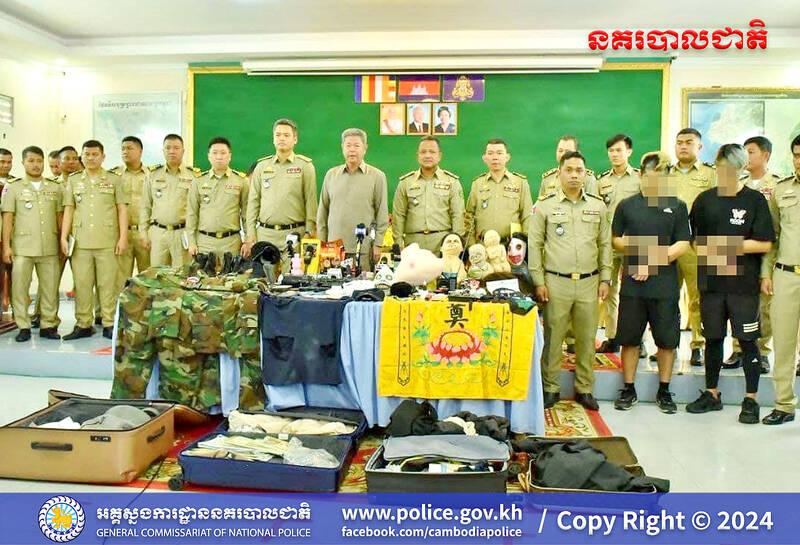
Photo courtesy of the Cambodian General Commissariat of National Police
Officials in Preah Sihanouk Province, Cambodia, were quoted by local media as saying the two Taiwanese streamers face charges of inciting discrimination, making false statements and illegal interference in the exercise of public functions.
Preah Sihanouk Province Governor Kuoch Chamroeun presided over the news conference, where the two streamers were present, handcuffed and surrounded by more than 20 police officers.
Chamroeun said that in their videos, the men pretended that they were running from a kidnapping attempt.
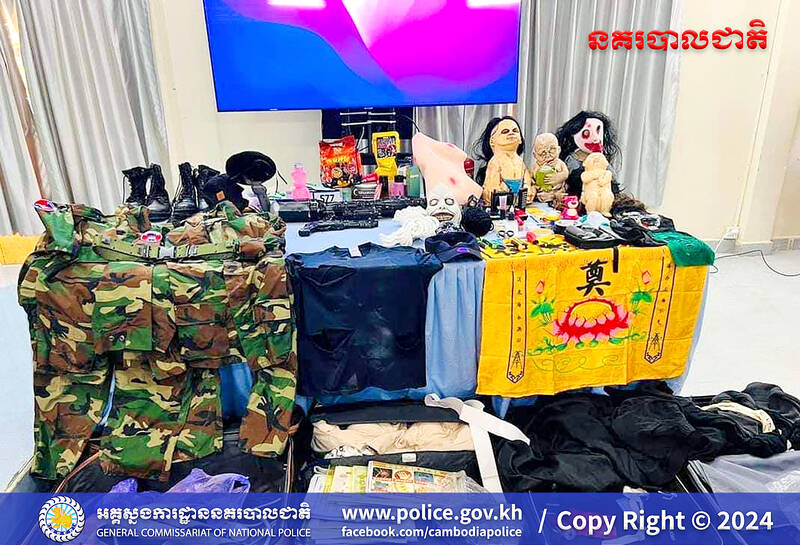
Photo courtesy of the Cambodian General Commissariat of National Police
They later posted two clips, one calling for help and one purporting to show them escaping from a hotel, the Phnom Penh Post reported.
“After seeing the video, local authorities tracked the two men to a hotel room. We discovered many of the props used in the fake video,” Chamroeun said.
The fake videos represent a threat to Cambodia’s reputation, particularly the coastal province, he added.
“It is clear that their activities were an attempt to incite chaos in society, so our police officers are continuing with legal procedures and building a case,” Chamroeun said.
Police showed the material collected in four open suitcases and on a table, including military fatigues, ghoulish rubber masks, red paint for fake blood and a torn T-shirt.
Both men have a significant following for their controversial live streams, in which they visit so-called haunted houses and abandoned buildings in Taiwan where they claim to see ghosts, human skeletons and dead creatures.
Chen in the first video claimed he had broken into the “scam park” of Sihanoukville, then showed he was being chased and beaten by an assailant.
In the second video, he claimed to have escaped from the kidnappers.
“They said they did it by themselves to get views and attract more followers. They may want views, but we cannot tolerate something that affects public order in the Kingdom [of Cambodia],” Chamroeun was quoted as saying by the Phnom Penh Post.
The reality of life in Sihanoukville was nothing like what the two depicted or what had been shown in some feature films, he said.
“Most of the bad things people hear about the province are spread by various groups for their own benefit. The reality is nothing like that,” he added. “I accept that there are some issues in every society, but most of the claims I have heard are nothing more than exaggerations.”
The Criminal Investigation Bureau in Taipei said that based on similar cases, Chen may be charged with inciting discrimination, making false statements or interference with public functions.
The bureau said it would respect the Cambodian authorities’ investigation and would stay in contact with local police via Taiwan’s liaison office in Vietnam.
Separately, Ministry of Foreign Affairs spokesman Jeff Liu (劉永健) said that neither the ministry nor overseas offices have received a request for assistance from the suspects or their families.
The ministry would respect the Cambodian police and judicial system, and overseas offices would ensure that Taiwanese receive fair treatment under the law and provide assistance when necessary, he added.
Additional reporting by CNA

A signaling system malfunction disrupted high-speed rail (HSR) services beginning at 8am today, with trains temporarily reduced to three northbound and three southbound trains per hour as authorities conduct inspections. The malfunction occurred on a section of track in Miaoli County during pre-operation checks early this morning, forcing northbound and southbound trains to use a single track, the HSR operator said. The regular schedule has been replaced with three hourly trains offering only nonreserved seating in each direction, stopping at every station, it said, adding that business class cars would still have reserved seating. Departures from terminal stations are scheduled at the top

DRONE CENTRAL: Taiwan aims to become Asia’s democratic hub for drones, with most exports focused on high-quality military-grade models, an official said Taiwan’s drone industry is expected to expand significantly by 2030, producing 100,000 units per month and exporting half of them, the Ministry of Economic Affairs said yesterday. Current drone production capacity is about 15,000 units per month, but the industry can quickly scale up as demand increases, Industrial Development Administration Director-General Chiou Chyou-huey (邱求慧) told a news conference in Taipei. Taiwan’s drone output grew 2.5-fold last year to NT$12.9 billion (US$408.3 million) under a government program to develop the uncrewed vehicle sector, he said. The Executive Yuan in October last year approved plans to invest NT$44.2 billion into domestic production of uncrewed aerial

VERBOSE VESSELS: A CGA cutter and a China Coast Guard exchanged verbal barbs for more than a day in Taiwanese-controlled waters before the Chinese vessel left The Taiwanese and Chinese coast guards had a standoff near the strategically located Pratas Islands (Dongsha Islands, 東沙群島) in the north of the South China Sea, the Coast Guard Administration (CGA) said yesterday. The two sides engaged in intense radio exchanges over sovereignty claims during the 33-hour standoff. China Coast Guard vessel 3501 eventually left the restricted waters, 26.6 nautical miles (49.2km) west of the Pratas Islands, at 5pm yesterday, the CGA said. Lying approximately between southern Taiwan and Hong Kong, the Taiwan-controlled Pratas are seen by some security experts as vulnerable to Chinese attack due to their distance — more than
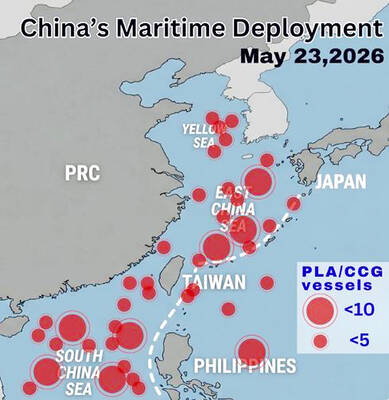
WARNING: China should stop engaging in actions that undermine regional peace and stability, as it would only build resentment among people across the Strait, the CGA said China has deployed more than 100 navy, coast guard and other vessels in waters from the Yellow Sea to the South China Sea and the western Pacific since US President Donald Trump and Chinese President Xi Jinping (習近平) met in Beijing, National Security Council Secretary-General Joseph Wu (吳釗燮) said yesterday. “In this part of the world, #China is the one & only PROBLEM wrecking the #StatusQuo & threatening regional peace & stability,” Wu wrote on X. In a separate post, he said Beijing was coercing Taiwan’s maritime domain, calling it illegal and provocative, after the Coast Guard Administration (CGA) expelled a


 RSS
RSS