


Several novel election interference methods have been discovered, with most funded by foreign powers, Prosecutor-General Hsing Tai-chao (邢泰釗) said on Friday.
Hsing made the remarks at a meeting on election-related investigations, which was convened by the Supreme Prosecutors’ Office and was attended by head prosecutors from across Taiwan.
Accepting money, unusually cheap trips or other perks in exchange for political support is a breach of the Public Officials Election and Recall Act (公職人員選舉罷免法), the Supreme Prosecutors’ Office said.

Photo: Taipei Times file
The penalty for contravening the law is up to 10 or 15 years in prison depending on whether the crime was committed by following the instructions of an external force, it said.
Colluding with external forces breaches the Anti-Infiltration Act (反滲透法), and it comes with a penalty of up to five years in prison, it said.
As of Thursday, prosecutors were investigating 2,938 cases of alleged election-related law breaches and have listed 3,125 people as defendants, including 40 who were placed in pretrial detention, it said.
About 1,300 of these cases involve election gambling schemes, while contravention of the Anti-Infiltration Act accounted for 96 cases, in which 190 people were named as defendants, it said.
An investigation by the Ciaotou District Prosecutors’ Office, in which borough wardens have been indicted for allegedly accepting free trips from Chinese officials in exchange for election support — a first in the nation — is among the 96 cases.
The Kaohsiung District Prosecutors’ Office is handling the case of China Pan-Blue Association member Chen Chih-cheng (鄭志成), the first person in the nation to be listed as a defendant in Beijing’s trips-for-votes scheme, it added.
Prosecutors are also probing 290 alleged disinformation cases related to the elections on Saturday, with the same number of people listed as defendants, it said.
Hsing had several times said that disinformation, Chinese electoral interference and vote-buying schemes were the main challenges for prosecutors handling breaches of electoral laws, adding that election gambling is also a national security threat financed by groups that have a vested interest in influencing election outcomes.
Members of the public should report election-related crimes via the hotline 0800-024-099, extension 4, to protect democracy, the Supreme Prosecutors’ Office said.
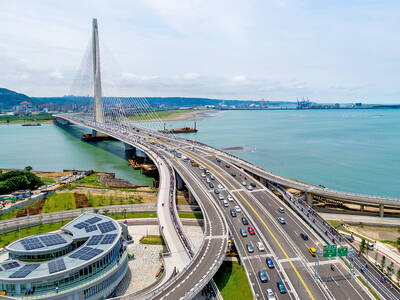
The Ministry of Transportation and Communications yesterday inaugurated the Danjiang Bridge across the Tamsui River in New Taipei City, saying that the structure would be an architectural icon and traffic artery for Taiwan. Feted as a major engineering achievement, the Danjiang Bridge is 920m long, 211m tall at the top of its pylon, and is the longest single-pylon asymmetric cable-stayed bridge in the world, the government’s Web site for the structure said. It was designed by late Iraqi-British architect Zaha Hadid. The structure, with a maximum deck of 70m, accommodates road and light rail traffic, and affords a 200m navigation channel for boats,
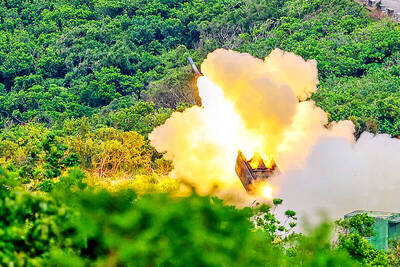
PRECISION STRIKES: The most significant reason to deploy HIMARS to outlying islands is to establish a ‘dead zone’ that the PLA would not dare enter, a source said A High Mobility Artillery Rocket System (HIMARS) would be deployed to Penghu County and Dongyin Island (東引) in Lienchiang County (Matsu) to force the Chinese military to retreat at least 100km from the coastline, a military source said yesterday. Taiwan has been procuring HIMARS and Army Tactical Missile Systems (ATACMS) from the US in batches. Once all batches have been delivered, Taiwan would possess 111 HIMARS units and 504 ATACMS, which have a range of 300km. Considering that “offense is the best defense,” the military plans to forward-deploy the systems to outlying islands such as Penghu and Dongyin so that

Taiwan Semiconductor Manufacturing Co (TSMC, 台積電), the world’s largest foundry service provider, yesterday said that global semiconductor revenue is projected to hit US$1.5 trillion in 2030, after the figure exceeds US$1 trillion this year, as artificial intelligence (AI) demand boosts consumption of token and compute power. “We are still at the beginning of the AI revolution, but we already see a significant impact across the whole semiconductor ecosystem,” TSMC deputy cochief operating officer Kevin Zhang (張曉強) said at the company’s annual technology symposium in Hsinchu City. “It is fair to say that in the past decade, smartphones and other mobile devices were
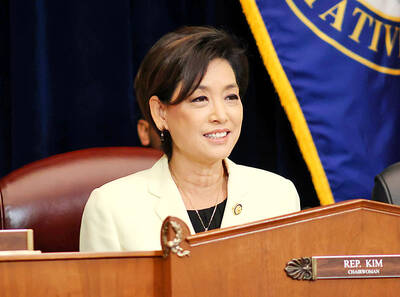
‘CLEAR MESSAGE’: The bill would set up an interagency ‘tiger team’ to review sanctions tools and other economic options to help deter any Chinese aggression toward Taiwan US Representative Young Kim has introduced a bill to deter Chinese aggression against Taiwan, calling for an interagency “tiger team” to preplan coordinated sanctions and economic measures in response to possible Chinese military or political action against Taiwan. “[Chinese President] Xi Jinping [習近平] has directed the People’s Liberation Army to be ready to invade Taiwan by 2027. China has a plan. America should have one too,” Kim said in a news release on Thursday last week. She introduced the “Deter PRC [People’s Republic of China] aggression against Taiwan act” to “ensure the US has a coordinated sanctions strategy ready should


 RSS
RSS