


Free government-funded COVID-19 rapid test kits are to be offered to outbound and inbound international travelers at Taiwan Taoyuan International Airport starting today, the Centers for Disease Control (CDC) said yesterday.
CDC Deputy Director-General Philip Lo (羅一鈞) said the policy is being implemented in response to an increasing number of COVID-19 cases, locally and internationally, and the expected increase in international travelers ahead of the Lunar New Year holiday.
He said COVID-19 rapid test kits would be offered at Taiwan Taoyuan International Airport for both outbound and inbound travelers, and each traveler can pick up a pack — consisting of four or five rapid test kits — at one of the four designated stations at the airport.
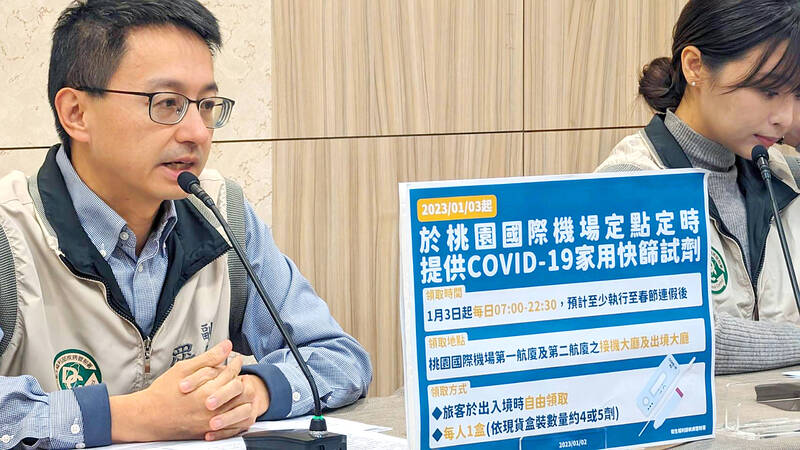
Photo: CNA
The four stations are at the departure hall and arrival hall of the airport’s Terminal One and Terminal Two, Lo said, adding that the test kits can be picked up between 7am and 10:30pm every day until the end of the Lunar New Year holiday.
Travelers are not obliged to take the rapid test kits, nor are they required to take the test, but the test kits are provided to conveniently test for COVID-19 if they experience cold or flu-like symptoms during their trip or after they have returned, he said.
The policy is not being implemented at other airports in the nation, as about 90 percent of international travelers arrive or leave from the airport in Taoyuan, Lo said, adding that the policy could be extended depending on supply and demand, as well as the COVID-19 situation.
Meanwhile, CDC Epidemic Intelligence Center Director Guo Hung-wei (郭宏偉) said 360 hospitalized local COVID-19 cases were reported last week, slightly more than the 325 cases the previous week, and 38 deaths were also reported.
He said 98 percent of the hospitalized cases last week did not get the new XBB 1.5 vaccine and genome sequencing data from the past four weeks show that the EG.5 subvariant is still the dominant strain spreading locally, accounting for about 69 percent of cases.
The global positivity rate of COVID-19 is increasing, reaching 14.9 percent in the week between Dec. 24 and Saturday, Guo said.
There were 109,394 hospital visits for flu-like symptoms last week, 20 severe flu complications and four deaths, he said.
Lo said there are still about 260,000 doses of government-funded flu vaccines available, so the CDC encourages eligible recipients to get vaccinated as soon as possible.
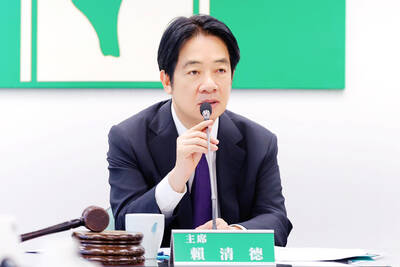
President William Lai (賴清德) yesterday criticized the nuclear energy referendum scheduled for Saturday next week, saying that holding the plebiscite before the government can conduct safety evaluations is a denial of the public’s right to make informed decisions. Lai, who is also the chairman of the Democratic Progressive Party (DPP), made the comments at the party’s Central Standing Committee meeting at its headquarters in Taipei. ‘NO’ “I will go to the ballot box on Saturday next week to cast a ‘no’ vote, as we all should do,” he said as he called on the public to reject the proposition to reactivate the decommissioned
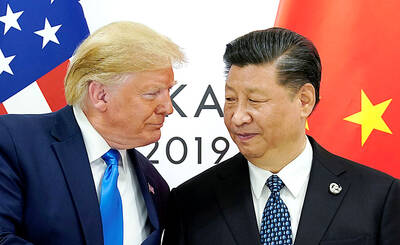
US President Donald Trump on Friday said that Chinese President Xi Jinping (習近平) told him China would not invade Taiwan while Trump is in office. Trump made the remarks in an interview with Fox News, ahead of talks with Russian President Vladimir Putin over Moscow’s invasion of Ukraine. “I will tell you, you know, you have a very similar thing with President Xi of China and Taiwan, but I don’t believe there’s any way it’s going to happen as long as I’m here. We’ll see,” Trump said during an interview on Fox News’ Special Report. “He told me: ‘I will never do
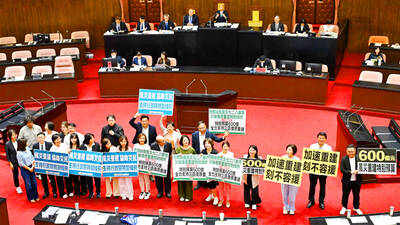
The Legislative Yuan yesterday approved an aid and recovery package authorizing the government to allocate up to NT$60 billion (US$1.99 billion) for regions hit by Typhoon Danas and subsequent torrential rains last month. Proposed by the Executive Yuan on Aug. 7, the bill was passed swiftly after ruling and opposition lawmakers reached a consensus in inter-party talks on relief funding and assistance for disaster-stricken areas. The package increases the government’s spending cap from the originally proposed NT$56 billion to NT$60 billion, earmarked for repairing and rebuilding infrastructure, electricity systems, telecommunications and cable TV networks, cultural heritage sites and other public facilities.
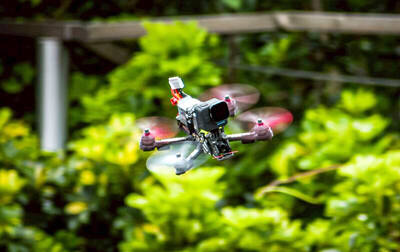
FLEXIBLE FORCE: Only about 10 percent of small drones reach their target, an expert said, which is why it is important to make it easier to procure large numbers of drones The military is planning to recategorize military drones as “consumables/munitions,” rather than as aircraft, to speed up the procurement process, the army said yesterday. The Army Command Headquarters said the decision was made because drones, like munitions, need to be rapidly replaced, and thus should be categorized as consumables/munitions “to meet the army’s practical needs.” The headquarters’ confirmation came after the Chinese-language Liberty Times (the Taipei Times’ sister paper) early yesterday reported that the army was about to make the classification change based on the example of the US, which is Taiwan’s biggest arms provider. US Secretary of Defense Pete Hegseth announced a


 RSS
RSS